Your reusable working recordAnnotated completed recordDownload the printable pack
Version 2 · Revised 11 November 2026 · 1/12
Why Better Questions Matter
Turn a broad concern into an investigation that can change a specific decision.
Bring to the taskOne recent difficulty, an actual example and the decision you need to make.
A manager hears that proposals are arriving late and asks, “Which training should we buy?” An entrepreneur hears polite interest in a new service and asks, “How soon can we launch?” A student receives a strong case-study answer and asks, “How can I remember this?” Each question selects what happens next. Training, a launch plan or memorization may be useful, but the question has already narrowed the investigation.
Questions matter because they direct scarce attention. A useful question makes a gap in understanding visible and helps someone obtain information that could alter an action. Asking more questions is not automatically better. A long interview can repeat assumptions, and a short factual check can resolve an important uncertainty.
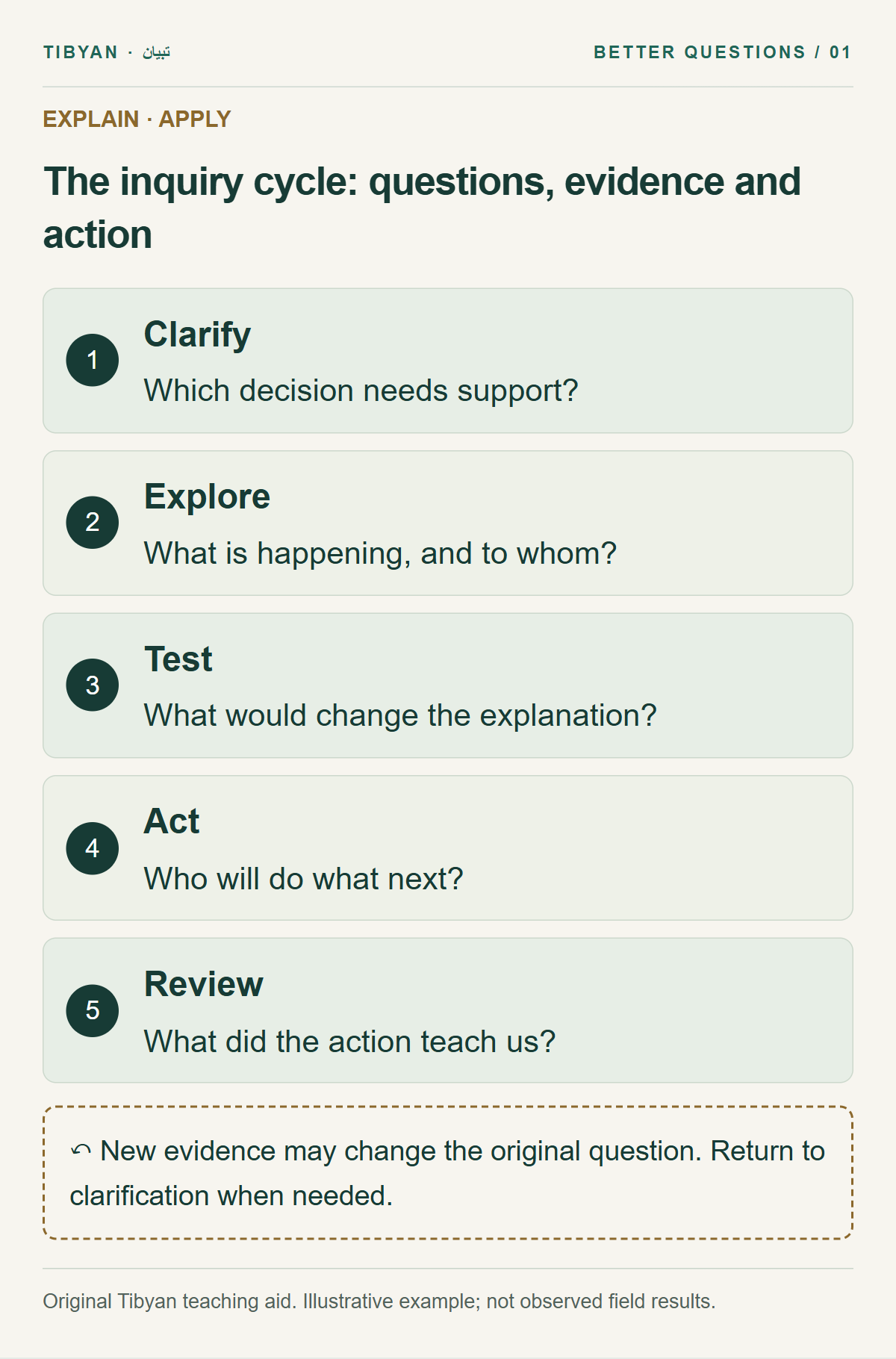
Case, demonstration and correction
Work the inquiry through to a decision
Fictional case packet, prepared 11 November 2026. Mariam, Namaa's service manager, must choose the next response to late proposals by 12 November. She can authorize a small handoff repair or targeted practice; she cannot change the customer deadlines. The records below describe three cases, not a measured company-wide rate.
| Proposal | Agreed deadline | Estimate requested | Confirmed estimate received | Draft submitted |
|---|---|---|---|---|
| P1 | 6 Nov, 16:00 | 6 Nov, 15:00 | 6 Nov, 17:00 | 6 Nov, 18:00 |
| P2 | 9 Nov, 16:00 | 8 Nov, 10:00 | 9 Nov, 11:00 | 9 Nov, 14:00 |
| P3 | 10 Nov, 16:00 | 9 Nov, 10:00 | 10 Nov, 11:00 | 10 Nov, 18:00 |
Huda coordinates proposals; Omar prepares estimates. The packet does not establish whether the work was equally complex or what else Huda handled. A useful inquiry question is: Where did time accumulate between requesting the estimate, receiving it and submitting the draft, and what would a different finding change?
The first answer, “Estimates arrive late, so train the estimators,” overreaches. P1 makes estimate timing worth investigating. P3 shows that a draft can be late despite an estimate arriving before the deadline; it weakens an explanation based only on late estimates. Neither observation proves which intervention will work.
Mariam's completed decision note reads: “At 15:00 on 11 November, Huda and Omar will reconstruct P1 and P3 against the records and show how they check completeness. If the task can be done correctly with timely inputs but requests lack ownership, I will test an owned request-and-escalation step. If a required checking skill is missing despite adequate inputs and time, I will arrange practice of that specific step. Mixed findings will require both support and practice.” Mariam owns the choice; Huda brings the draft histories; Omar checks the estimate timestamps.
Review the next three eligible proposals after the chosen change. Record whether the agreed step happened and what uncertainty remains. This review is a practical learning opportunity, not proof of a causal effect on performance.
Choose a manageable starting point
Managers can use one recent handoff; entrepreneurs can investigate one customer's current workaround; students can use a group-project decision. Choose a case with information you may responsibly access. If you cannot collect real evidence, use this packet and mark your output as a simulation.
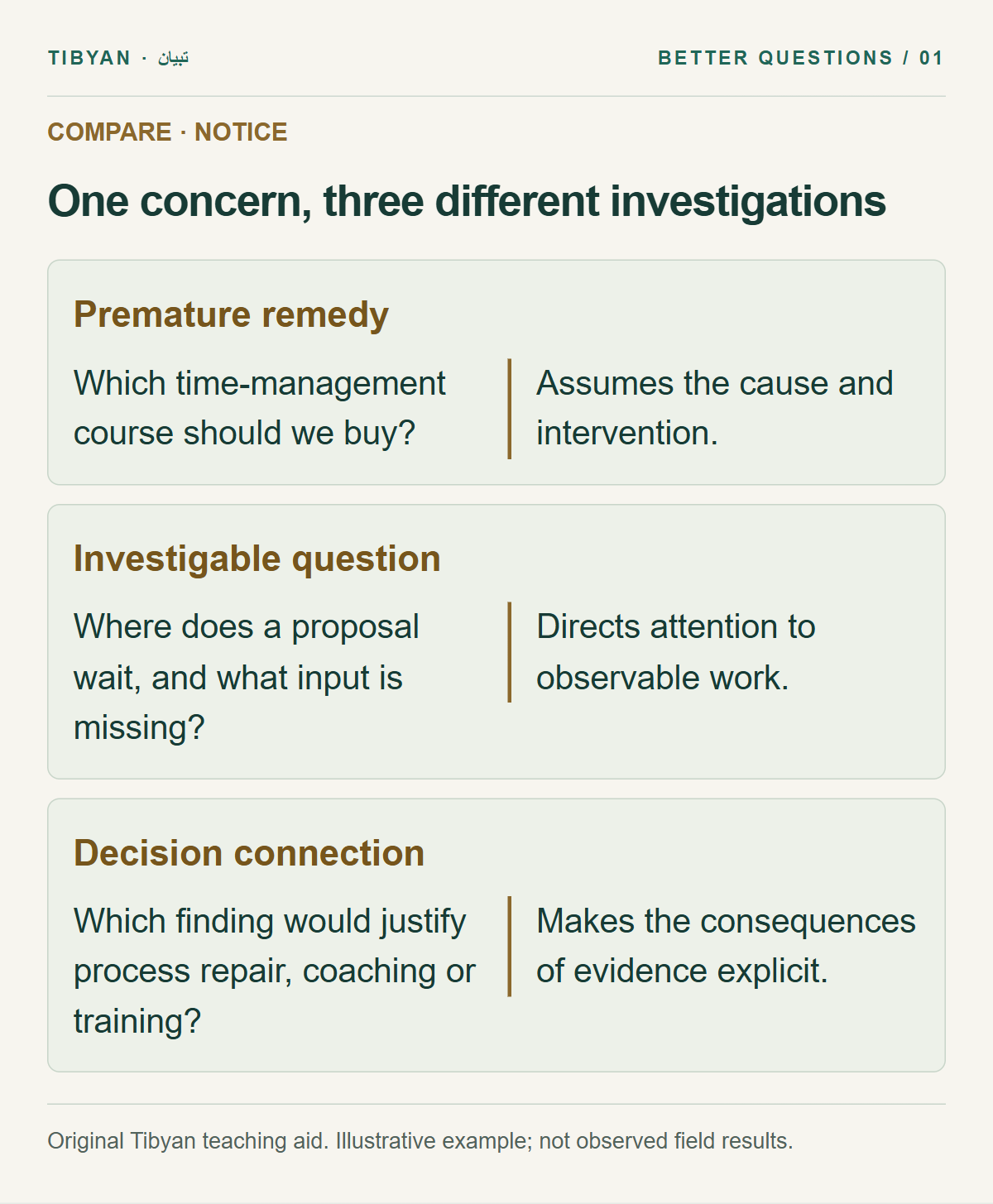
Your reusable working record
Annotated completed record
Decision and deadline
Mariam chooses a bounded response to proposal delay by 12 November 2026. Customer deadlines stay fixed.
The choice, authority and deadline are visible; the record does not start by buying a course.
Observed records
P1 received its confirmed estimate after the deadline. P3 received its estimate at 11:00 but the draft was submitted at 18:00 against a 16:00 deadline.
P3 prevents the record from quietly treating every late draft as a late-estimate case.
Investigation question
Where did time accumulate from estimate request to draft submission in P1 and P3?
It selects an observable sequence and leaves several explanations possible.
Explanations and missing information
Possible explanations: request ownership, input timing, checking skill or competing workload. Case complexity and workload are not supplied.
Missing context is retained rather than invented.
Next check and people
At 15:00 on 11 November, Huda and Omar reconstruct P1/P3 and demonstrate the completeness check using the draft histories and timestamps.
The check can reveal both a process condition and a skill need.
How findings change the action
If timely inputs permit correct checking but requests lack ownership, test an owned request/escalation step. If checking errors remain with adequate inputs and time, rehearse the specific checking step.
The responses follow different findings; neither is already declared effective.
Responsibilities
Mariam authorizes and reviews the response; Huda brings draft histories; Omar verifies estimate timestamps.
Roles are assigned in the completed example rather than left as an instruction.
Review point and limit
Review the next three eligible proposals for use of the agreed step and remaining obstacles. Do not infer revenue impact from this small review.
The review examines implementation and learning, with a stated limit.
Practice and retry
Use the supplied packet to complete the record before viewing the model. Write two findings that would lead to different actions. Then ask a partner to introduce one missing condition and revise the question or next check.
Common error and corrective feedback
Weak: “All delays are caused by poor planning.” Correction: the records show different sequences and leave complexity/workload unknown. A supported next step investigates P1 and P3; it does not announce a cause.
Independent-study alternative
Write your record first. Then read the model and mark one place where it preserves an unknown you had treated as a fact. Revise that part and explain the changed action.
Check your work
- A specific decision is named.
- Observation and interpretation are separated.
- At least two explanations remain possible.
- The next evidence could alter the action.