Your reusable working recordAnnotated completed recordDownload the printable pack
Version 2 · Revised 11 November 2026 · 2/12
How to Ask Clear, Useful Questions
Design a short sequence of neutral, answerable questions for a defined purpose.
Bring to the taskA real conversation or investigation, its purpose and any facts already established.
“Why are you always late with proposals?” looks like a request for an explanation. It also assumes repeated lateness and places responsibility on the person being questioned. A more useful opening might be, “Can we trace what happened on the last proposal?” The second question gives the colleague something specific to describe and leaves the explanation open.
Question design begins with purpose. You might need to confirm a fact, understand a sequence, explore an experience, test a belief, create possibilities or make a choice. A question that works well for one purpose can be cumbersome for another. “Was the proposal approved?” is a sensible closed question when approval status is the missing fact.
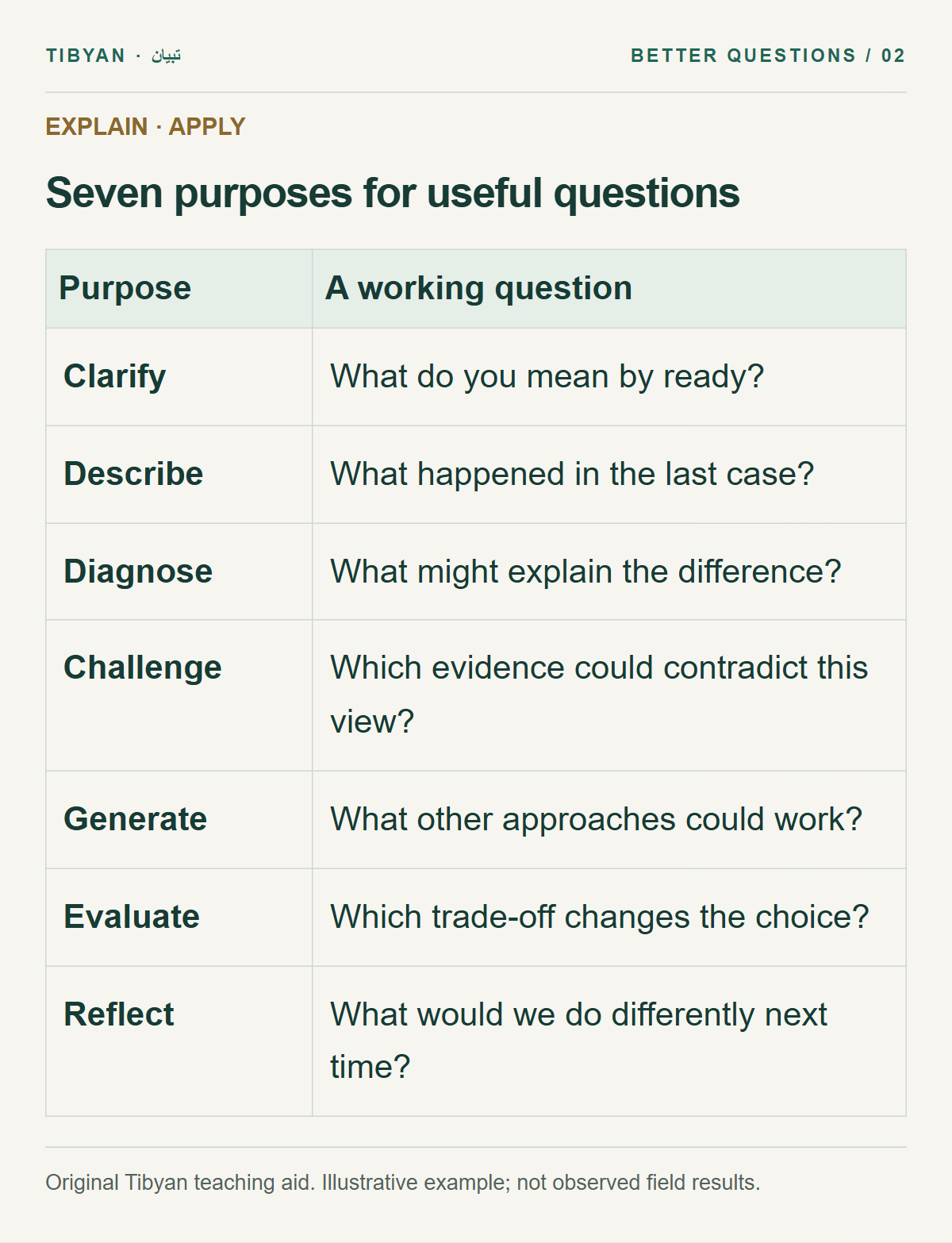
Case, demonstration and correction
Five repairs with reasons, not a list of preferred phrases
Original fictional practice set, revised 11 November 2026. Use Namaa's proposal handoff as context. For this exercise, assume P3 underwent an approval review and that a dispatch log confirms one request was sent on 10 November; its routing and outcome are not established. The questioner wants to understand the process before choosing a change. Each repair below has an acceptable alternative; wording is judged by purpose, evidence and the response it permits.
| Problem and original question | A usable repair and acceptable alternative | Answer-dependent follow-up and reason |
|---|---|---|
| Leading premise: “How much time did our new form save?” | “What changed in preparation and checking time after the form?” Alternative: “What took more or less time in the latest case?” | If the speaker reports no saving: “Which step stayed the same?” The repair permits benefit, no change or additional work. |
| Vague: “Why is the quality bad?” | “What happened during P3’s approval review?” Alternative: “Which requirement, if any, was unmet?” | If the information was complete: “What step followed the review?” It makes the criterion discussable without assuming the missing-information explanation is true. |
| Compound: “Why was P3 late, who failed, and how will you fix it?” | “What happened between receipt of the estimate and submission of P3?” Alternative: “Talk me through those steps.” | If an internal review held the draft: “What did that review require?” It starts with one event sequence before responsibility or remedies. |
| Loaded attribution: “Why do you keep ignoring requests?” | “What happened to the request sent on 10 November?” Alternative: “When did you first see that request?” | If it reached the wrong person: “How was responsibility assigned?” It tests the event without treating intention or repetition as established. |
| False choice: “Should we train everyone or accept missed deadlines?” | “Which responses could address the observed gap?” Alternative: “What could change besides training?” | If an ownership repair is proposed: “What evidence would show that it addresses this case?” It keeps process, practice, support and other feasible options open. |
“Who was responsible for that request?” followed by “How was that responsibility agreed?” is more neutral than asking someone to confirm that nobody owned it. A later summary can still invite correction: “I understand that the request went to Omar but no response owner was recorded. What have I misunderstood?”
Try this sequence: identify the case; reconstruct its events; probe one consequential detail; check your interpretation; ask what evidence would change the next action. If the answer corrects your premise, change the next question. A closed question can efficiently confirm a bounded record; its answer still needs appropriate checking before it is treated as fact.
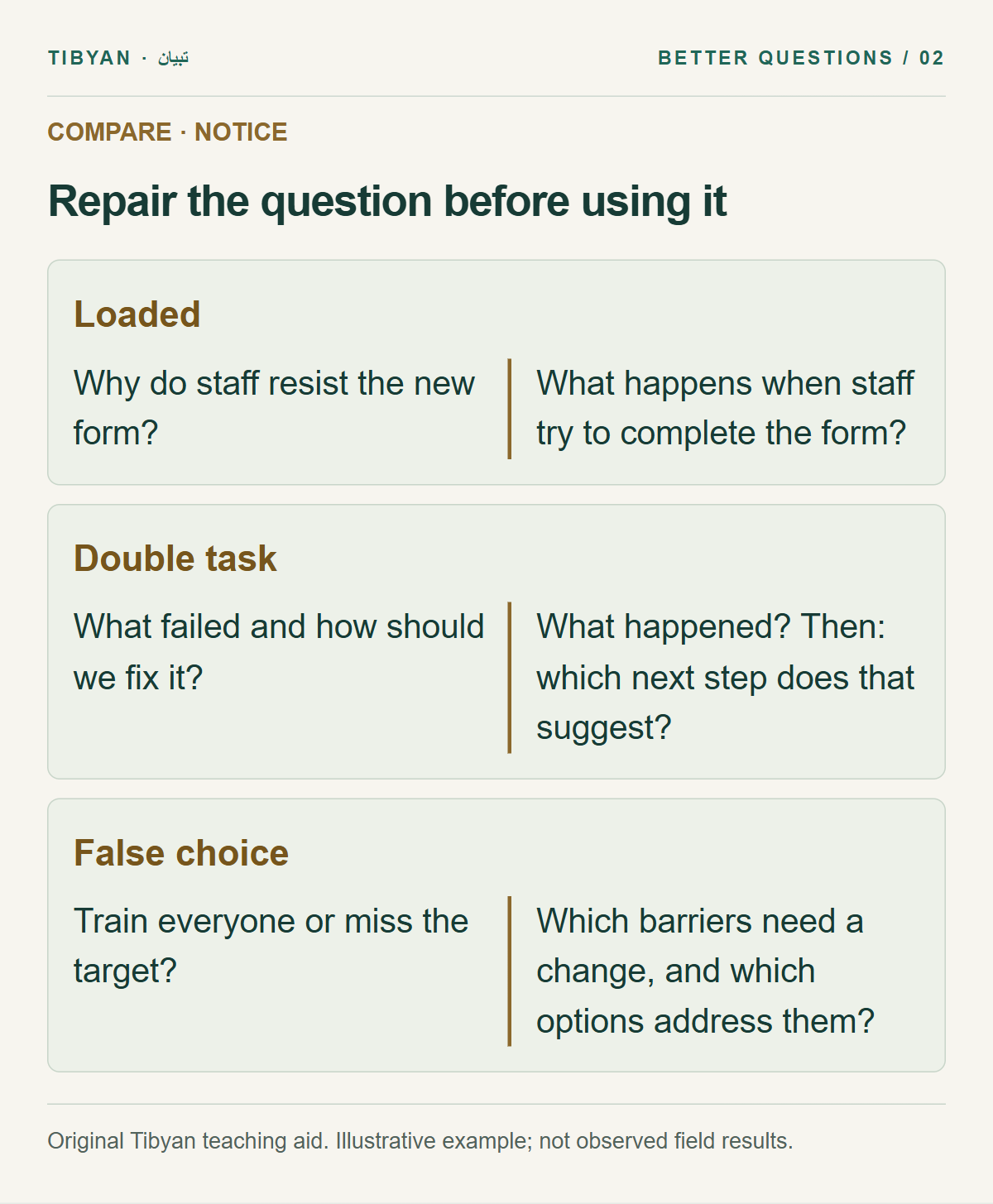
Your reusable working record
Annotated completed record
Repair row 1
Original: How much time did the form save? Purpose: compare preparation effort. Problem: assumes a saving. Repair: What changed in preparation and checking time? Alternative: What took more or less time in the latest case? If no change: Which step stayed the same?
The repair admits an unfavorable answer; it does not replace one preferred answer with another.
Repair row 2
Original: Why is quality bad? Purpose: understand the approval sequence. Problem: quality is undefined. Repair: What happened during P3’s approval review? Alternative: Which requirement, if any, was unmet? If information was complete: What step followed the review?
The alternative does not assume missing information when the event may have another explanation.
Repair row 3
Original: Why was P3 late, who failed, and how will you fix it? Purpose: reconstruct the sequence. Problem: multiple tasks and assumed blame. Repair: What happened after the estimate arrived? Alternative: Talk me through those steps. If review paused work: What did the review require?
Only the first needed task is asked; responsibility and remedies can follow checked information.
Repair row 4
Original: Why do you keep ignoring requests? Purpose: trace one request. Problem: assumes intention and repeated neglect. Repair: When did you first see the 10 November request? Alternative: What happened to that request? If it arrived late: How was it routed?
The record investigates delivery and responsibility without asserting motive.
Repair row 5
Original: Train everyone or accept missed deadlines? Purpose: choose a response. Problem: excludes other feasible responses. Repair: Which responses could address the observed gap? Alternative: What could change besides training? If an ownership repair is proposed: Which case would let us examine it?
A process repair remains an option to investigate, not a proven solution.
Selected conversation sequence
Which case are we discussing? → What happened after the estimate arrived? Speaker: internal review paused it. → What did that review require?
The third question follows the actual answer rather than the next item on a fixed list.
Partner correction and revision
My partner noted that “Which information was missing?” assumed a deficit. I changed it to “What happened during the approval review?” and kept the information question only if the answer supports it.
The revision explains why a more neutral opening was needed.
Practice and retry
Repair the five original questions before reading the table. For each, justify the change and provide a different acceptable wording. In a five-minute conversation, use three questions and document one answer-dependent follow-up.
Common error and corrective feedback
A question is not neutral merely because it begins with “what.” “What made you ignore the request?” still assumes ignoring. Investigate receipt and action first. Closed questions are acceptable when the missing fact is bounded; an unverified answer is not automatically established evidence.
Independent-study alternative
Write a repair for every original, then compare with the key. Imagine an answer that contradicts your premise and write the next question you would actually ask. Explain one difference between your wording and the model.
Check your work
- Purpose and wording fit.
- Unsupported premises are removed.
- Each question asks one main thing.
- At least one follow-up depends on the answer.