Your reusable working recordAnnotated completed recordDownload the printable pack
Version 2 · Revised 11 November 2026 · 5/12
Questions for Leadership, Coaching, and Team Learning
Choose between direction, coaching and a team debrief, then guide a conversation toward an accountable action.
Bring to the taskOne observable work situation, the person’s responsibilities and any non-negotiable requirements.
Here, coaching means a developmental conversation with genuine room for the employee’s judgment; direction means a clear managerial instruction or fixed requirement.
A manager asks, “What do you think we should do?” The employee suggests an approach and discovers that the manager had already decided on another. A question presented as an invitation has become a test of whether the employee can guess the preferred answer. Good leadership questioning starts with honesty about who owns the decision.
Case, demonstration and correction
Choose the conversation before choosing the question
Original fictional teaching cases, revised 11 November 2026. A manager's question is useful only when it matches the work and the decision space.
| Situation | Appropriate starting response | Why |
|---|---|---|
| A new coordinator does not know how provisional estimates must be marked | Explain the rule, show an example, then let the coordinator try it | A guessing exercise does not supply missing knowledge. |
| A confirmed organizational requirement must be followed before release | Give the requirement and its reason directly; check understanding | Presenting a fixed rule as an open choice creates a misleading invitation. |
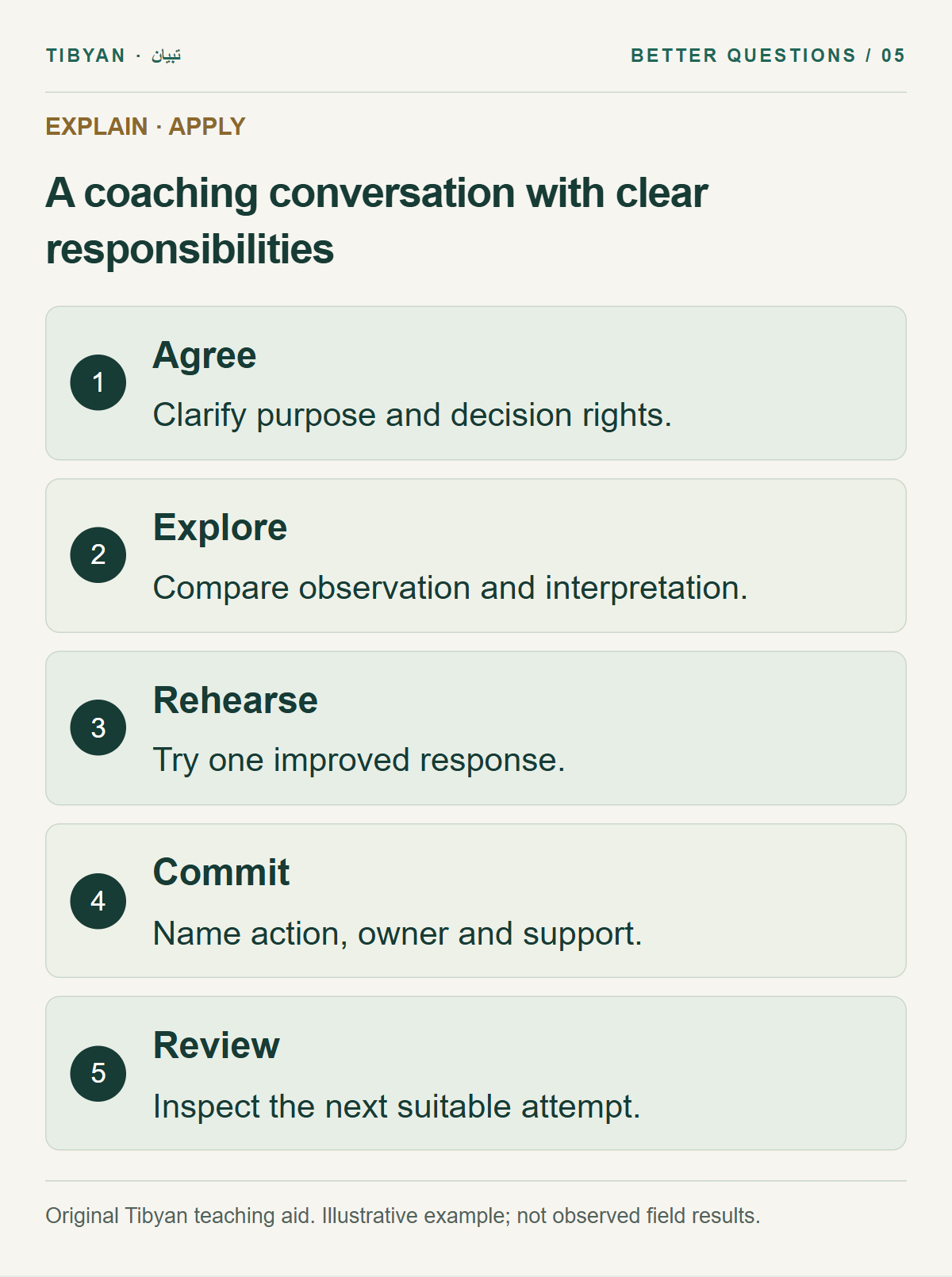
| The coordinator understands the requirement and has discretion over how to obtain confirmation | Agree the outcome, explore reasoning, rehearse an option and review the attempt | Developmental coaching can support judgment within genuine choices. |
| Several people need to understand a shared handoff event | Debrief the event using records and contrasting accounts | A team process cannot be repaired by asking one employee to reflect alone. |
A complete coaching agreement and attempt
The fictional next draft is due at 16:00 on 12 November. Mariam states the fixed rule: every unresolved estimate assumption must be visibly marked before release. Huda may choose how to seek confirmation; she cannot remove an unresolved item merely to make the document look complete. They agree to rehearse a confirmation request and inspect the next draft together. They will share the task note with each other and Omar, who owns the estimate; Mariam does not promise absolute confidentiality beyond her managerial responsibilities.
Huda explains that an earlier fictional reply from Omar said “looks fine”; she had taken that general reassurance as confirmation of the support period. Her first request in the rehearsal is, “Is this all fine?” Mariam asks, “What would a useful answer need to distinguish?” Huda identifies the support period and the confirmation status. Her revised request is: “Please confirm whether the estimate includes support through the stated implementation period. If this is not confirmed, I will mark it unresolved for the approver. Who can respond if you are unavailable?”
They rehearse Omar replying, “I have not checked that period.” Huda then marks it unresolved rather than treating silence as approval. Huda owns the request; Mariam owns the backup route to Lina when Omar cannot respond. They review the draft and response record at 16:30 on 12 November. The planned criterion is whether the specific commitment was confirmed or visibly unresolved before release. A successful rehearsal is practice evidence; the next draft is the opportunity to examine workplace use.
A separate team debrief
For P3, the intended outcome was submission by 16:00 on 10 November. The draft history shows submission at 18:00; Huda reports a scope change at 14:30, and Omar reports that the changed support period needed confirmation. Mariam asks, “Which parts do the records establish, and which are accounts we still need to check?”
Huda: “The version history can establish when the scope changed.” Omar: “We need to check who could authorize the new commitment.” Mariam: “For the next eligible scope change, Huda will record the changed assumption and named response owner; I will confirm the authority and backup route. At our next handoff review, we will compare the expected sequence with the actual record.” This is a bounded team action, not a conclusion that one person caused the delay.
Your reusable working record
Annotated completed record
Conversation type and reason
Developmental coaching: Huda knows the marking requirement and can choose how to seek confirmation. The shared P3 event also needs a separate team debrief.
The record distinguishes an individual practice task from a shared process review.
Fixed requirement and genuine choices
Unresolved estimate assumptions must be visible before release. Huda can choose the communication method and propose a workable confirmation request.
The manager does not disguise a fixed requirement as employee choice.
Outcome and information agreement
Rehearse a specific confirmation request and inspect the next draft. The task note is shared with Huda, Mariam and Omar; Mariam retains release accountability.
The agreement makes the use of the conversation explicit without promising absolute privacy.
Employee’s first interpretation
Huda thought “looks fine” confirmed the support period. She had not distinguished general reassurance from confirmation of that commitment.
The interpretation is elicited before correcting it.
Rehearsed behavior and response
Huda asks whether the support period is included. When Omar says it has not been checked, she marks the item unresolved for the approver.
The rehearsal includes uncertainty rather than an unrealistically agreeable reply.
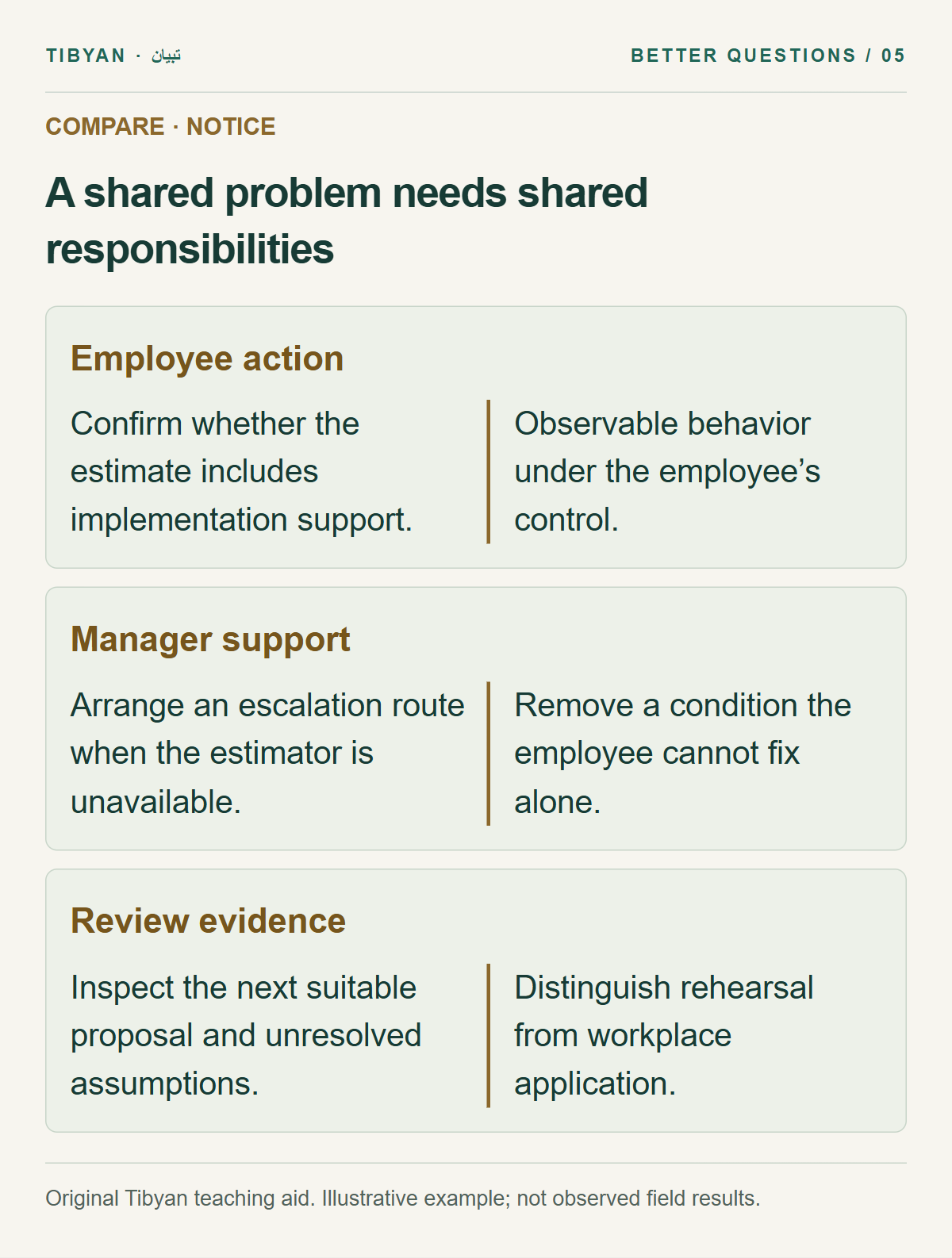
Employee action
Before the 12 November 16:00 draft, Huda sends the specific request and records the confirmation or unresolved status in the draft.
The action is observable and within Huda’s responsibility.
Manager support
Mariam establishes Lina as the backup contact and checks who may approve a revised support commitment.
Authority and access are managerial support tasks, not employee attitude problems.
Application evidence and review
At 16:30 on 12 November, Huda and Mariam inspect the draft and response record for confirmed or visibly unresolved commitments before release. Outcome not yet observed.
A planned review is not presented as a successful workplace result.
Team debrief: intended and actual event
P3 target: submission by 16:00 on 10 November. Draft history: submitted at 18:00. Huda reports scope changed at 14:30.
The event record separates a timestamp from a reported explanation.
Team debrief: conditions and unknowns
Huda identifies the scope change; Omar identifies the need for confirmation. The authority for approving the revised support period is not yet checked.
Different accounts add conditions; the record does not choose a culprit.
Team debrief: action and support owners
For the next eligible scope change, Huda records the changed assumption and response owner. Mariam confirms the authority and backup route.
The response assigns both process execution and organizational support.
Team debrief: review opportunity
At the next handoff review, compare the expected change/request/approval sequence with the actual version and response records.
The debrief ends with reviewable work rather than a general promise to communicate better.
Practice and retry
Classify the four situations before choosing a question. In triads, run a ten-minute coaching attempt with one rehearsal and specific feedback, then change the condition so the employee lacks the rule and requires instruction. Finish with a separate short team-debrief record using the P3 packet.
Common error and corrective feedback
Do not score agreement with the manager as learning. Do not ask the employee to reflect repeatedly when the barrier is missing authority or information. In the debrief, distinguish what the version record shows from what each participant reports.
Independent-study alternative
Classify the situation cards, write a direct instruction for the missing-knowledge case and a coaching question for the genuine-choice case. Rehearse both sides of the unconfirmed reply aloud, then complete the separate debrief fields and compare with the model.
Check your work
- Fixed requirements and choices are explicit.
- The employee’s reasoning is explored.
- The practice targets one observable behavior.
- Both employee action and manager support have owners.