Your reusable working recordAnnotated completed recordDownload the printable pack
Version 2 · Revised 11 November 2026 · 6/12
Customer Discovery: Ask Questions That Reveal Real Needs
Conduct a neutral discovery interview and distinguish evidence of a problem from expressions of interest.
Bring to the taskA defined customer type, a problem hypothesis and a decision about what to investigate next.
An entrepreneur describes a proposed service and asks, “Would this help your team?” A friendly “yes” feels encouraging. It tells you little about the work the customer is trying to accomplish, what happens today or whether anyone will commit resources to a change. Discovery should produce a correctable account of the customer’s situation.
Start with a hypothesis, not a conclusion: “We think operations managers struggle to obtain complete implementation assumptions before approving proposals.” Identify who actually performs that work, who experiences the consequences and who decides whether a new approach can be adopted. They may be different people.
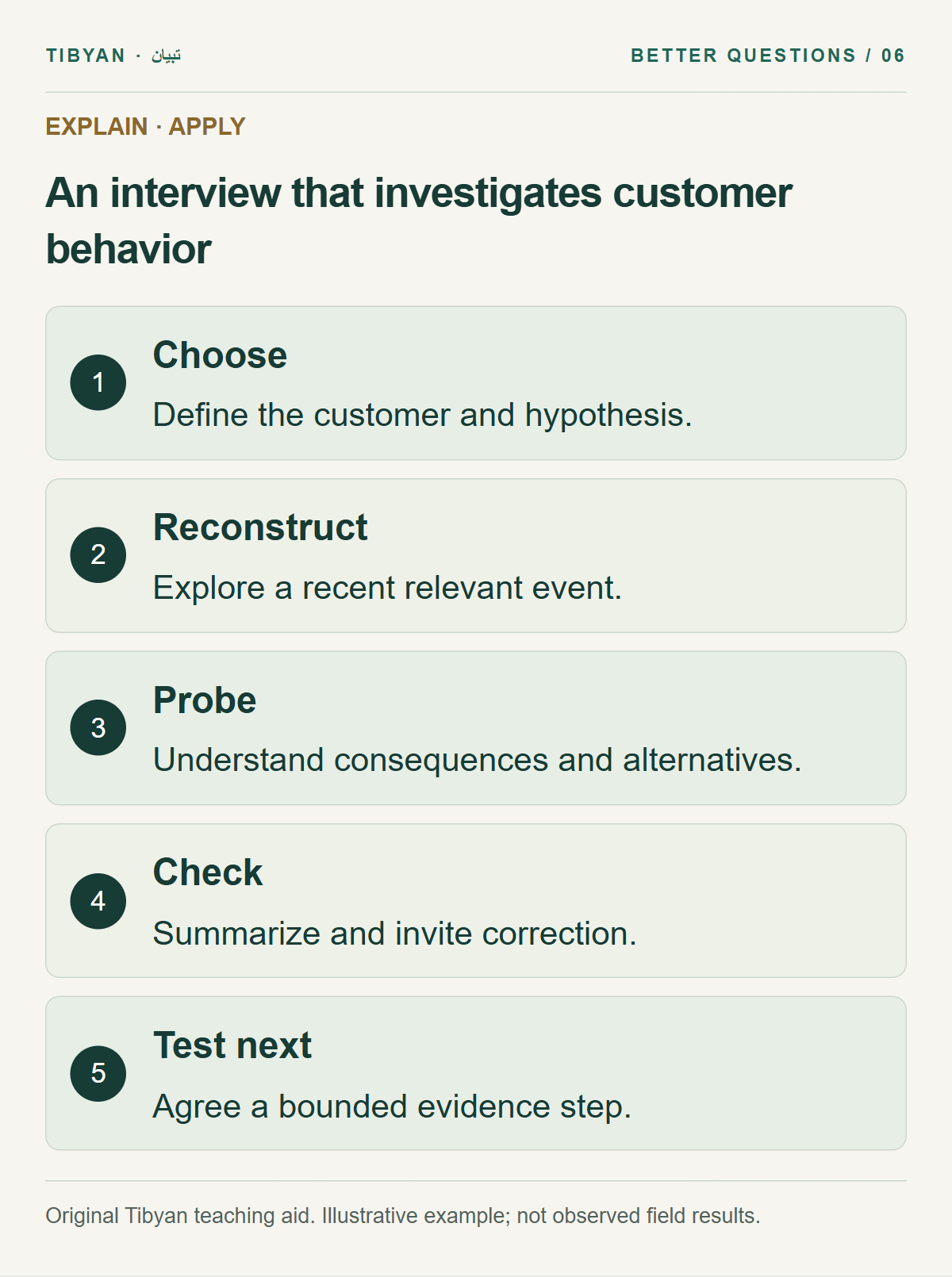
Case, demonstration and correction
A discovery interview that produces a usable record
Fictional research exercise, prepared 11 November 2026. Sami is exploring a proposal-readiness service. His initial claim is too broad: “Service buyers need clearer proposals and will buy a checking service.” Discovery examines the task and problem; qualification examines whether a specific opportunity is feasible, including decision roles, resources and timing. Neither a complaint nor an interview establishes purchase intent.
Use this interview sequence as an adaptable guide:
- Agree the purpose and permission: “I am learning how approval works, not asking you to assess my service. May I take task-related notes?”
- Choose a recent event: “Tell me about the last proposal that needed implementation approval.”
- Reconstruct the steps: “What happened next? Who needed which information?”
- Examine the current workaround: “How did you resolve what was unclear?”
- Explore consequences neutrally: “What happened because that item was unresolved?”
- Clarify decision roles: “Who could authorize the commitment, and who could adopt a different process?”
- Check the account: “What have I misunderstood or overstated?”
- Agree the next uncertainty: “Which permitted, non-sensitive example could help us check that?”
Three accounts, including a contrary case
These are supplied fictional accounts, not real interviews or representative findings.
| Account dated 11 Nov 2026 | Reported event and current alternative | Interpretation and limit |
|---|---|---|
| A · Amal, operations manager for a multi-party implementation | On 10 Nov, she sought clarification of an unspecified support period before approval. “We called operations twice before the commitment was clear.” She reports a one-day wait and about 30 minutes in calls. | The account supports investigating an approval-information problem in this situation. The wait and call duration are reported, not independently timed. Buying a new service is unknown. |
| B · Karim, procurement coordinator for the same type of work | His most recent approval, on 7 Nov, took about an hour after the authorized technical owner confirmed the scope. “A shorter document would not let me authorize the technical promise.” His alternative is to obtain that owner's confirmation. | His role differs from Amal's. The obstacle may concern authority and confirmation, not document length. The account needs checking against a permitted process walkthrough. |
| C · Nour, owner of a small firm buying a routine service | On 9 Nov, she approved a one-page offer using an existing checklist and reported no difficulty understanding the support commitment. “I do not need another review step for this purchase.” | This weakens the claim about all service buyers. The case has less complex approval; it does not refute Amal's reported difficulty. |
A completed synthesis and next decision
Sami writes: “I will narrow the hypothesis to some multi-party implementation purchases where commitments need confirmation across roles. I will not assume that shorter proposals or a paid checking service address the problem. Amal's and Karim's accounts suggest investigating confirmation and authority; Nour's account makes the broad segment claim untenable.”
His next step is a planned usability check, not a demand test. On 12 November, Sami will ask one operations participant and one procurement participant to identify two deliberately unresolved commitments using two matched fictional proposals with the same required commitment information: one in the current presentation and one in an assumptions summary. He reverses the format order for the second participant and records that order. For this exercise, both material commitments must be noticed without prompting before he treats the summary as ready for further investigation; this is a case-specific requirement, not a universal research benchmark. If either remains hidden, he will revise the presentation. If both are found, willingness to adopt or pay still requires separate evidence. He limits this first check to two 45-minute sessions. With only two participants, order and practice effects may remain; this is an exploratory task check, not a causal comparison. If the current presentation already reveals both items, he must examine whether the new summary adds useful value rather than assume it does.
Choose participants for the task and decision roles, including people with a workable current alternative and cases that may contradict your idea. Do not rely only on friendly supporters. These purposeful conversations help refine a hypothesis; they do not estimate market prevalence.
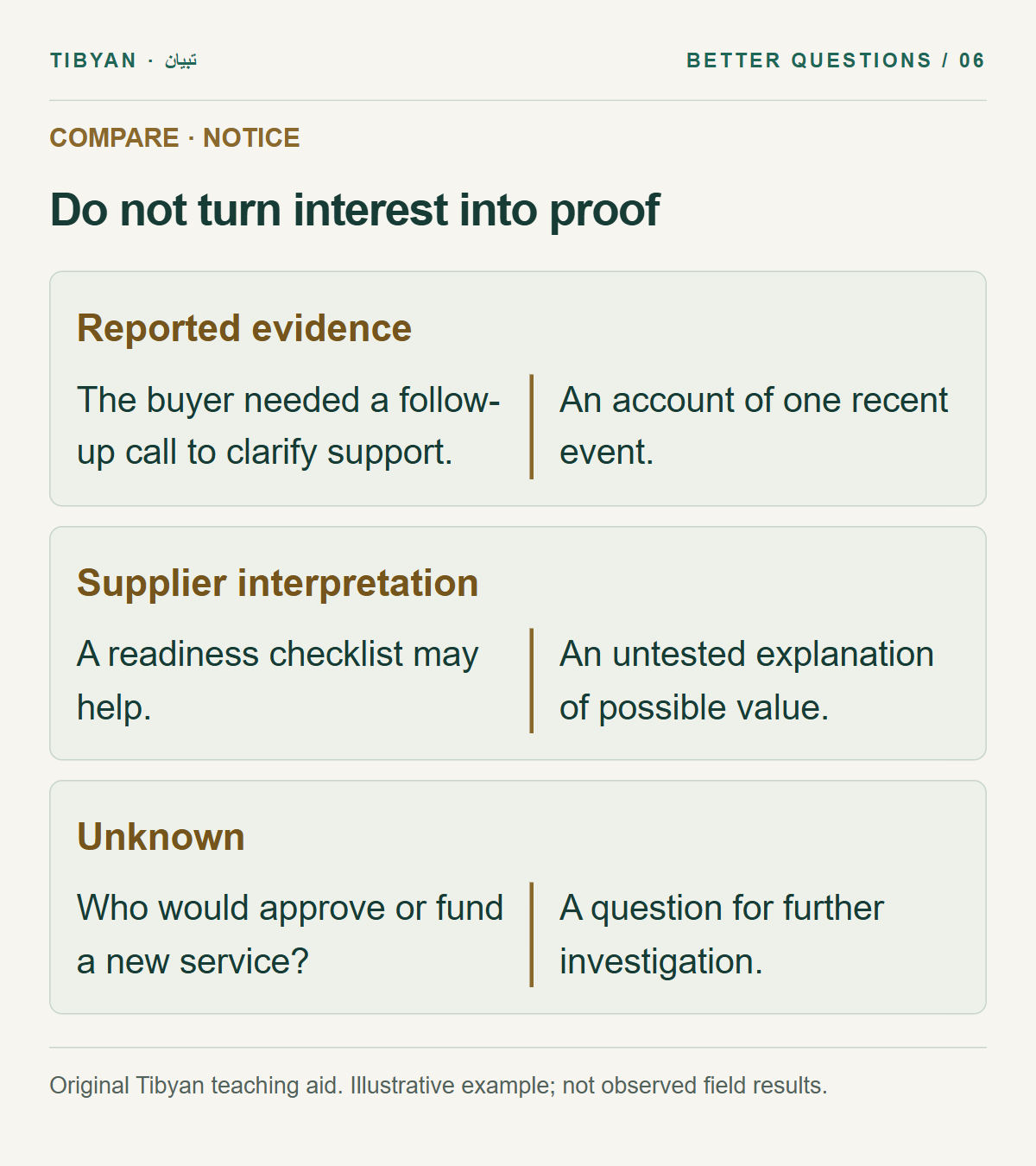
Your reusable working record
Annotated completed record
Purpose, hypothesis and participant selection
Sami is exploring confirmation of implementation assumptions. Initial claim: all service buyers need clearer proposals and will buy checking. Select an operations user, a procurement coordinator and a routine-service buyer with a working alternative.
Selection tests the scope of the hypothesis rather than recruiting only likely supporters.
Interview record A — repeatable record
11 Nov 2026; Amal, operations manager, multi-party implementation. Event: 10 Nov approval needed an unspecified support period clarified. Report: “We called operations twice before the commitment was clear.” Reported consequence: one-day wait and about 30 minutes of calls. Alternative: operations calls. Interpretation: investigate confirmation. Unknown: independently checked duration and purchase intent.
The record distinguishes reported time and quotation from an established organizational measure.
Interview record B — repeatable record
11 Nov 2026; Karim, procurement coordinator. Event: 7 Nov approval took about one hour after the technical owner confirmed scope. Report: “A shorter document would not let me authorize the technical promise.” Alternative: seek owner confirmation. Interpretation: authority may matter. Unknown: process rule and who could adopt a new service.
Different roles reveal different decision constraints; a shorter form is not assumed to resolve either.
Contrary interview record C — repeatable record
11 Nov 2026; Nour, small-firm owner buying a routine service. Event: 9 Nov approval of a one-page offer using an existing checklist. Report: “I do not need another review step for this purchase.” Reported consequence: no support-commitment confusion. Interpretation: the broad segment claim is too wide. Unknown: other purchase types.
The contrary case narrows the claim without erasing a different participant’s account.
Source status and permitted next evidence
All three records are supplied fictional accounts. Within the exercise, reported wait times are not independently timed. A future real check would use a permitted non-sensitive process walkthrough, not unnecessary customer records.
No actual interview or permissioned field evidence is invented.
Cross-interview comparison
Amal and Karim both mention confirmation but occupy different roles; Karim highlights authority. Nour has a routine purchase and an adequate current checklist. Complexity and approval roles may condition the problem.
A pattern is expressed as a revisable hypothesis, not a market prevalence estimate.
Revised hypothesis and current decision
Investigate some multi-party implementation purchases requiring cross-role confirmation. Drop the claim about all service buyers; do not infer demand for a paid checking service.
The hypothesis is narrowed by both relevant and contrary accounts.
Next evidence test, owner and decision rule
Sami plans two 45-minute sessions on 12 Nov. Operations and procurement participants identify two unresolved commitments in matched fictional proposals, one current format and one summary. Reverse and record format order for the second participant. Both items must be noticed without prompting before progressing; otherwise revise. Examine added value if baseline already works. This is exploratory usability, not payment or a causal comparison.
The rule is justified by the two material commitments in this fictional task and is not a universal benchmark.
Note-taking and information boundaries
Exercise-only supplied accounts; no real participant consent or customer files exist. Permission for a future real interview has not yet been requested, so real collection remains on hold.
The completed status is honest about permission; it does not fabricate consent.
Practice and retry
Draft the opening and eight-stage interview guide, then conduct a ten-minute interview or use the supplied accounts. Complete three repeatable records, compare their conditions and rewrite the hypothesis. Specify one next evidence step and what it cannot establish.
Common error and corrective feedback
Do not turn “we called twice” into verified cost savings or a buying commitment. Do not erase a contrary case because its segment differs; use the difference to refine scope. A confirmed next meeting proves only that meeting, and a usable summary does not establish demand.
Independent-study alternative
Read account A and write your hypothesis before opening B and C. After each new account, record exactly what you retain, qualify or reject. Then create a neutral follow-up for each role and compare your synthesis with the model.
Check your work
- Questions explore a recent event.
- The proposed solution does not lead the opening.
- Consequences and alternatives are examined.
- Interest and purchase intent remain distinct.