Your reusable working recordAnnotated completed recordDownload the printable pack
Version 2 · Revised 11 November 2026 · 8/12
Use Questions to Generate Ideas and Explore Opportunities
Produce alternative problem frames and turn one promising idea into a bounded learning test.
Bring to the taskA specific user or customer task, observations about the difficulty and meaningful constraints.
“How can we make our proposal template shorter?” invites edits to a document. “How can a buyer find the information needed for a decision?” invites changes to navigation, timing, conversations or the document itself. Both may be useful, but they open different spaces for action.
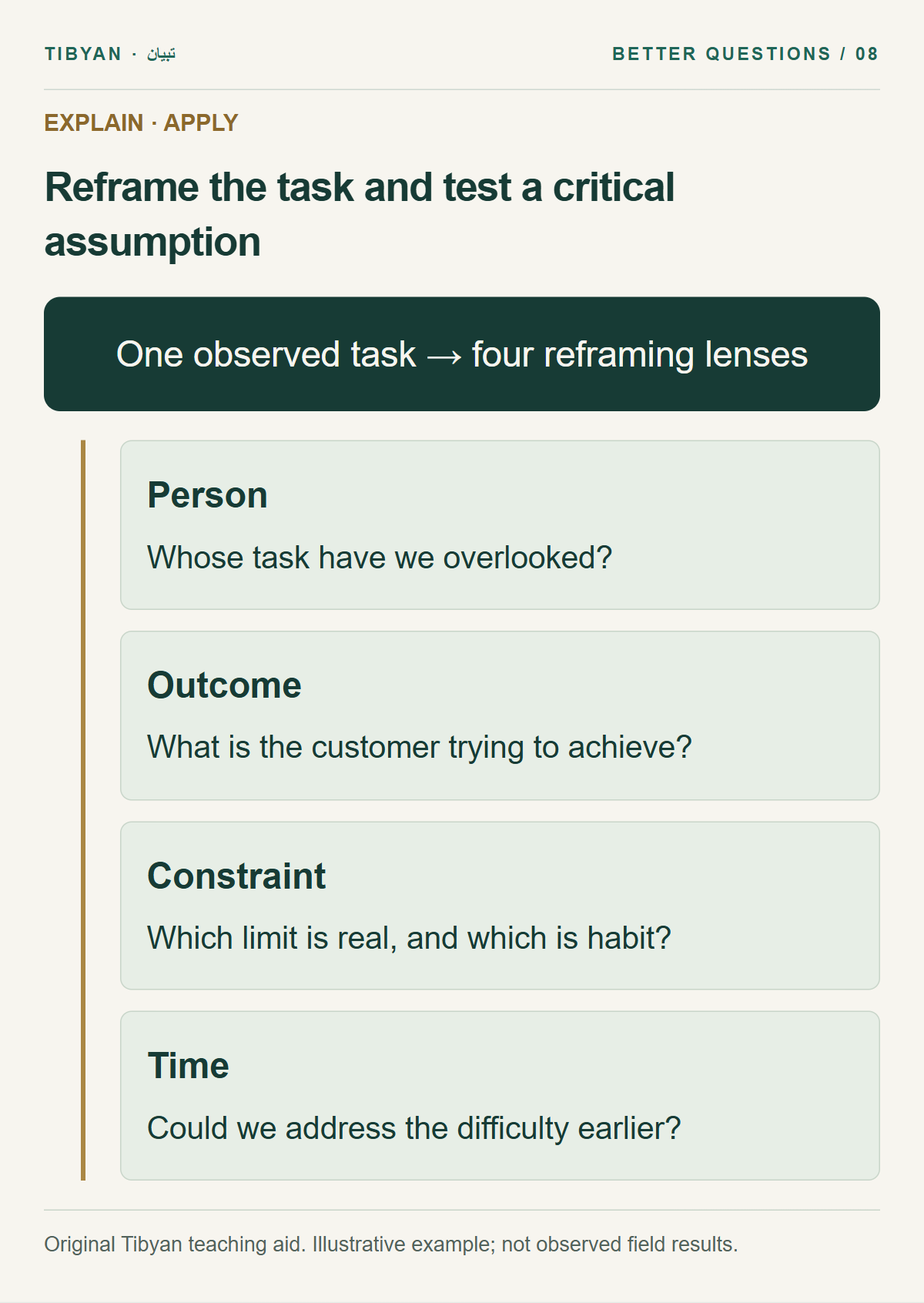
Innovation questioning begins by reconsidering the frame: who is trying to achieve what, where does difficulty occur and which assumptions have selected the current approach? Reframing is not permission to ignore evidence. It should explain the same observed situation in another useful way.
Case, demonstration and correction
Reframe a customer-onboarding task
Fictional teaching case. Namaa's new customers receive a welcome email and a setup form. In three invented walkthroughs, two customers could not identify who would confirm their first-week setup date. This tiny packet identifies a design question; it does not estimate how common the problem is.
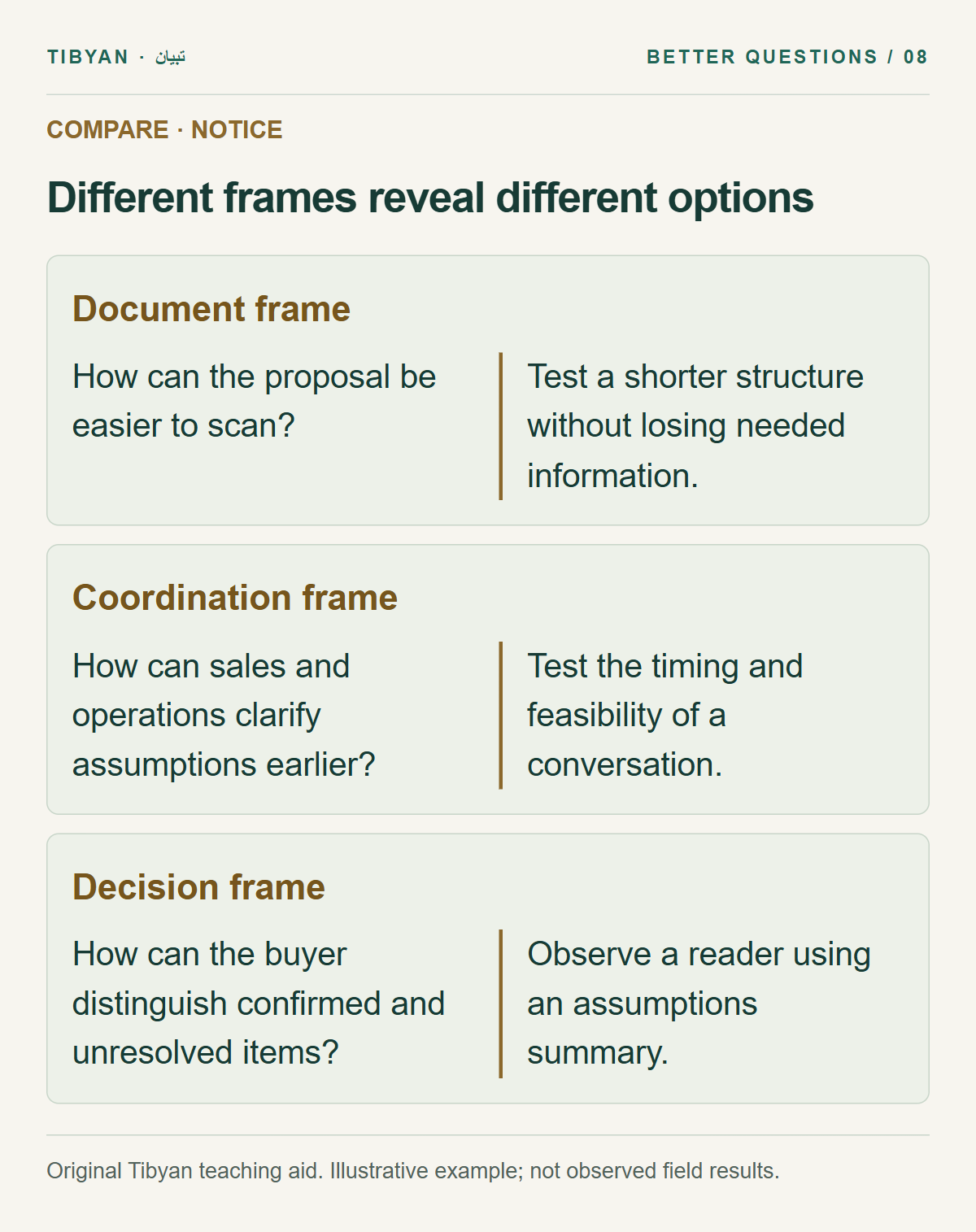
| Frame | Working question | A different approach |
|---|---|---|
| Document | How can a new customer find the date-confirmation contact in the welcome message? | Put the named contact and next step beside the date field. |
| Coordination | How can the customer and delivery coordinator confirm the date together? | Offer a short confirmation call before setup begins. |
| Decision visibility | How can both parties see whether the date is proposed or confirmed? | Use a shared status card with a named owner and confirmation state. |
“Which welcome-email color will customers prefer?” is an attractive but weak reframing here: color preference may leave the observed ownership problem untouched. A defensible frame still explains the original difficulty.
A complete bounded test card
Selected approach: a fictional status card. Assumption: a new customer can distinguish a proposed date from a confirmed date and identify the person who can change it.
Exhibit C1 — original card text: “First-week setup: 15 November 2026, 09:00. State: proposed. Confirmation owner: Hana, delivery coordinator. Next action: await Hana’s written confirmation before treating the date as agreed. Request date changes from Hana.” All times use this fictional team’s business clock. The team can maintain one named confirmation owner for this exercise.
Task: give three relevant colleagues playing new customers a fictional card; ask each to name the date state, the confirmation owner and the next action without hints. These are simulated users; a later test with intended customers is still required.
Decision rule for this design exercise: all three must identify the state, owner and next action correctly before the team takes the card to a small intended-customer trial. Any misunderstanding of a confirmed commitment triggers a revision. This is a conservative, fictional screening choice for this task, not a universal usability threshold.
Invented result: two people identify all three correctly; the third reads “proposed” as confirmed. Product coordinator Dina changes the label to “Proposed — awaiting confirmation from Hana” and retests the changed task. She does not recommend rollout or infer demand.
Exhibit C2 and answer key — reveal after the attempt: keep C1’s date, owner and next action, but replace the state line with “Proposed — awaiting confirmation from Hana.” The correct reading of either version is: the date is not confirmed; Hana owns confirmation and receives change requests; the customer waits for her written confirmation before treating the date as agreed.
What would change the next action? Accurate interpretation with substantial coordination effort would shift attention to workload. Accurate interpretation at manageable effort would justify a limited customer trial. Continued misunderstanding would require redesign or a different approach. None of these outcomes establishes willingness to pay, sustained adoption or business impact.
Weak record: “Three people liked the card, so customers will buy.” Improved record: “The exercise exposed one commitment-state error; revise the label before testing with intended users.” The changed decision follows the observation.
Your reusable working record
Annotated completed record
Observed user/task and limit
Two of three fictional walkthrough participants could not identify the first-week date-confirmation owner. The packet does not estimate prevalence.
The observation is specific and its sampling limit stays visible.
Frame → question → approach
Document → find the contact → revised welcome message. Coordination → confirm together → short call. Decision visibility → distinguish states → shared card.
The alternatives change how the task works, not only its wording.
Constraints and excluded frame
The team can maintain one named confirmation owner; the message must distinguish proposed from confirmed. Color preference does not address the observed ambiguity.
The rejected frame is judged against the user task, not taste.
Critical assumption and task
With the card, a new customer can identify the confirmation state, owner and next action without hints.
The assumption can be examined through observable interpretation.
Participants, materials and procedure
Dina gives three colleagues the supplied C1 card separately; each names the state, owner and action. She records errors without coaching.
This is a screening simulation; customer usability remains unknown.
Decision rule before the test
For this exercise, all three must identify state, owner and next action correctly before a small customer trial. Any commitment-state error means revise first.
A fictional screening rule is not a universal standard.
Observation, next decision and owner
Two identify all three correctly; one read proposed as confirmed. Dina revises the label and retests before approaching intended customers.
The observation leads to redesign, not a demand or rollout claim.
Limits and review trigger
No claim about payment, long-term adoption or revenue. Review immediately after retest; if interpretation is clear but workload excessive, inspect the coordination option.
The next uncertainty can shift even when the design becomes clearer.
Practice and retry
Before reading the test result, choose a frame and write a decision rule. Then use the invented result to decide what changes. Add a new constraint: no staff time is available for an extra call. Reconsider feasibility without pretending that the constraint proves the card works.
Common error and corrective feedback
Common errors: changing the task until the favored idea wins; counting cosmetic variants as distinct mechanisms; interpreting praise as adoption; inventing a threshold after seeing the result.
Independent-study alternative
Use the supplied observations and write your frames before revealing the example. Read the fictional results only after committing to a rule. Record the change you made and why.
Check your work
- Frames relate to observed work.
- Approaches differ in mechanism.
- Constraints are explicit.
- The test answers a specific uncertainty.