Your reusable working recordAnnotated completed recordDownload the printable pack
Version 2 · Revised 11 November 2026 · 9/12
Ask Better Questions Before Making Business Decisions
Produce a decision record that connects options, evidence, uncertainty and a reviewable commitment.
Bring to the taskA decision owner, deadline, feasible alternatives and the information currently available.
A team asks, “Which option has the highest score?” before agreeing on what matters. A polished matrix can hide uncertain estimates, omit the current arrangement and give a weak assumption the appearance of precision. Better decision questions make the choice and its consequences explicit before adding numbers.
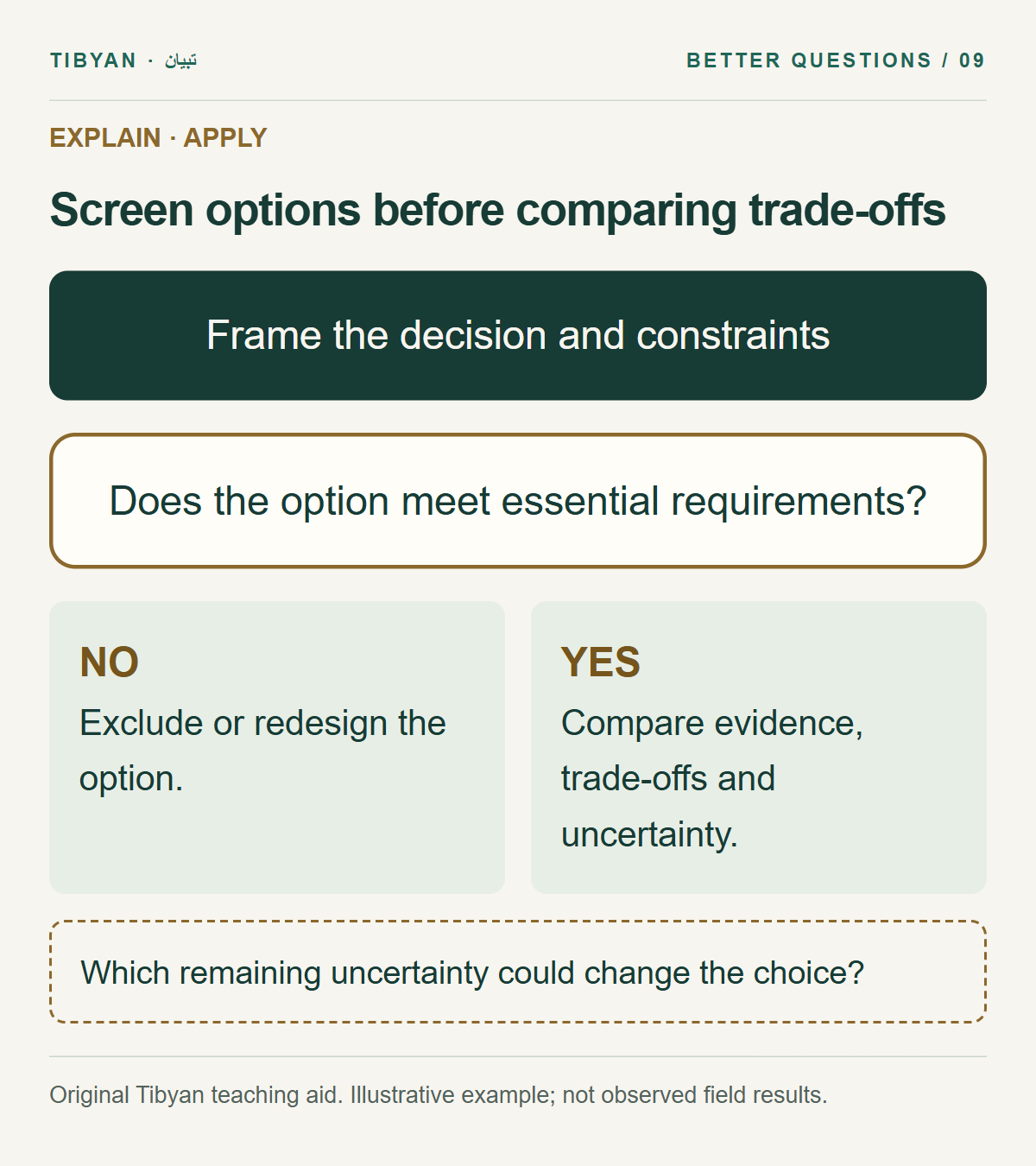
Write the decision in one sentence: who chooses what, by when, within which constraints? Distinguish a reversible trial from a large commitment. Include the option of keeping the current arrangement or deferring the decision when either is genuinely feasible. Delay also has consequences and should be examined rather than treated as free.
Case, demonstration and correction
Make an auditable options comparison
Fictional decision exercise. Salma, Namaa's operations manager, must choose a bounded way to prepare the next two suitable proposal approvals by 12 November 2026. Her team can spend at most 30 minutes on extra preparation for this exercise. This is an invented resource bound, not a recommended universal limit.
The essential requirements are: a written distinction between confirmed and unresolved commitments; an owner who keeps the record current; and a feasible preparation workload. Comprehension must then be tested. An attractive score cannot compensate for a missing essential requirement.
| Option as specified | Essential-requirement screen | Evidence and trade-off | Unknown and next check |
|---|---|---|---|
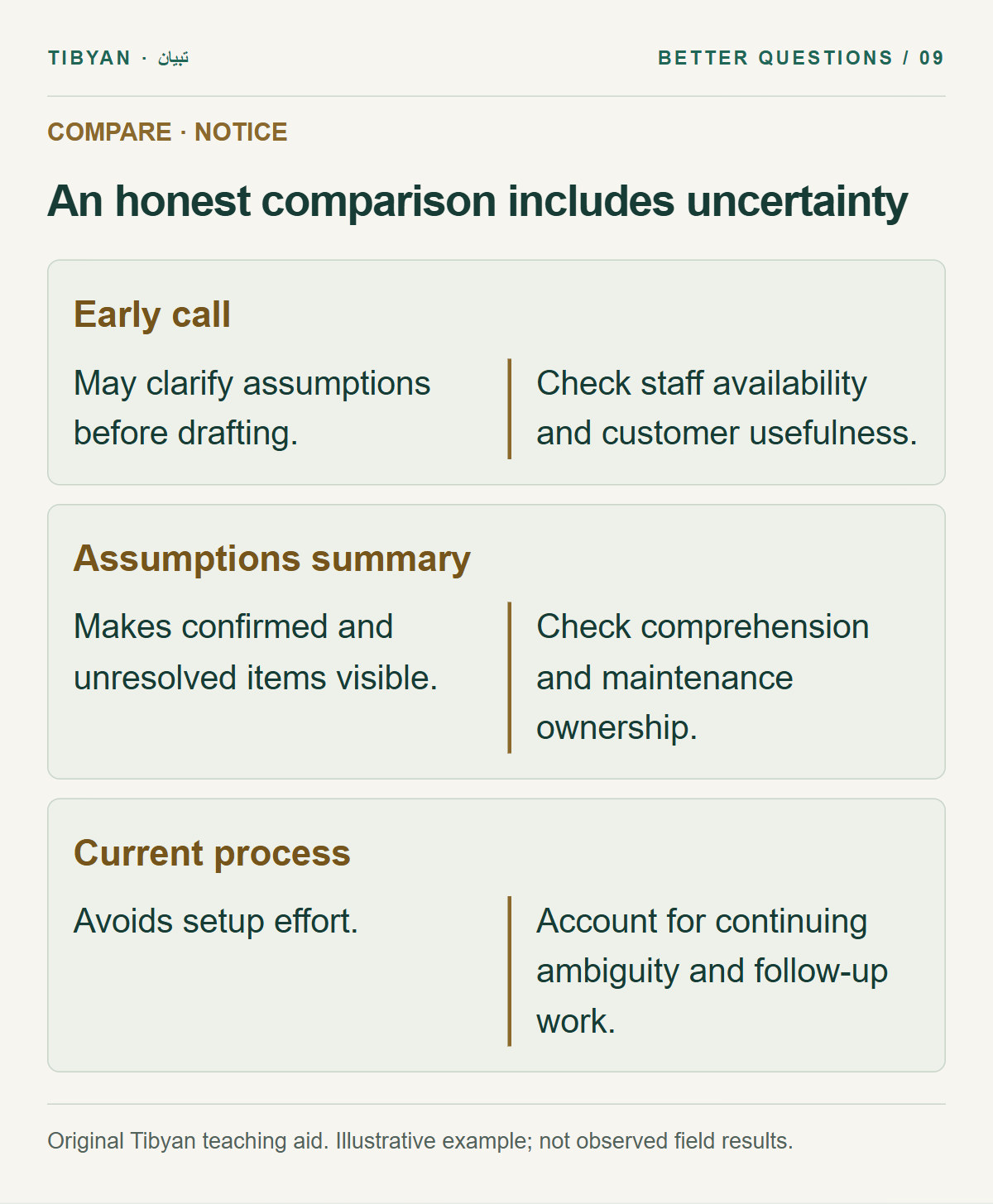
| A · Early call only | Redesign before selection: the call does not itself leave the required written status record. | May expose ambiguity quickly. Calendar availability and a recording step add effort. | Can a short call plus agreed note fit the bound? Ask the two roles to plan the task, not rate its appeal. |
| B · Assumptions summary with Huda as maintenance owner | Eligible for a bounded task test, not yet for rollout. A draft has separate confirmed/unresolved fields and a named owner. | Estimated setup: 10 minutes; per-proposal preparation/checking: 5 minutes for each of two proposals, total 20 minutes. These are untested estimates. | Can another reader identify unresolved items correctly? Use a fictional proposal without hints and record actual preparation time. |
| C · Current process unchanged | Retain as the comparison baseline; do not choose unchanged for future issue because its sample does not mark unresolved items. | No setup effort; continuing clarification work remains. | How much clarification does it actually create? The packet contains no reliable time measure. Do not invent one. |
Prototype entry for B: “Implementation support outside business hours: unresolved. Technical estimator to confirm coverage before issue; Huda tracks the reply.” It keeps an unconfirmed commitment visible without promising it.
Decision note: Salma selects B for two simulated approval tasks, keeps the existing approval safeguard and makes no live customer commitment from the prototype. The strongest objection is that readers may mistake the summary's presence for confirmation. Her review is due 14 November, or immediately if anyone reads an unresolved item as confirmed.
Two possible findings: if readers identify status correctly and the measured effort remains within the exercise's bound, proceed to a small, permissioned work trial. If interpretation fails, revise the wording or reconsider A with a written record. If effort exceeds the bound, simplify or rescope rather than silently changing the limit.
Weak recommendation: “B looks professional and is cheapest.” Improved recommendation: “B is the most feasible test candidate on current evidence; comprehension and effort remain unresolved, so limit the commitment.” The decision is defensible without claiming a guaranteed outcome.
Your reusable working record
Annotated completed record
Decision owner, choice and deadline
Salma chooses preparation for the next two suitable approvals by 12 November 2026; this is a fictional simulation.
The entry gives the choice a boundary and accountable role.
Essential requirements and resource bound
Written confirmed/unresolved status; named maintenance owner; no more than 30 extra preparation minutes for this two-case exercise.
These requirements are fictional decision conditions, not validated standards.
Option A: requirement, evidence, trade-off and uncertainty
Call only: no written status record, so redesign before selection. It may reveal ambiguity; availability and recording effort unknown. Next: plan a call plus note.
The screen rejects the specified version, not every possible use of a call.
Option B: requirement, evidence, trade-off and uncertainty
Summary + Huda owner: prototype includes status fields. Untested estimate 10 + 2×5 = 20 minutes. Reader comprehension and actual effort require a task test.
Feasibility is provisional; the arithmetic is clear while the inputs remain estimates.
Baseline/current arrangement
Current sample has no unresolved-status label. Keep it as baseline; no reliable clarification-time measure is supplied.
Unknown costs remain unknown rather than being set to zero.
Strongest objection and decision-sensitive unknown
A reader may treat a present summary as confirmation. A status error would overturn the choice to progress toward a work trial.
The unknown bears on the decision, not merely on curiosity.
Bounded commitment and rationale
Salma selects two simulated B tasks, retains approval safeguards and records interpretation and actual preparation time. No live customer commitment follows.
The commitment buys useful evidence without implying rollout.
Review condition and next decision
Review 14 November, or immediately on a status misreading. Clear interpretation + feasible effort: small permissioned work trial. Failure: revise, rescope or compare redesigned A.
Several plausible findings produce different next actions.
Practice and retry
Complete the three-option comparison, then receive a new fictional observation: preparing each summary took 14 minutes, in addition to the 10-minute setup. Recalculate 10 + 2×14 = 38 minutes, compare it with the 30-minute bound and revise the commitment. Do not keep the original recommendation unchanged by relabeling the estimate as fact.
Common error and corrective feedback
Common errors: summing scores before screening essentials; replacing “unknown” with a convenient estimate; excluding the baseline; judging the original reasoning solely from a favorable outcome.
Independent-study alternative
Write your recommendation and strongest objection before reading the worked note. After revealing the 38-minute result, write a second dated note explaining the change rather than erasing the first.
Check your work
- The choice and constraints are explicit.
- Alternatives are genuinely feasible.
- Estimates and observations are distinguished.
- The recommendation includes a review trigger.