Your reusable working recordAnnotated completed recordDownload the printable pack
Version 2 · Revised 11 November 2026 · 11/12
Question AI’s Answers and Verify the Evidence
Create a verification record that identifies claim status, source support, uncertainty and the resulting decision.
Bring to the taskAn AI-generated response, the intended use and access to relevant original sources.
An AI response gives a neat statistic, a plausible citation and a confident recommendation. None of these establishes that the statistic exists, that the source supports it or that it applies to your decision. Verification is a separate task with its own questions and evidence.
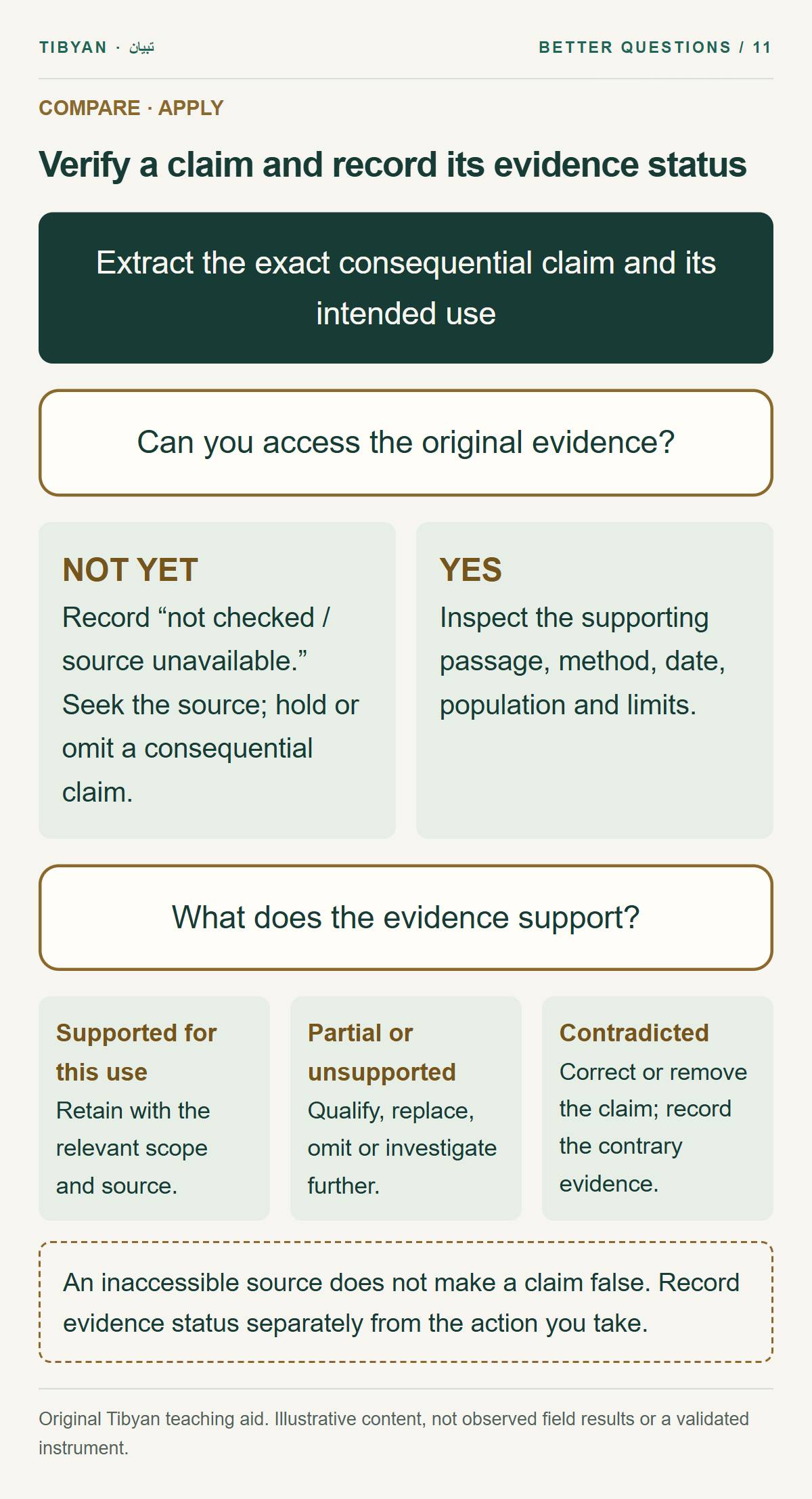
Begin with intended use. A casual brainstorming suggestion needs a different level of checking from a claim that will enter a client proposal or a teaching article. Identify the statements that could materially change an action, harm understanding or mislead another reader. Spend verification effort where the consequence matters.
Case, demonstration and correction
Complete a three-claim verification ledger
The following AI draft and business numbers are fictional teaching material, revised 11 November 2026. The Lee publication linked below is a real source; the invented draft is intentionally inaccurate.
- “Research proves that AI reduces workers' critical-thinking ability.”
- “Our clarification rate fell by two percentage points after the checklist.”
- “An unspecified report proves this checklist doubles every team's productivity.”
Supplied fictional record for claim 2: before, 8 requests needed clarification out of 40 reviewed; after, 6 out of 50. The periods contain different tasks and there is no comparison group. No source, author or URL is supplied for claim 3.
| Exact claim | Source and locator | Evidence judgment | Action |
|---|---|---|---|
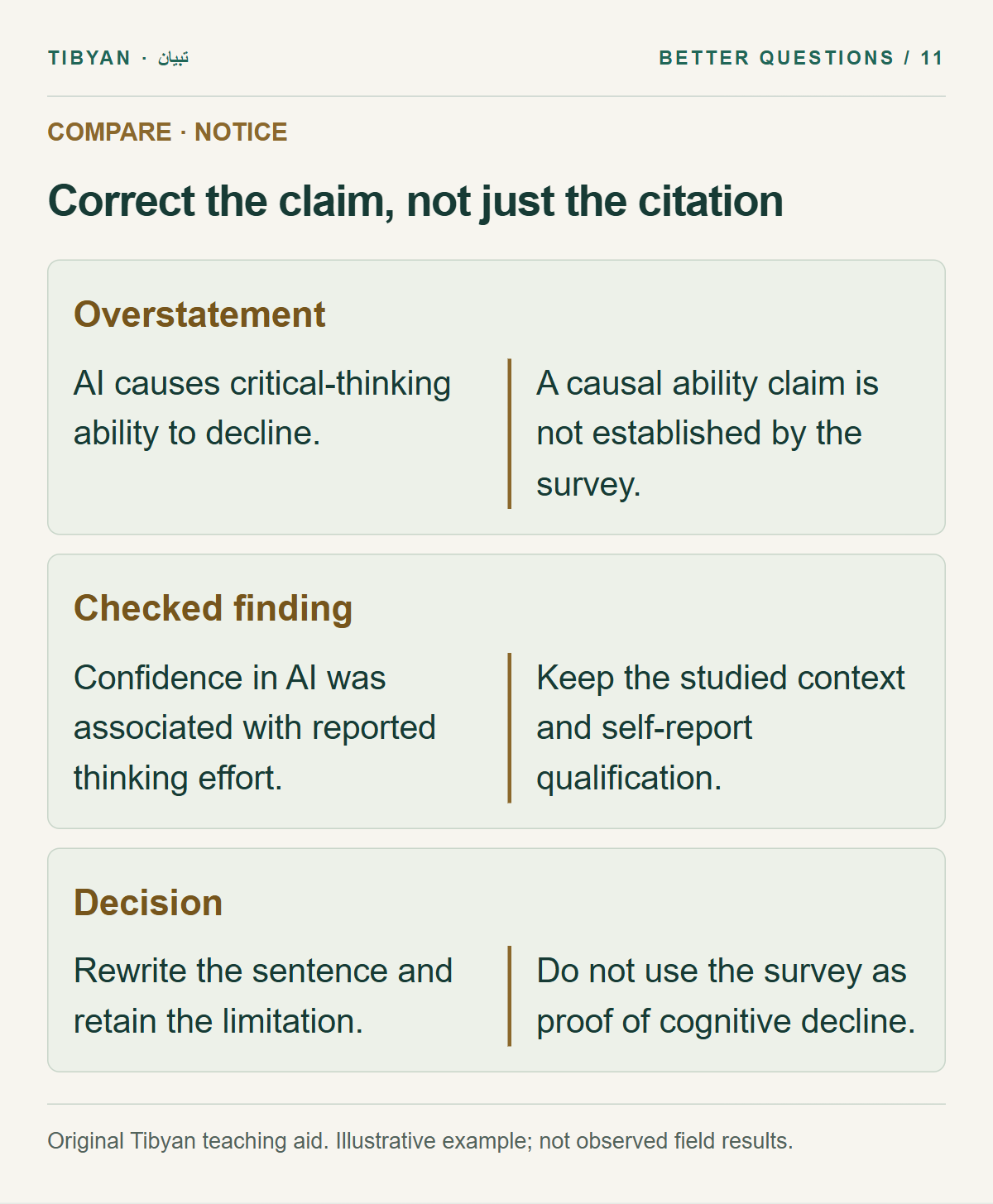
| 1 · AI causes an ability decline. | Lee et al., 2025, CHI paper; original publication page, publication summary, quantitative finding and qualitative interpretation paragraphs. | The source concerns a survey of 319 knowledge workers and self-reported effort; it does not establish a causal ability decline. | Reject the causal wording and qualify the sentence below. |
| 2 · A two-percentage-point decline. | Fictional record above, “before” and “after” rows. | 8/40 = 20%; 6/50 = 12%; the difference is 8 percentage points. The relative decline is 8/20 = 40%. This does not isolate a checklist effect. | Correct both the number and causal implication. |
| 3 · Doubled productivity for every team. | Source unavailable in this packet; no verifiable citation supplied. | Not checked. The missing source is not itself proof that the proposition is false, but it is insufficient for responsible use. | Hold or omit the claim until an appropriate source can be opened and appraised. |
Corrected sentence for claim 1: “In the surveyed tasks, greater confidence in generative AI was associated with lower self-reported critical-thinking effort; this does not establish a causal decline in ability.”
Corrected sentence for claim 2: “In this fictional record, clarification rates were 20% and 12%, a difference of eight percentage points. Different task mixes and the absence of a comparison prevent attributing the change to the checklist.”
Claim 3's disposition: omitted from the teaching recommendation; verification remains open. Do not replace “unverified” with “false.”
Audit entry: exercise check recorded on 11 November 2026 by the fictional teaching reviewer. In real use, record the actual checker, date, accessible source, page or section and revised wording. If a PDF or report cannot be opened, say so; do not imply you read it. A second AI's agreement does not supply an independent source.
Weak completion: “The citation is from a respected institution; retain all three.” Improved completion: attach the exact source support to each claim, recalculate the numerical comparison, and leave the unavailable-source claim unresolved. A credible source name is the beginning of appraisal, not its conclusion.
Your reusable working record
Annotated completed record
Intended use and consequence
A public teaching explanation about AI and a checklist; inaccurate causal claims or percentages could mislead readers.
The level of checking follows the intended use.
Claim 1: exact original sentence
“Research proves that AI reduces workers’ critical-thinking ability.”
The exact causal and ability wording is available for inspection.
Claim 1: source/title/date/locator
Lee et al., 2025, The Impact of Generative AI on Critical Thinking. Original publication page, quantitative/qualitative summary paragraphs. https://www.microsoft.com/en-us/research/publication/the-impact-of-generative-ai-on-critical-thinking-self-reported-reductions-in-cognitive-effort-and-confidence-effects-from-a-survey-of-knowledge-workers/
The locator lets a second reader repeat the check.
Claim 1: support, method and applicability
Survey/self-report association; causal ability decline not established.
The claim is appraised at its actual strength.
Claim 1: status and revised wording
Unsupported causal claim. Replacement: “Greater AI confidence was associated with lower self-reported thinking effort in the surveyed tasks; causal ability decline was not established.”
This is a qualified use of the source, not confirmation of the original claim.
Claim 2: exact claim, inputs and source
“Our clarification rate fell by two percentage points after the checklist.” Fictional before record: 8/40; after record: 6/50; different task mixes, no comparison group.
Both denominators are retained; the fictional dataset is not presented as research.
Claim 2: reproducible calculation and uncertainty
8/40=20%; 6/50=12%; 20−12=8 percentage points; 8/20=40% relative decline. Task differences prevent causal attribution.
The calculation can be checked independently and its limit is explicit.
Claim 2: status and actual replacement
Contradicted numerically. Replace with: “The fictional rates were 20% and 12%, eight percentage points apart; the record does not isolate a checklist effect.”
The replacement fixes the arithmetic without overclaiming.
Claim 3: exact claim and accessible source
“An unspecified report proves this checklist doubles every team’s productivity.” No author, title or URL supplied.
The sentence is intentionally fictional; no real report is being alleged.
Claim 3: evidence status and disposition
Not checked/source unavailable. Omit from the recommendation; seek an appropriate accessible source before reconsidering.
Omission is justified by insufficient support, not proof of falsehood.
Checker, check date, unresolved items and release decision
Fictional teaching reviewer; 11 November 2026. Claims 1–2 rewritten; claim 3 held. An actual publication still requires checking the retained statements and links.
The exercise does not impersonate human approval or a completed real-world audit.
Practice and retry
Complete all three claim records without viewing the answer column. Open the real Lee source for claim 1; recalculate claim 2 from the supplied fictional counts; mark claim 3 honestly when its source is unavailable. Rewrite the draft and have a partner repeat one check from your locator.
Common error and corrective feedback
Common errors: accepting an institutional logo instead of checking support; using one denominator for two periods; confusing relative percent change with percentage points; calling an inaccessible source disproved; asking another AI for certainty instead of obtaining evidence.
Independent-study alternative
Use the three supplied claims. Check the real source if online access is available; if not, mark claim 1 not checked and complete the arithmetic and source-unavailable records. Reopen the real source later before treating the corrected research sentence as verified.
Check your work
- The exact claim is identified.
- The source was opened and supports the wording.
- Method and applicability limits are recorded.
- The status leads to an explicit action.