Your reusable working recordAnnotated completed recordDownload the printable pack
Version 2 · Revised 11 November 2026 · 12/12
Build a Lasting Questioning Practice
Complete a small investigation and defend how your questions, evidence and judgment led to a proportionate action.
Bring to the taskA manageable work or business-study challenge, a review partner and permission to access the required non-sensitive information.
Knowing a list of question types is a starting point. Capability appears when you notice a consequential uncertainty, choose a question that addresses it, listen to the answer and revise an action. The final module turns that work into a visible investigation that another person can review.
Choose a challenge small enough to investigate responsibly. A business student might examine confusion in a group project handoff. A manager might inspect an approval delay. An entrepreneur might explore a customer’s current workaround. Do not choose a topic that requires inaccessible records or specialist decisions beyond the project’s scope.
Case, demonstration and correction
A completed inquiry portfolio
All people, work records and outcomes in this portfolio are fictional. It demonstrates documentation; it is not evidence that the series has improved a real organization.
Starting decision: Salma must decide whether Namaa's next response to late proposals should address planning, technical checking or handoff communication. Rana's first question is “Which time-management course should we buy?” She discards it because it assumes the cause and selects the remedy.
Initial evidence: the module 7 packet contains one estimate arriving after its deadline, one timely case and one late, more complex case with a missing approval log. Rana asks: “Who received responsibility for the unresolved item, and how did they acknowledge it?”
New simulation evidence: message F1 names an owner for the complex case, but the coordinator's copy was not delivered. Responsibility existed on paper; communication was unconfirmed. In a second fictional demonstration, F2, Rana misses a support-coverage ambiguity in an additional-service example despite checking all four obvious omissions in the simpler exercise. These observations keep both a communication condition and a specific practice need in the diagnosis.
Revised action: Salma owns a trial of acknowledged handoffs on three suitable proposals; Rana rehearses the support-coverage check with feedback and marks unresolved commitments before issue. Salma reviews at the third case, or immediately if an unresolved commitment is about to be issued.
Invented follow-up record F3: all three trial proposals visibly mark unresolved assumptions; two meet their deadlines, while one is delayed after a customer changes scope. This is a fictional description, not a causal estimate. The combined repair and practice cannot reveal which element produced any change.
Portfolio conclusion: retain the visible status/acknowledgment procedure provisionally, investigate the changed-scope case separately, and observe Rana's next independent coverage check. A successful rehearsal and a combined trial do not by themselves establish lasting capability or revenue impact.
Use the same five dimensions throughout
| Dimension | 0 · absent/unsupported | 1 · partial | 2 · clear and justified |
|---|---|---|---|
| Framing | No decision, or an assumed cause presented as fact. | A decision is named, but scope or constraints remain unclear. | Decision, constraints and revisable assumptions are explicit. |
| Question relevance and sequence | Questions do not address the task. | Relevant questions with limited adaptation. | A clear sequence changes appropriately when new information appears. |
| Responsive listening | Answers are ignored or an interpretation is imposed. | Some probing; limited checking of meaning. | Relevant details inform follow-ups; a checked summary invites correction. |
| Evidence judgment | Assertions are treated as established facts. | Some checking, with weak limits or alternatives. | Support, contradiction, claim type and uncertainty are examined. |
| Action and reflection | No justified next step. | A proposed action lacks ownership, support or review. | A proportionate action names an owner, support and a review condition. |
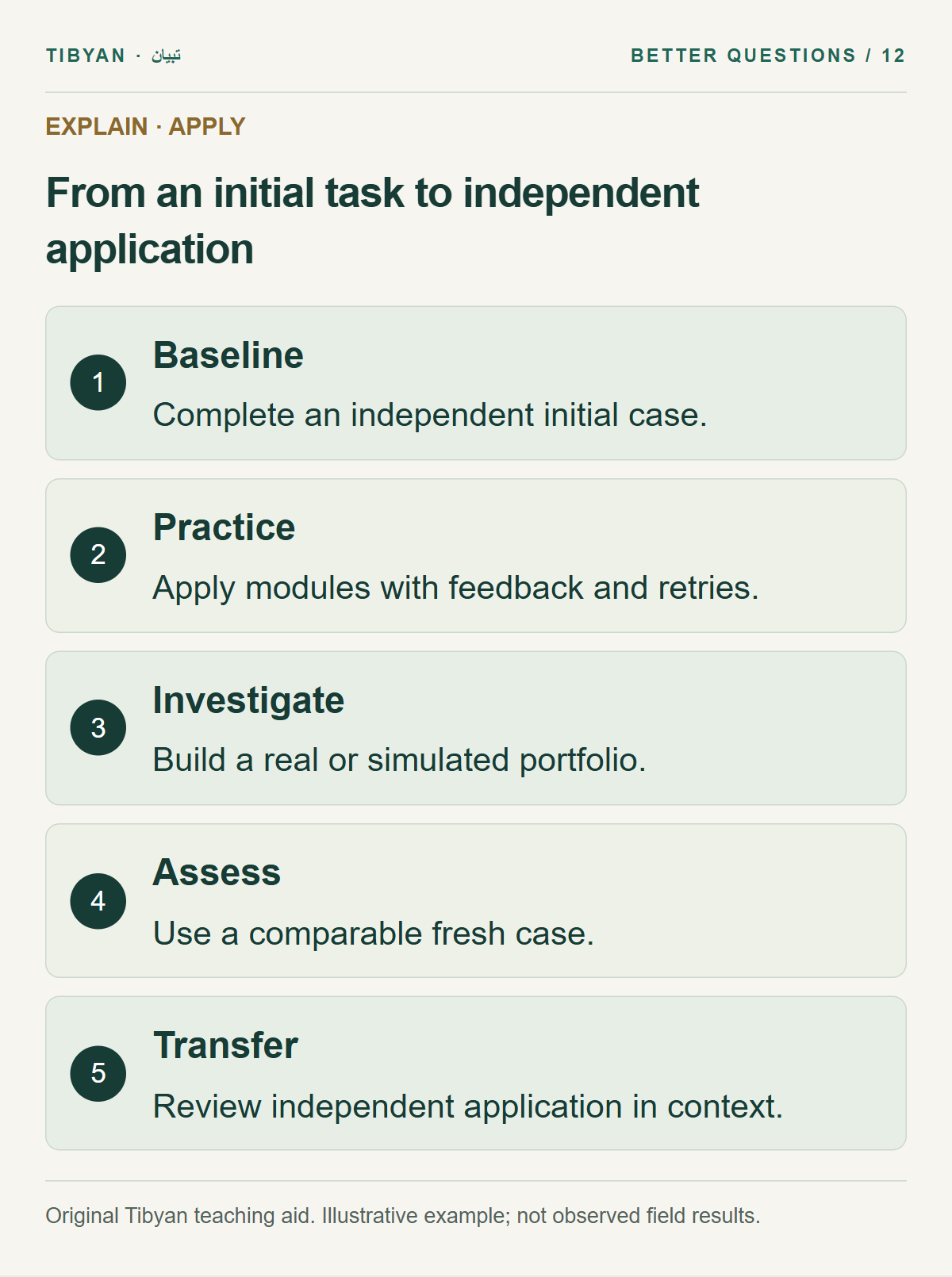
The accompanying assessment packet supplies the initial/final case records, respondent cards and complete scored calibration responses. Do the initial task before studying the pathway. Keep the assistance conditions consistent; do not reinterpret a supported rehearsal as an independent assessment.
Make practice fit the next real opportunity
An optional routine is to spend a few minutes before a relevant task naming the decision and assumption; during the conversation, record one answer-dependent follow-up; afterward, review one artifact with a partner and choose the next correction. If useful in your work, collect these at a short weekly review. This is a suggested routine, not a proven frequency.
Record the task, whether help was used, what the learner actually did, what support remained and the next decision. If no suitable application opportunity occurred, record “no opportunity observed,” not failed transfer. Satisfaction and downloads concern engagement; a scored case concerns demonstrated learning; an independently observed work task concerns application. Commercial impact requires a separate evaluation.
Five-dimension assessment rubric
| Dimension | 0 · absent | 1 · partial | 2 · clear and justified |
|---|---|---|---|
| Framing | No clear decision or an unsupported premise. | Decision named; scope or alternatives unclear. | Specific decision, constraints and revisable assumptions. |
| Question relevance and sequence | Questions do not serve the task. | Relevant questions with limited adaptation. | Clear sequence changes with new information. |
| Responsive listening | Ignores answers or imposes an interpretation. | Some probing; limited checking. | Uses details, summarizes accurately and invites correction. |
| Evidence judgment | Treats assertions as facts. | Some checking; weak limits or alternatives. | Checks support, distinguishes claim types and records uncertainty. |
| Action and reflection | No justified next action. | Action proposed; ownership or review incomplete. | Proportionate action, owner, support and review trigger. |
Your reusable working record
Annotated completed record
Decision, owner and initial assumptions
Salma chooses the next response to proposal delay. Rana initially suspects planning and asks which course to buy; this remains an assumption.
The portfolio makes the initial premise open to challenge.
Actual questions and discarded question
Discarded: “Which course?” Revised: what happened in P41/P43; when did inputs arrive; who received ownership; how was receipt acknowledged; what could contradict this account?
The sequence opens alternatives before selecting the remedy.
Evidence records and locators
E1–E4 from module 7; F1 undelivered assignment copy; F2 missed support ambiguity; F3 three-case trial. All records are explicitly fictional.
The record can be checked without mistaking invented teaching data for a field case.
New information and revised interpretation
F1 weakens “no owner” and raises unconfirmed communication; F2 identifies a specific checking gap. Planning is not established as the sole cause.
The learner revises the explanation rather than only adding information.
Action, owner and support
Salma organizes acknowledged handoffs and an escalation route. Rana rehearses the support-coverage check with feedback and flags unresolved items before issue.
Manager support and learner practice have distinct owners.
Review date/condition and actual follow-up
At case 3, F3 shows all unresolved assumptions marked; two cases timely, one late after changed scope. Reopen immediately if a commitment is misread.
The fictional follow-up includes an exception and a review condition.
Assistance and independent demonstration
F2 was supported practice. Rana’s next independent coverage check remains to be observed; no independent proficiency score is inferred from the trial.
The portfolio leaves an unobserved outcome unclaimed.
Five-dimension profile and feedback
Profile status: not rated. No standardized independent learner response and live interaction are supplied for this fictional portfolio. The five judgments remain unassigned; the scored calibration packet is a separate practice asset.
The example is not a pre-awarded score or a certification.
Learning, application and impact limits
F3 is fictional simulation data; the combined change cannot identify which element mattered. No real transfer or business impact is claimed.
This protects the difference between demonstration, observation and effect.
Next practice opportunity and review partner
Rana will record one answer-dependent follow-up in the next suitable approval discussion and review it with Dina. If no opportunity occurs, record that and choose another suitable task.
The plan specifies an opportunity rather than promising a universal schedule.
Practice and retry
Complete a portfolio from the supplied simulation or a permitted real task. Label the evidence type. Add the question that changed your interpretation, a discarded question, the exact next action and an observation/review condition. Complete the final assessment separately under the same assistance conditions as the initial task.
Common error and corrective feedback
Common errors: a polished hindsight story with no initial view; treating a plan as an observed action; scoring supported practice as independent skill; using a pre/post difference to claim that the course caused business impact.
Independent-study alternative
Use the fictional exhibits and assessor cards in self-study order: attempt, record your answer, reveal new information, revise, then compare with calibration. Self-scoring is formative reflection; it is not an independent rater judgment or proof of transfer.
Check your work
- The portfolio shows a specific decision.
- Questions respond to evidence and answers.
- Claims and uncertainties are distinguished.
- The action has an owner and review trigger.
Apply and review
Sources and further reading
- World Health Organization (2019). Guidance for after action review
- Donoghue & Hattie (2021). A Meta-Analysis of Ten Learning Techniques
- HM Treasury. The Magenta Book: Test and Learn
Initial and final independent tasks
Learner instructions — same for both forms
Use only the supplied packet, ordinary writing tools and the live respondent. No AI, outside research, colleague advice or worked answer during the independent assessment. A reasonable accessibility accommodation may be agreed in advance; record it and keep the assistance conditions comparable across attempts.
20-minute task: minutes 0–12: name the decision and constraints; separate observations from assumptions; write five questions in a useful sequence; compare at least two explanations and their predictions; select the next evidence and a provisional action. Minutes 12–16: conduct the scripted respondent conversation. Minutes 16–20: revise your record after the conversation, noting what changed and why. The respondent is a role-play partner, not an adviser.
Submit the initial and revised record, the question that responded to new information, source/exhibit references, the next action and owner, remaining uncertainty and a review condition. There is no required favorite solution. Do not diagnose an employee's character from a delay.
Take the initial task before reading the learning pathway. Use the other form after practice and feedback. The packets are designed to be comparable, but equivalence has not been established; pilot timing and difficulty before interpreting score differences. Report five dimensions separately. A pre/post change alone does not isolate an effect of the course.
Solo self-study variant
Without a respondent, complete and retain the written phase first. Then open the scripted new fact, record what it changes and revise without another person's help. Mark responsive listening “not observed / not assessed”; a written adaptation is not evidence of live listening. This solo variant is not directly comparable with the live initial/final administration. If both attempts use the solo variant, report only the four written dimensions and record the assistance conditions; do not invent a listening score.
Case A: complete before studying the worked examples
Form A — proposal readiness
Fictional scenario. All people, dates, documents and statements are invented for this assessment. A small service firm, Namaa, has late proposals. Operations manager Salma must choose the next response for two suitable proposals by 12 November 2026, 10:00. She can authorize up to ten extra checking minutes per proposal for this bounded exercise; no larger intervention has been approved.
Terms: a technical estimate states the planned work and assumptions. Support coverage means the hours and activities the supplier would support after installation. Receiving a document does not necessarily confirm every item in it.
A-S · Agreed working standard
Before a proposal is issued, scope and support commitments must be confirmed, or clearly marked unresolved for the authorized approver. The coordinator prepares the record; the estimator confirms technical content; Salma owns escalation if a required item cannot be confirmed.
A-T · Event record
| Case | Customer deadline | Technical estimate received | Recorded outcome |
|---|---|---|---|
| A-11 · standard service | 2 November, 15:00 | 2 November, 16:00 | Proposal late. |
| A-12 · standard service | 4 November, 15:00 | 3 November, 11:00 | Proposal on time. |
| A-13 · additional service | 6 November, 15:00 | 5 November, 11:00 | Proposal late; confirmation field blank. |
The packet contains no complete request-time or workload log. It does not establish the firm's overall lateness rate.
A-I · Two stakeholder accounts
- Coordinator Rana: “Planning helps, but some inputs are not ready when the deadline is promised. For A-13 I had the estimate before the deadline.”
- Estimator Omar: “Some requests reach me after the customer date has already been set. I cannot tell from this table which items the coordinator considered complete.”
These are attributed accounts, not verified causes.
A-M · Message fragment
An internal message on 5 November, 12:00, says: “Use the current version; the remaining questions can follow.” The excerpt does not identify the remaining questions or demonstrate who accepted responsibility for them.
A-X · What is not yet available
The full A-13 confirmation exchange is not in the written packet. A respondent playing Rana can answer questions using an assessor-only card. Do not invent timestamps or treat an empty field as proof that nobody acted.
Case B: fresh final task
Form B — onboarding handoff
Fictional scenario. All people, dates, documents and statements are invented for this assessment. A small service firm, Riwaq, has late handoffs from onboarding to installation. Operations manager Mazen must choose the next response for two suitable handoffs by 12 November 2026, 10:00. He can authorize up to ten extra checking minutes per handoff for this bounded exercise; no larger intervention has been approved.
Terms: a setup pack lists the work and conditions needed before installation. A site-access slot is the time the customer confirms the installation team can enter the location. Receiving a pack does not mean every condition has been confirmed.
B-S · Agreed working standard
Before the handoff is issued, scope and site-access commitments must be confirmed, or clearly marked unresolved for the authorized approver. The coordinator prepares the record; the site contact confirms access; Mazen owns escalation if a required item cannot be confirmed.
B-T · Event record
| Case | Installation handoff deadline | Setup pack received | Recorded outcome |
|---|---|---|---|
| B-11 · standard setup | 2 November, 15:00 | 2 November, 16:00 | Handoff late. |
| B-12 · standard setup | 4 November, 15:00 | 3 November, 11:00 | Handoff on time. |
| B-13 · additional location | 6 November, 15:00 | 5 November, 11:00 | Handoff late; confirmation field blank. |
The packet contains no complete request-time or workload log. It does not establish the firm's overall handoff-delay rate.
B-I · Two stakeholder accounts
- Coordinator Hadi: “Planning helps, but some conditions are not confirmed when the date is promised. For B-13 I had the setup pack before the deadline.”
- Site contact Leila: “Some requests reach me after the installation date has already been set. I cannot tell from this table which conditions the coordinator considered complete.”
These are attributed accounts, not verified causes.
B-M · Message fragment
An internal message on 5 November, 12:00, says: “Use the current version; the remaining questions can follow.” The excerpt does not identify the remaining questions or demonstrate who accepted responsibility for them.
B-X · What is not yet available
The full B-13 access-confirmation exchange is not in the written packet. A respondent playing Hadi can answer questions using an assessor-only card. Do not invent timestamps or treat an empty field as proof that nobody acted.
Assessment profile
| Dimension | 0 · absent | 1 · partial | 2 · clear and justified |
|---|---|---|---|
| Framing | No clear decision or an unsupported premise. | Decision named; scope or alternatives unclear. | Specific decision, constraints and revisable assumptions. |
| Question relevance and sequence | Questions do not serve the task. | Relevant questions with limited adaptation. | Clear sequence changes with new information. |
| Responsive listening | Ignores answers or imposes an interpretation. | Some probing; limited checking. | Uses details, summarizes accurately and invites correction. |
| Evidence judgment | Treats assertions as facts. | Some checking; weak limits or alternatives. | Checks support, distinguishes claim types and records uncertainty. |
| Action and reflection | No justified next action. | Action proposed; ownership or review incomplete. | Proportionate action, owner, support and review trigger. |
Original evidence-informed teaching aid. Cases and example records are hypothetical; the assessment is not a validated certification.
Workplace follow-up record
After the first suitable, permissioned application opportunity, collect one non-sensitive artifact or observe a conversation. Record task/date, assistance used, the question, the answer or evidence, the revised action, owner, support and next review. Distinguish a learner report from an independently observed artifact. If there is no opportunity, document that rather than inferring failure to transfer. Record business results separately with alternative explanations; a small usability or practice pilot does not establish causal business impact.