AI Drafts in Minutes. Why Is the Work Still Waiting?
When AI speeds up drafting, work can pile up at review. Follow the whole workflow and test one change to the queue before expanding AI use.

At 10 a.m., a service team has drafted all its replies. By 4 p.m., seven still sit in the reviewer’s queue. The team’s supervisor has two suggestions on the table. Buy more AI licenses or set aside time for a second reviewer. Which change would get an accepted reply to the customer sooner?
In this hypothetical team, drafting is one step in a shared process. Follow a request all the way to an approved response before changing the capacity of any one step.
See where the time goes
Start the clock when the team accepts an eligible request. Stop it when the response meets the existing acceptance standard and is approved to send. For a sample of comparable requests, log when drafting begins, when the first version reaches review, when it comes back for corrections and when it is approved. Count the open requests at the end of the observation period, too. Measuring only completed requests hides work that is still waiting.
A March 2026 DORA analysis of open-ended responses from Google software engineers described a related trade-off. Faster initial code generation could shift effort into auditing and verification. The study concerned software development. For a service manager, it suggests a question worth testing locally. Has AI saved time across the workflow, or has some of that time moved to review? DORA, “Balancing AI Tensions”
Look inside the review queue
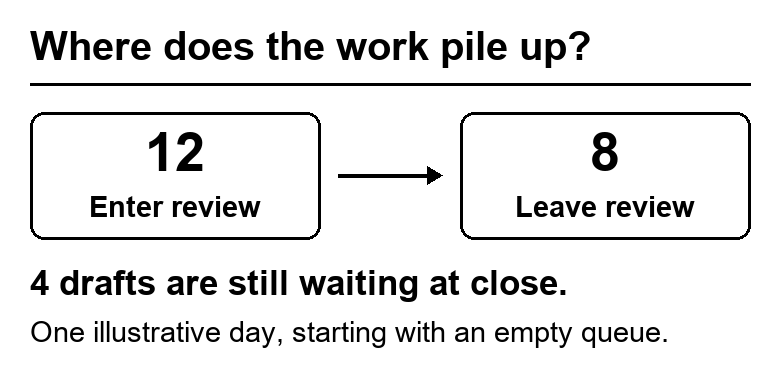
In one illustrative day, 12 drafts enter review and eight leave it. Four remain in the review queue at close if it started empty and there were no other exits. The four still waiting at close matter as much as the eight the reviewer cleared. It will take more than one day to tell whether the pattern persists.
 Open the diagram full size ↗
This hypothetical day shows how unfinished work can accumulate after drafting.
- Drafts arrive in a burst. If most arrive together and the reviewer clears them later, stagger when the team sends work for review. Ask authors to finish the oldest in-progress response before starting another.
- The same corrections keep coming back. If reviewers repeatedly have to verify the same facts, ask authors to attach the approved source and flag anything they could not verify before submitting.
- Ready drafts exceed review capacity over several comparable days. If a standing backlog grows even after the team improves the handoff, consider protected review time or an additional qualified reviewer.
The response depends on what is clogging the queue. A second reviewer may help if demand consistently exceeds capacity. The Agile practice of working in small batches is useful when bursts cause the wait. It gives the reviewer fewer drafts to handle at once and lets authors use feedback on their next replies. If missing evidence drives the delays, the second reviewer inherits the same problem.
Test one change at a time
Suppose the team finds repeated returns for missing source information. For a short trial, keep the same review standard and add a single requirement at handoff. Ask authors to include the source of each material claim.
Compare like with like. Use the same request types and similar staffing windows. Track elapsed time from accepted request to approved response, the number still waiting at the end of the day and the share accepted on first review. Count critical defects separately. Give requests near the end of the trial the same follow-up time as earlier ones before comparing completed cases. If the task mix or staffing changes substantially, record it and treat the comparison as provisional.
Return to the seven replies waiting at 4 p.m. Ask the reviewer to show where those requests spent their time. If those requests are waiting for review, another license would add drafting capacity at the wrong step. Choose the first change that addresses the observed delay. Use Tibyan’s small-experiment worksheet to record the hypothesis, measures and next decision.
Sources
Continue exploring

Practical perspective
How to Prepare a Professional B2B Sales Quotation: Beyond Price
Prepare a B2B quotation that procurement, finance, and operations can assess. Use Tibyan’s QUOTE Framework, an annotated example, and a 13-point checklist.
Read perspective
Talent Development
When Should You Retire a Training Course?
Check whether the task still matters, how people learn it and what gets in their way before you keep, redesign or retire a course.
Read perspective
Team development
Why Did the Customer Have to Explain It Three Times?
Follow one customer case across teams and find which handoff lost the facts, ownership or promise.
Read perspective