Tibyan Toolkit 11
Review application after 30 days
Use a work sample to discuss what changed and what support comes next.
PDF · 8 pages · 114 KB · Version 1
Download English PDFCheck whether the task still matters, how people learn it and what gets in their way before you keep, redesign or retire a course.

In a hypothetical distribution business, warehouse staff keep attending a course on how to record goods-receipt discrepancies. The course gets good feedback, but the operations manager still finds incomplete records. At the annual review, the team has to decide whether to keep the course, change it or free the time for something else.
Start with the record staff are expected to complete today. If the task has changed, an excellent course on the old workflow has limited value. If the task still matters, find out whether people can perform it and what happens when they try on shift.
The CDC’s Quality Training Standards call for checking the need for training, evaluating it and providing follow-up support. They also recommend setting a date to review, update or retire the course as needed. A meta-analysis by Hughes and colleagues found positive relationships between support from peers, supervisors and the organization and training transfer. The portfolio decisions below are Tibyan’s practical application. CDC Quality Training Standards · Hughes et al., 2020
Experienced warehouse staff can complete the record in practice. On shift, a field appears only after staff switch screens. First check whether practice uses the same screens and steps as live work. If it does, observe whether missed fields cluster on busy shifts or when access is interrupted. If the screens differ, test the updated practice. If new starters still struggle on a representative task, find out which step they need to learn. More than one cause can be present.
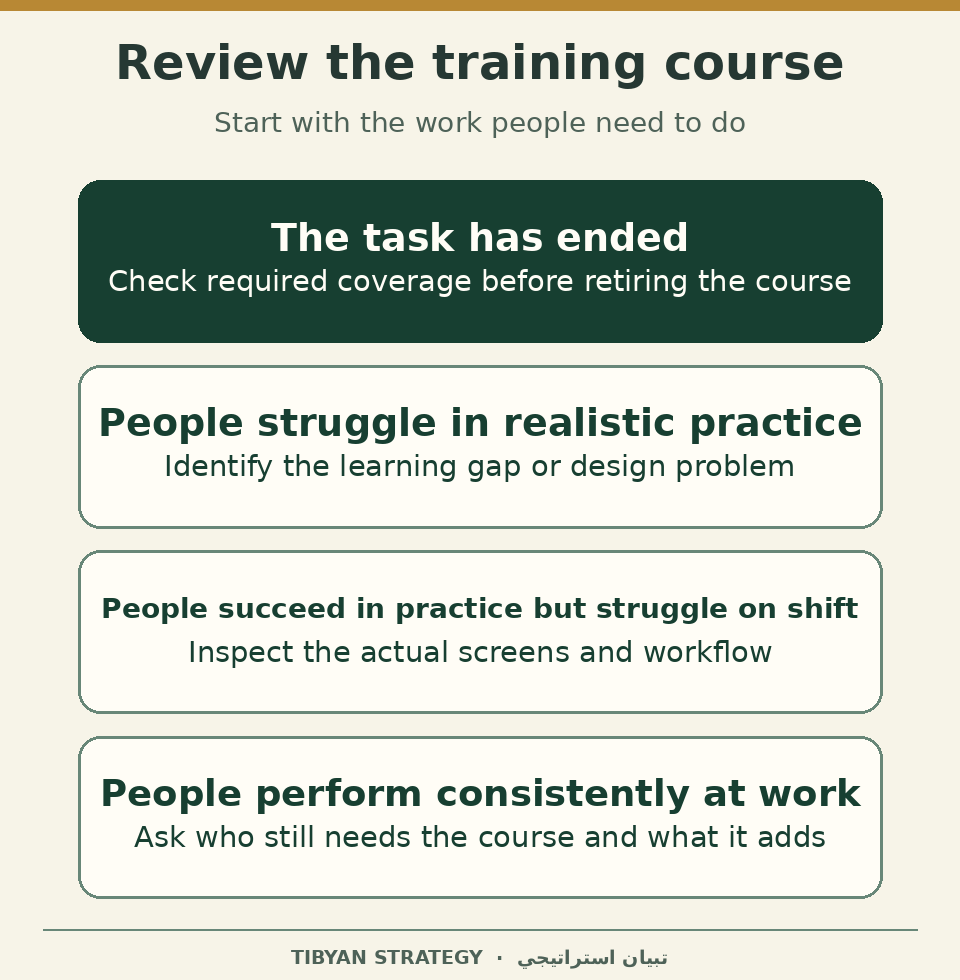
Use the same questions to decide what happens next. If the task has ended, check required coverage before retiring the course. If people struggle in realistic practice, identify the learning gap or design problem. If they can perform in practice but miss steps on shift, inspect the workflow. If they perform consistently at work, ask who still needs the course and what it adds for them.
 Open the diagram full size ↗
Check what the course contributes before deciding to keep, redesign, replace, or retire it.
| Decision | Evidence to look for |
|---|---|
| Keep | A defined group still needs the skill, and representative work or practice shows what the current course contributes. For example, check what new starters can do before and after the course, or compare with a group that uses a simpler form of preparation. |
| Redesign | The learning need remains and the course is the right format, but its practice or assessment misses a specific step or condition. |
| Replace | A verified shorter exercise, job aid or workflow change can meet the same need. Check it with the people who will rely on it, including new starters. |
| Retire | The task or learning need has ended, or equivalent coverage is already verified elsewhere. Check mandatory requirements and assign ongoing ownership before withdrawing the course. |
Choose one course. Collect recent work samples from the roles and shifts involved, including new starters where relevant. Record who needs to learn the task, what the course adds and what alternative coverage exists. Use an existing before-and-after comparison or a small trial of a simpler option if the evidence is thin. If you replace or retire the course, agree who owns any remaining requirement and set a date to review outcomes for the next group.
Use Tibyan’s 30-day application review to collect one part of the evidence. For a worked follow-up routine, see A 30-Day Training Application Review.
Take the next step
Free downloads. No registration. Each PDF includes instructions, an illustrative example and a reusable worksheet.
Tibyan Toolkit 11
Use a work sample to discuss what changed and what support comes next.
PDF · 8 pages · 114 KB · Version 1
Download English PDFPractical worksheets, not validated assessments. Adapt the task and timing to your context. See each PDF for its revision date.
Explore the tools & toolkits library ↗
Practical perspective
Prepare a B2B quotation that procurement, finance, and operations can assess. Use Tibyan’s QUOTE Framework, an annotated example, and a 13-point checklist.
Read perspective
Team development
Follow one customer case across teams and find which handoff lost the facts, ownership or promise.
Read perspective
Team development
Give a concern a fair hearing, choose the right response route and follow up with the person who raised it within the limits of that process.
Read perspective