Your Team Shipped More. Did the Service Improve?
Measure what users can do after a release and agree what result would change your Agile team’s next priority.

At the end of the month, an onboarding team reports six improvements to its self-service portal. The service manager asks how many new users finished onboarding without contacting support. Nobody has the number. Should the team build the seven changes already planned, or use the next cycle to find out where users get stuck?
Measure what users can do after a release
For this hypothetical team, a new reminder is a delivery output. The outcome the manager cares about is whether new users can finish onboarding without contacting support. Track completion alongside support contacts. A quieter support queue could mean users found the process easier. It could also mean more people gave up.
Scrum.org’s Evidence-Based Management guide recommends defining the outcome you want, testing a hypothesis and using the results to decide what to do next. PMI’s Agile Practice Guide also covers outcome and flow measures. The onboarding team can use delivery measures to track its work and a user outcome to decide where that work should go next. Scrum.org Evidence-Based Management Guide · PMI Agile Practice Guide
Compare the same outcome before and after the change
Count every eligible new user who starts onboarding in the chosen week, once. Then count how many complete the required steps within seven days of starting and make no onboarding-related support contact in those same seven days. Give every starter the full seven days and use the same eligibility rules before and after the change.
Suppose the team tests clearer instructions at the identity-verification step after observing users hesitate there. Before the test, 60 of 100 starters finish without help under the agreed definition. After the change, 70 of 100 do. That’s an increase from 60% to 70%, or 10 percentage points. Before drawing a conclusion, check whether users came through similar channels, faced the same requirements and were equally easy to identify in support records. The figures are illustrative. Other changes could also explain a difference between the two weeks.
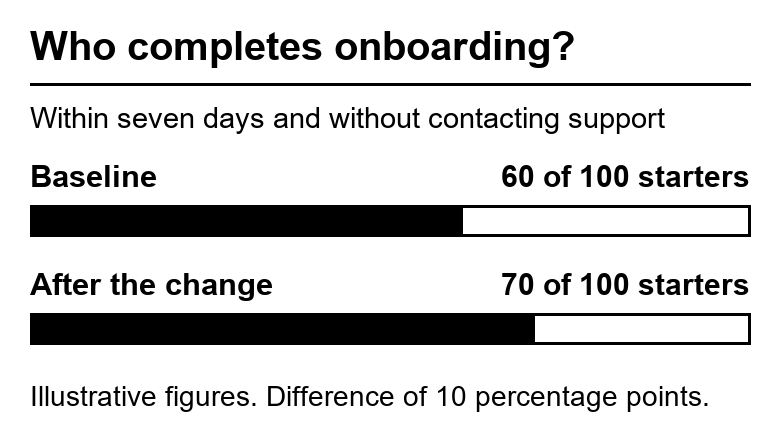 Open the diagram full size ↗
Both rates use the same definition and seven-day observation window.
Check for two other changes. Did overall completion fall? Did more users finish with a setup error that staff had to fix? These measures help the team see whether a higher rate of independent completion came with a cost elsewhere in the process.
Agree what would change the next cycle
Before testing the instructions, the team agrees how much improvement would justify keeping them, how much evidence it needs, and what level of setup errors would trigger a pause. Set those thresholds with ordinary week-to-week variation and the value of the improvement in mind.
At the next review, put the evidence beside the seven planned changes. If the improvement meets the agreed threshold across comparable groups and setup errors stay within the limit, keep the clearer instructions and continue monitoring. If users still stop at identity verification, observe a few people who have agreed to take part and use what happens to plan the next test.
Try this at your next review. Pick one item marked “shipped.” Write down what users should be able to do because of it, who counts in the measure, and what result would change the order of the backlog. Tibyan’s small-experiment worksheet
Sources
Continue exploring

Practical perspective
How to Prepare a Professional B2B Sales Quotation: Beyond Price
Prepare a B2B quotation that procurement, finance, and operations can assess. Use Tibyan’s QUOTE Framework, an annotated example, and a 13-point checklist.
Read perspective
Talent Development
When Should You Retire a Training Course?
Check whether the task still matters, how people learn it and what gets in their way before you keep, redesign or retire a course.
Read perspective
Team development
Why Did the Customer Have to Explain It Three Times?
Follow one customer case across teams and find which handoff lost the facts, ownership or promise.
Read perspective