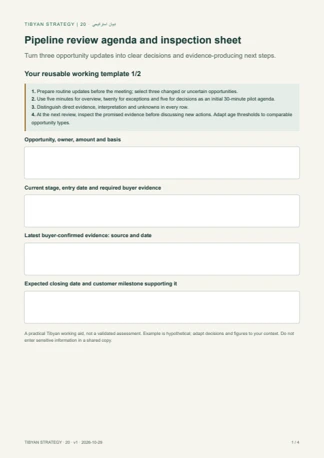
Tibyan Toolkit 20
Pipeline review agenda and inspection sheet
Turn three opportunity updates into clear decisions and evidence-producing next steps.
PDF · 4 pages · 66 KB · Version 1
Download English PDF Open editable working template ↗Use buyer evidence to distinguish a rational deferral, an unresolved decision, a confirmed outcome, and an unknown one.

“Positive demo, awaiting internal discussion.” The same note sits beside three opportunities in your pipeline. One buyer has agreed to test its own workaround. A second has two teams that disagree about what evidence would justify a decision. A third cannot staff an implementation. The note alone gives you little basis for forecasting a purchase.
Use two entries when a deal stalls. One records what you know about the buyer’s decision. The other records what the seller will do with the opportunity and the forecast. A seller can remove an opportunity from the committed forecast while the buyer’s outcome is still unknown.
In a fictional Saudi distributor, finance and operations agree to test a required-field checklist before buying order-management software. Operations owns a six-week review of rework and release errors. There is a clear next decision for the distributor. The seller can pause the software pursuit and return at the buyer’s agreed review, outside the current committed forecast.
Research offers several reasons to investigate the situation. Samuelson and Zeckhauser found that how a status quo option was framed affected choices in experimental tasks. Their field examples concerned individual insurance and retirement decisions. In organizational buying, Wind and Webster describe how multiple participants and constraints shape decisions. Bygballe’s study of a single supplier switch traces how changes to routines affected implementation and how part of the old relationship continued. Use these as reasons to check alternative explanations. Establish the cause in a particular opportunity from buyer evidence. Status quo study · Organizational buying framework · Supplier-switching case
Sami reaches for the “Committed” stamp. Rana slides the buyer’s last email under it and asks, “Which line are we stamping?” Record what the buyer actually agreed to before updating the forecast.
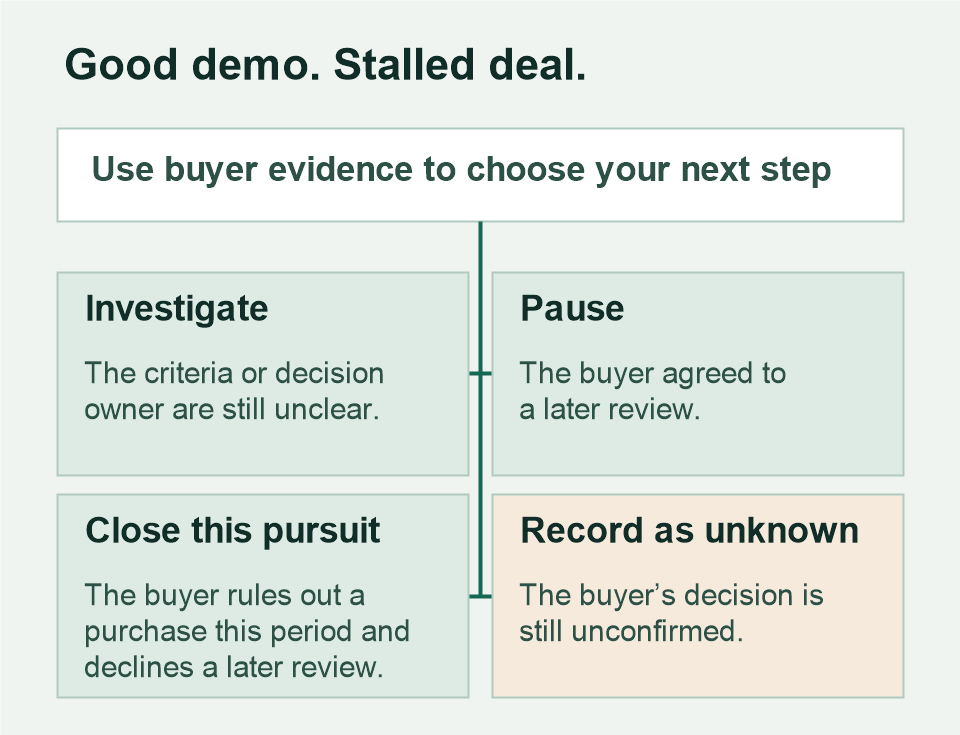
Start from the buyer’s last confirmed decision or commitment. “Waiting for finance” might mean that finance has the evidence and needs time, or that the team has yet to agree what evidence would be enough. Ask which of those is closer to the situation, and who owns the decision. If a technical review is pending, check whether it has an owner and a slot, or whether the buyer has confirmed a lack of capacity for this planning period.
 Open the diagram full size ↗
Update your action when the evidence changes. Record what the buyer confirmed separately from the seller’s forecast.
| Evidence from the buyer | Buyer status | Seller action and forecast |
|---|---|---|
| Finance and operations agree to test the checklist. Operations will review rework and release errors in six weeks. | Purchase deferred pending the test. | Pause outside committed forecast. Return at the review the buyer agreed to. |
| Finance wants cash evidence and operations wants higher throughput. The buyer has yet to name a decision owner or agree what would resolve the difference. | Decision criteria unresolved. | Investigate if invited, outside committed forecast. Ask who can own an agreed test. |
| IT confirms it lacks capacity during this planning period. The buyer confirms there will be no purchase in that period and declines a revisit. | No purchase confirmed for the period. | Close the current pursuit and record the constraint. Save the agreed revisit condition if there is one. |
| A follow-up has gone unanswered. | Outcome unknown. | Reassess forecast confidence based on the missing milestone. Record what is verified and respect the buyer’s contact preferences. |
If the buyer confirms they selected another vendor, record a competitive loss. A decision to keep the current workflow, an agreed deferral and an unknown outcome are each useful to record on their own terms. If your team later estimates a no-decision rate, define which of these outcomes it counts, who was eligible for the count and the period observed.
Choose a stalled entry. Before looking for new evidence, write two plausible causes and one record or answer that would distinguish them. Then rewrite the entry using the fields below. A reviewer should be able to see which part comes from the buyer and why the forecast changes.
| Buyer statement and source | Competing explanations | Evidence to check | Buyer status | Forecast action and reason | Return condition and owner |
|---|---|---|---|---|---|
| The operations lead reports a checklist trial and a six-week review. | Deliberate deferral, or an unresolved approval problem. | Confirm the review owner, measures and decision with the buyer. | Purchase deferred. | Pause outside committed forecast while the buyer runs the trial. | Operations owns the scheduled review. Return when invited under that agreement. |
Try the decision with less information. Replace the buyer statement with an unanswered follow-up. The opportunity may still come out of the committed forecast if evidence of a buyer-owned next step is missing. The buyer status becomes unknown. Review the two entries together and tie any claim of a confirmed decline to the buyer’s actual statement.
Use the inspection sheet to record the evidence and revise the pipeline decision with your team. Pipeline review agenda and inspection sheet
Take the next step
Free downloads. No registration. Each PDF includes instructions, an illustrative example and a reusable worksheet.
Tibyan Toolkit 20
Turn three opportunity updates into clear decisions and evidence-producing next steps.
PDF · 4 pages · 66 KB · Version 1
Download English PDF Open editable working template ↗Practical worksheets, not validated assessments. Adapt the task and timing to your context. See each PDF for its revision date.
Explore the tools & toolkits library ↗
Practical perspective
Prepare a B2B quotation that procurement, finance, and operations can assess. Use Tibyan’s QUOTE Framework, an annotated example, and a 13-point checklist.
Read perspective
Talent Development
Check whether the task still matters, how people learn it and what gets in their way before you keep, redesign or retire a course.
Read perspective
Team development
Follow one customer case across teams and find which handoff lost the facts, ownership or promise.
Read perspective