Tibyan Toolkit 02
Skill gap or work barrier?
Use a short conversation to choose the next useful action.
PDF · 8 pages · 114 KB · Version 1
Download English PDFUse four practical prompts to explore a performance gap, distinguish learning needs from workplace barriers, and agree a small next action.
A manager asks for a communication workshop because handovers keep coming back incomplete. The request is understandable. Before designing the workshop, hold a short conversation about the work itself.
Use a focused discussion to distinguish a possible learning need from a condition that makes good performance difficult, then agree a small action to test.
CIPD connects learning-needs identification with the capabilities an organization needs and the skills already available. That is a useful starting point: ask what the team needs to do, rather than which course it wants to buy. CIPD: Learning needs analysis.
CDC's needs-assessment guidance, developed for public-health training, asks developers to examine the gap before deciding whether training fits. Its discussion includes people and system factors. Applying that principle to a business team is an adaptation, not evidence that a particular business intervention will succeed. CDC: Assess training needs.
The following conversation is Tibyan's practical suggestion. It is not a validated diagnostic test, and the timing can be adapted to your setting.
| Prompt | Ask the manager and a person doing the work |
|---|---|
| Clarify the task | What should a complete handover contain, and who uses it next? |
| Inspect a sample | Can we look at one recent handover with identifying information removed? What is missing? |
| Explore the conditions | Can the person demonstrate the task? Are expectations, access, time or feedback getting in the way? |
| Choose a small test | What change will we try, who owns it, and when will we review a new work sample? |
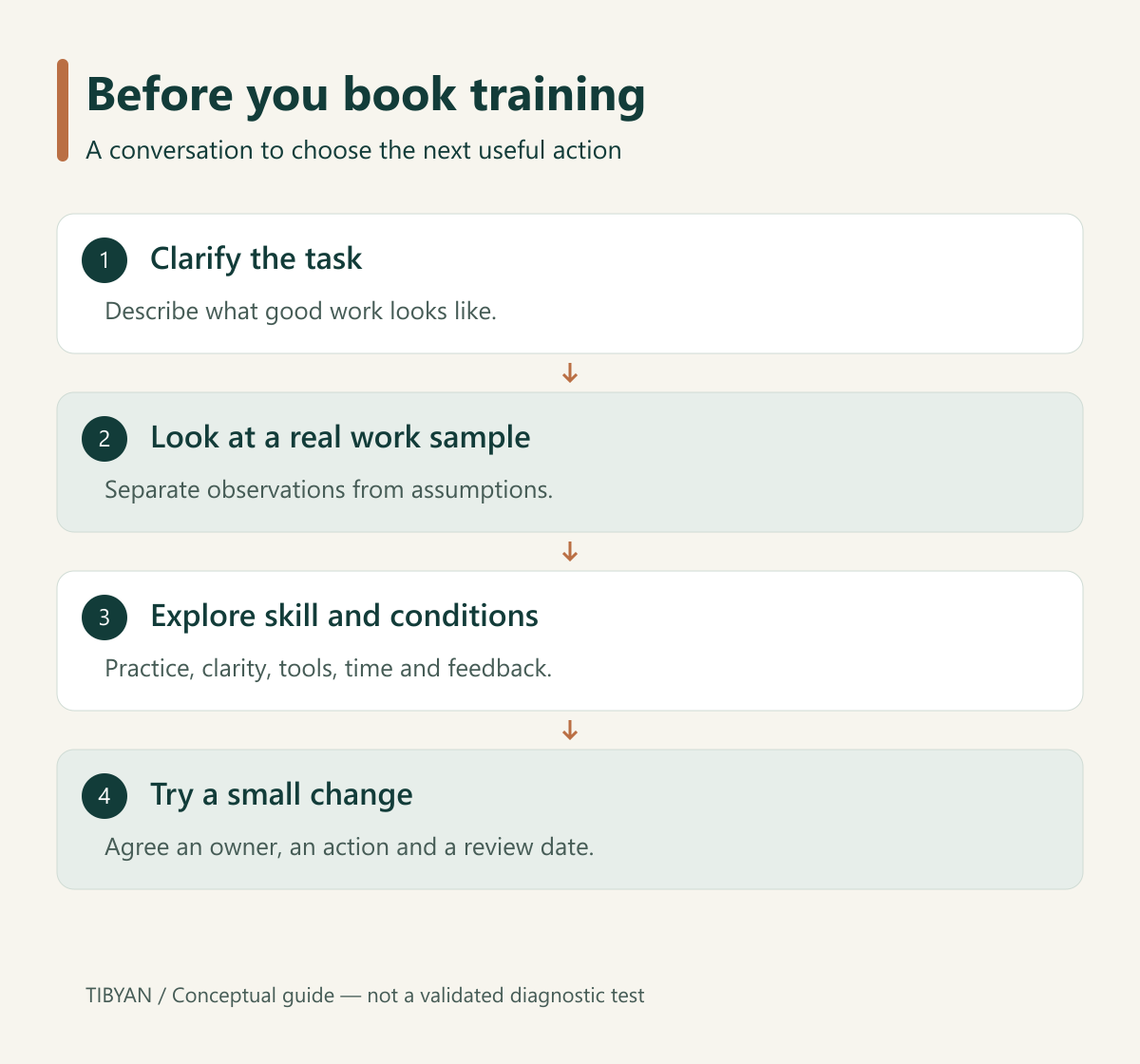 Open the diagram full size ↗
Conceptual illustration: a conversation structure proposed by Tibyan, not a measured model of training effectiveness.
Imagine an Arabic-speaking customer-support team in a regional services company. Its manager reports that new colleagues write inconsistent handovers. This is a hypothetical situation, not a Tibyan client case.
The team reviews a de-identified sample and finds that different supervisors expect different fields. A newcomer also struggles to summarize the next action. These observations suggest two questions to investigate: does the team need a shared standard, and does the newcomer need practice using it?
Tibyan's suggested next step is to agree a short handover template and let the newcomer practise with a realistic scenario and feedback. The manager then checks a small, agreed set of subsequent handovers. Avoid declaring the issue solved because a workshop was delivered or participants enjoyed it.
US Office of Personnel Management guidance explains that some performance gaps need management responses, such as clearer expectations and a supportive work environment, alongside learning. This is federal workforce guidance, not a local regulatory requirement for Arab-region organizations. OPM: Planning and evaluating training.
If someone needs to learn a task, define an observable outcome and design relevant practice. If the obstacle concerns tools, permissions or competing expectations, agree who can change that condition. Where both occur, combine the responses and review what people can actually apply.
Download the English “Skill gap or work barrier?” worksheet and use it to record the task, observations and next action. Adapt it to your team; it is a working aid, not a standardized assessment.
For a wider development discussion, explore a consultation with Tibyan.
Sources checked on 25 October 2026. This draft adapts institutional guidance into an original practical example; it reports no measured client outcomes.
Take the next step
Free downloads. No registration. Each PDF includes instructions, an illustrative example and a reusable worksheet.
Tibyan Toolkit 02
Use a short conversation to choose the next useful action.
PDF · 8 pages · 114 KB · Version 1
Download English PDFPractical worksheets, not validated assessments. Adapt the task and timing to your context. See each PDF for its revision date.
Explore the tools & toolkits library ↗
Practical perspective
Prepare a B2B quotation that procurement, finance, and operations can assess. Use Tibyan’s QUOTE Framework, an annotated example, and a 13-point checklist.
Read perspective
Talent Development
Check whether the task still matters, how people learn it and what gets in their way before you keep, redesign or retire a course.
Read perspective
Team development
Follow one customer case across teams and find which handoff lost the facts, ownership or promise.
Read perspective