Hybrid Agile: What to Fix and What to Revisit
When the launch date is fixed, which decisions can still change? Use Hybrid Agile to make commitments explicit and act on evidence before launch.

Three weeks before a customer service portal goes live, an agent tries the new intake form. She enters the details from a test request, stops at a required field and asks, “Where am I supposed to get that information?” In this hypothetical rollout, the launch date is already on the calendar. By the end of the day, the team has to decide what it can revise and which changes need the sponsor’s approval.
The launch date and the form answer different questions. One is a commitment the sponsor has made. The other is a design choice that staff have just put to the test. Hybrid Agile gives the team a way to honor the commitment and act on what it learns.
Put commitments and choices on the same page
Hybrid delivery combines deliberate upfront planning with short cycles of testing and revision. PMI and Agile Alliance’s July 2026 Agile Practice Guide describes predictive, adaptive and hybrid life cycles and encourages managers to choose an approach that fits the work. A practical place to start is with the decisions your team actually faces. PMI Agile Practice Guide
- Record the commitments. For the portal, the sponsor has set the launch date and a minimum set of acceptance criteria. The existing assistance channel also has to stay available during the transition.
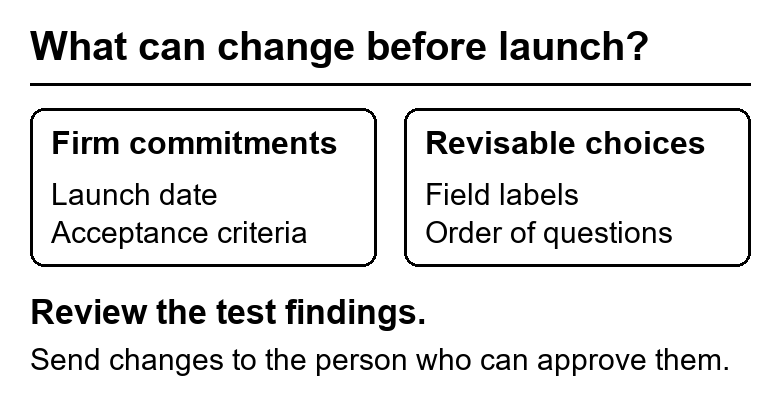
- Name the choices the team can revisit. The team can test the field labels, the order of questions and whether some information can be collected later. Write down how far that authority extends.
- Name who decides. The service lead can approve wording changes. A proposal to change which records are collected or who can access them goes to the designated data owner. Any change that affects launch readiness goes to the sponsor with the evidence and available options.
If the team needs permission to change a label, it needs a faster decision path. If it wants to remove information that downstream staff rely on, it needs to involve those staff.
 Open the diagram full size ↗
The portal example shows how a team can revise the form within the commitments it has made.
Give reviewers a task they can attempt
At the next checkpoint, ask service agents to enter representative test cases in a safe environment. Observe where they pause, which source they consult and what they have to ask a colleague. Then have the receiving team try to route the same cases using the information the form captured. This gives both teams something specific to discuss.
The same approach applies to training for the rollout. Megan Torrance describes using early releases and feedback to improve successive versions of learning materials. A rollout team can give agents one draft job aid and watch them use it on an unfamiliar test case. That exercise can reveal a missing instruction while the team still has time to revise it. Megan Torrance, Agile for Instructional Designers
Set the rule before you see the result
In the hypothetical rollout, the service lead discovers that routing depends on the customer’s reference number, but agents cannot always see it at intake. The team can try collecting the number later, provided the request can still reach the right queue and the receiving team can retrieve the number before acting. If the revised form leaves that team unable to route the request reliably, the sponsor can consider a narrower launch under the agreed readiness criteria.
Bring one upcoming milestone to your next team meeting. Write down one firm commitment, one choice the team can still revise, and one observation that would justify revising it. Add the decision owner and review date. If the team can answer those questions before the next test, it can act when evidence arrives. Use Tibyan’s small-experiment worksheet to plan the test.
Sources
Continue exploring

Practical perspective
How to Prepare a Professional B2B Sales Quotation: Beyond Price
Prepare a B2B quotation that procurement, finance, and operations can assess. Use Tibyan’s QUOTE Framework, an annotated example, and a 13-point checklist.
Read perspective
Talent Development
When Should You Retire a Training Course?
Check whether the task still matters, how people learn it and what gets in their way before you keep, redesign or retire a course.
Read perspective
Team development
Why Did the Customer Have to Explain It Three Times?
Follow one customer case across teams and find which handoff lost the facts, ownership or promise.
Read perspective