Tibyan Toolkit 02
Skill gap or work barrier?
Use a short conversation to choose the next useful action.
PDF · 8 pages · 114 KB · Version 1
Download English PDFCompare competing explanations for a sales-performance gap, test what remains uncertain, and agree an owned response using a worked diagnostic record.

A proposal returns from delivery with a familiar question: who will prepare the customer’s data? The sales manager sees incomplete discovery. The seller sees an unanswered request to a specialist. The learning designer receives a request for a questioning-skills workshop. Each explanation suggests a different intervention, and the proposal alone cannot tell the team which one is right.
The analysis stage of Instructional Systems Design (ISD) should make that choice better informed. Your working output is a diagnostic record linking an observed gap to competing explanations, the next evidence to collect, and an action owner. Use it jointly: sales leaders bring commercial priorities and operating authority; learning and enablement professionals investigate the task and the capability it requires.
Bring a recent proposal and its earlier versions, relevant customer correspondence, the requirements standard, and access to the people involved. Start with one consequential task. A diagnosis of the entire sales organization is usually too broad for this conversation.
Hypothetical teaching case: a regional B2B services company sells implementation projects across several customer sites. Some proposals omit verified requirements and implementation dependencies. The company, evidence examples, and proposed actions in this guide are fictional. They illustrate a method; they do not report a client investigation or measured results.
The team’s first problem statement is “discovery is weak.” Replace it with something inspectable: “The proposal does not identify who owns data preparation or state how that responsibility will be confirmed before scope is agreed.”
Check whether that information should have been available at the proposal stage. A customer may legitimately be unable to name the owner yet. The expected behavior could therefore be to record the uncertainty and agree a verification step. Requiring an invented answer would reward the wrong behavior.
CDC’s training standards advise validating the need for training before development. This is public-health training guidance; our sales diagnostic is a practical adaptation, not a regional requirement or validated sales assessment. CDC: Quality Training Standards.
Define which work you are examining: a service type, customer segment, proposal stage, and observation period. Keep first proposals distinct from later revisions. Otherwise, a more complex project or a routine customer change can look like a seller’s avoidable omission.
If you calculate an omission rate, specify the denominator: proposals that should contain the relevant requirement and have sufficient records to review. Report missing records separately. “Not documented” does not automatically mean “not discussed,” although documentation may itself be required work.
Start with a manageable sample that includes clearer and problematic examples. Explain how you selected it. A convenient pair can help generate questions; it cannot establish how common the problem is across the team.
Sales operations should check comparability and record availability. The manager confirms the relevant standard. The designer checks whether that standard describes a behavior learners can observe and practise.
CIPD describes needs analysis as connecting capability with organizational priorities and using methods including records, interviews, and observation. It recommends considering suitable responses rather than assuming a course. The four-view structure below is Tibyan’s way of applying that guidance. CIPD: Learning needs analysis.
| Evidence view | What to inspect | What remains uncertain |
|---|---|---|
| Commercial pattern | Revision reasons, stage history, project complexity | A pattern does not explain its cause |
| Actual behavior | Discovery notes, proposal versions, permitted observations | Records can omit parts of the interaction |
| Participant account | Seller, manager, and delivery explanations | Memory and interpretation need checking |
| Working conditions | Access, approval rules, information, response routes | A written process may differ from actual use |
Use only material you are permitted to inspect and share. Remove customer identifiers before group practice. Tell participants what the review will inform, and distinguish a development conversation from a formal performance decision.
When sources disagree, preserve the disagreement. The seller may remember requesting an answer that the shared record does not show. That supports a further check of the request route; it does not establish that either person is unreliable.
Ask the seller to walk through the sequence surrounding the proposal. Which customer statement raised the data issue? What was known at that moment? Which options were available? What happened after the seller requested specialist help?
The designer looks for decisions and cues. The manager checks authority and expectations: was the seller told to issue a proposal before dependencies were resolved? Delivery checks what question it received and whether it could reasonably answer it.
Keep observation separate from inference. “The summary contains no verification owner” is an observation. “The seller does not care about delivery” is an interpretation requiring substantially more evidence.
Moore’s diagnostic approach considers alternatives such as reference aids, workflow improvements, and training. We use that distinction to keep several responses open while investigating this sales task. Cathy Moore: Is training really the answer?.
Tibyan recommends writing down competing explanations before commissioning content. Ask what would weaken each one, as well as what appears to support it.
| Possible explanation | Evidence that could support it | Evidence that would challenge it |
|---|---|---|
| Seller cannot recognize a dependency | Misses a material dependency in a realistic task with adequate information | Identifies it and explains a suitable verification step |
| Required information is unavailable | Request remains unanswered or customer ownership is unresolved | Information was accessible through a usable route |
| Proposal expectations conflict | Instructions reward rapid issue while requiring unresolved details to be treated as final | Manager and workflow allow explicit provisional scope |
| Ownership is unclear | Sales and delivery assign the same verification task to each other | A shared owner exists and follows through |
Several explanations may apply together. A seller can need practice in recognizing dependencies while also facing a slow specialist response. Resolve each finding through its appropriate owner.
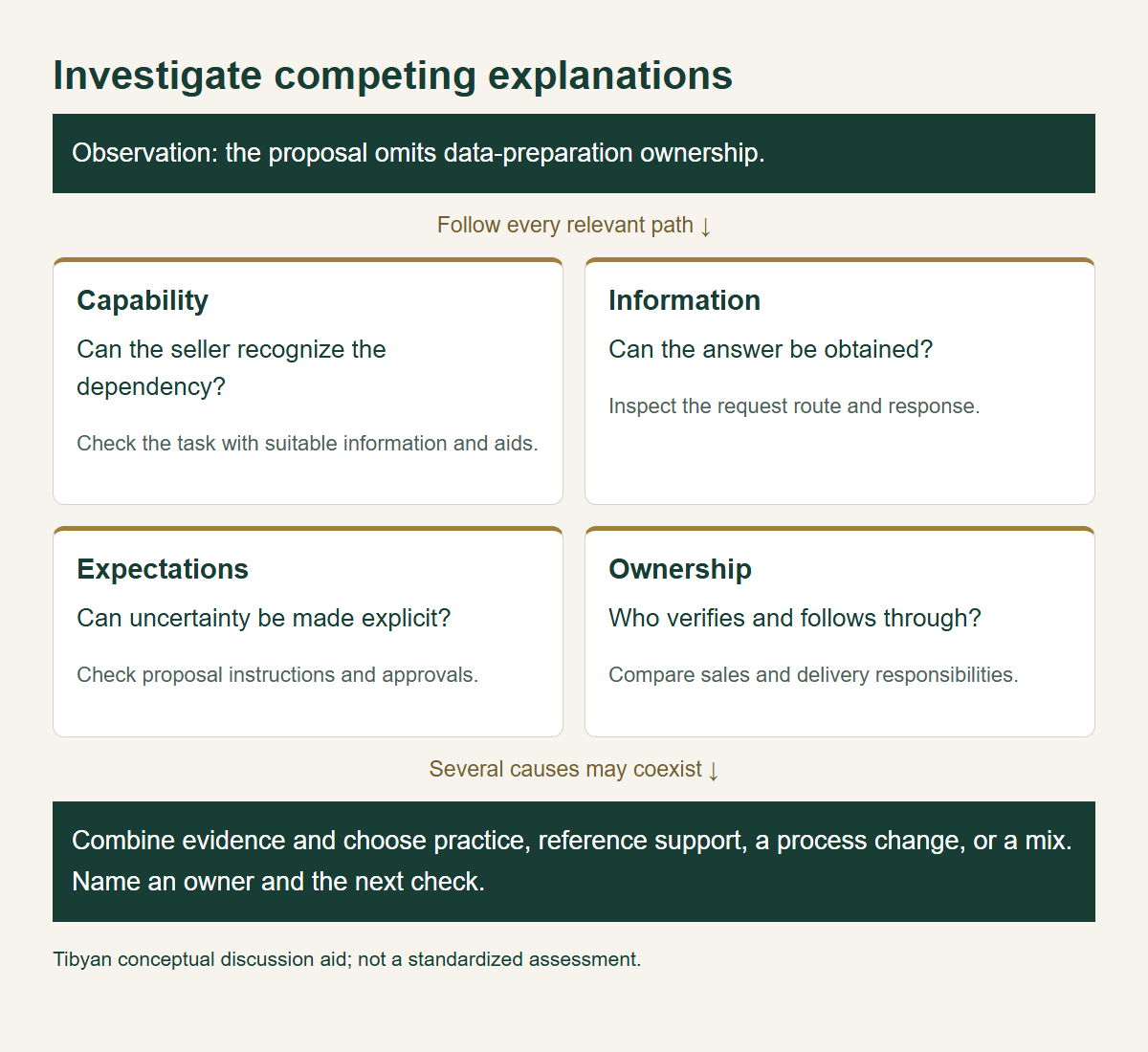 Open the diagram full size ↗
Tibyan conceptual diagnostic. Follow all relevant branches; this is a discussion aid, not a standardized assessment or a reproduction of Moore’s flowchart.
Give the seller a fictional customer brief and the approved requirements guide. Ask them to identify what is confirmed, what remains unknown, and what they would do before proposing scope. Include a realistic ambiguity about data preparation.
Agree the criteria in advance: recognizes the material dependency, avoids inventing customer facts, identifies a verification route, and documents the next action. Ask the seller to explain their reasoning. A missing answer might reflect an unclear instruction or unfamiliar terminology, so check those possibilities before labeling a skill gap.
Success in a supported task is evidence about capability under those conditions. It does not establish consistent workplace performance. Difficulty in one attempt also needs interpretation. Compare it with the work sample, available information, and the participant’s account.
If the person can recognize the issue but cannot find the current rule, test a usable reference aid. If they still cannot interpret the dependency when information is accessible, targeted explanation and practice become a more defensible response.
Use this blank structure once per explanation. Add the observed task and expected standard above it. Keep sensitive evidence in the approved system and reference it rather than copying it into an unrestricted worksheet.
| Field | Your entry |
|---|---|
| Explanation | What might account for this specific gap? |
| Supporting evidence | What dated observation supports it? |
| Challenging evidence | What contradicts or limits it? |
| Unknown | What still prevents a justified decision? |
| Next check | Which observation or task could resolve that uncertainty? |
| Action and owner | Who can act on the finding? |
| Review | Which new work sample will inform the next decision? |
Here is an illustrative completed entry, with invented observations used only to explain the reasoning:
This entry connects evidence to a decision while preserving an alternative explanation. “Unmotivated seller—book training” would provide neither a testable explanation nor an owned operating response.
Bring sales, learning, and the relevant process owner together. Record which findings support learning, which require changes elsewhere, and which remain unresolved. Select a small response whose operation you can inspect before extending it.
For the teaching case, that might combine practice in carrying unknowns into a requirements summary with a clearer route for specialist verification. These are proposed actions. No improvement in proposal quality or revenue is assumed.
Review the first suitable subsequent work sample with the seller. Note the support required, unresolved buyer questions, and whether the agreed process was available. If no relevant opportunity occurred, record that and arrange a later review. A review date should fit the work, rather than manufacture evidence of application.
Track proposal revisions separately, using defined reasons and comparable work. A reduction following simultaneous training and process changes would not isolate the effect of training.
Choose one clearer proposal and one that required clarification. With permission, reconstruct each, state the expected behavior, and complete the diagnostic record for the most consequential uncertainty. Ask a colleague to challenge the proposed explanation and identify what evidence could change it.
The record is ready to use when another person can distinguish observation from interpretation, identify the next check, and name someone able to act. If it only repeats the original training request, return to the task evidence.
Use Skill gap or work barrier? to structure the initial conversation, then extend it with the competing explanations above. The worksheet starts the discussion; it does not certify a diagnosis.
For a shorter introduction, read Is It a Skill Gap—or a Sales System Problem?. This guide is the diagnosis stage in Tibyan’s ISD sales-enablement series; later guides develop role pathways, practice, support, and evaluation.
Cover: AI-generated conceptual illustration. The case, diagnostic record, criteria, and diagram are Tibyan teaching materials, without empirical validation claimed.
Sources checked November 2, 2026. Institutional and practitioner guidance informs this approach; no quantified effectiveness or causal commercial result is reported.
Take the next step
Free downloads. No registration. Each PDF includes instructions, an illustrative example and a reusable worksheet.
Tibyan Toolkit 02
Use a short conversation to choose the next useful action.
PDF · 8 pages · 114 KB · Version 1
Download English PDFPractical worksheets, not validated assessments. Adapt the task and timing to your context. See each PDF for its revision date.
Explore the tools & toolkits library ↗
Practical perspective
Prepare a B2B quotation that procurement, finance, and operations can assess. Use Tibyan’s QUOTE Framework, an annotated example, and a 13-point checklist.
Read perspective
Talent Development
Check whether the task still matters, how people learn it and what gets in their way before you keep, redesign or retire a course.
Read perspective
Team development
Follow one customer case across teams and find which handoff lost the facts, ownership or promise.
Read perspective