Tibyan Toolkit 20
Pipeline review agenda and inspection sheet
Turn three opportunity updates into clear decisions and evidence-producing next steps.
PDF · 4 pages · 66 KB · Version 1
Download English PDF Open editable working template ↗Re-examine a deal when its sponsor, deadline or funding changes and record a fresh decision.

A warehouse upgrade entered the forecast because the buyer needed to go live before a peak season. The target date moves and the sponsor changes roles. The CRM still shows the old close date. Requalification starts with the events that originally made the purchase worth pursuing.
The old date still shows up faithfully in the CRM. Before you move it to a new month, ask what event would actually put a decision back on the buyer’s calendar.
In this fictional case, confirm which problem remains, who can make a decision, and whether a new trigger exists. A buyer can still need the solution while deciding to defer. Wind and Webster’s organizational buying framework helps explain why the same operational issue can produce a different purchase decision when participants or organizational conditions change. Wind and Webster, Industrial Buying as Organizational Behavior
| Original basis | What changed | What the buyer can verify | Seller decision |
|---|---|---|---|
| Peak-season deadline and named sponsor | Deadline moved and sponsor changed roles | The new operations lead confirms the problem remains. No decision date or budget review is agreed. | Move outside committed forecast. Ask whether the buyer wants to define a review trigger. |
Ask “Which reason to act still holds, and who decides what happens next?” Listen for a buyer-owned action. A forwarded introduction creates access. A time and owner for a defined evidence review show more about the decision. Update the record and reconsider any proposal work that relied on the former deadline.
Retain the opportunity as active when the buyer confirms the reason, an owner and a meaningful next decision. Defer with a trigger if the buyer wants to revisit under a later condition. Close the current pursuit when the buyer confirms the project has ended. If the outcome remains unknown, record it as unknown and apply the forecast policy to the evidence you actually have.
Try another trigger. A grant fell through, but the buyer offers a smaller self-funded test. Record whether the test has a defined purpose, an owner and authority to spend. A suitable decision can retain the test as a separate active opportunity while keeping the original purchase out of the forecast. Have a reviewer check which claims come from the buyer and which are your judgment.
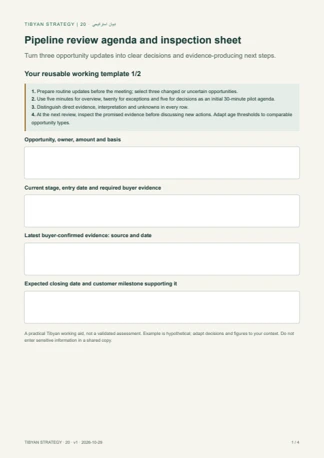
Use the pipeline inspection sheet to record what changed, the evidence you have, and the forecast action. Pipeline review agenda and inspection sheet
Take the next step
Free downloads. No registration. Each PDF includes instructions, an illustrative example and a reusable worksheet.
Tibyan Toolkit 20
Turn three opportunity updates into clear decisions and evidence-producing next steps.
PDF · 4 pages · 66 KB · Version 1
Download English PDF Open editable working template ↗Practical worksheets, not validated assessments. Adapt the task and timing to your context. See each PDF for its revision date.
Explore the tools & toolkits library ↗
Practical perspective
Prepare a B2B quotation that procurement, finance, and operations can assess. Use Tibyan’s QUOTE Framework, an annotated example, and a 13-point checklist.
Read perspective
Talent Development
Check whether the task still matters, how people learn it and what gets in their way before you keep, redesign or retire a course.
Read perspective
Team development
Follow one customer case across teams and find which handoff lost the facts, ownership or promise.
Read perspective