Tibyan Toolkit 19
Buying-Group Map and Mutual Action Plan
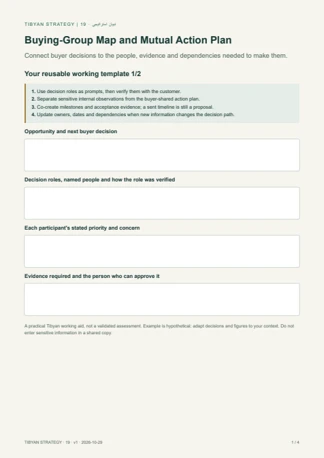
Connect buyer decisions to the people, evidence and dependencies needed to make them.
PDF · 4 pages · 68 KB · Version 1
Download English PDF Open editable working template ↗Turn conflicting criteria into a joint decision memo with comparable options and a named owner.

Operations prefers an immediate rollout because rework is delaying orders. Finance prefers a limited test because savings are uncertain. Both teams can be right about their own responsibility. Put their criteria into a decision they can make together.
Imagine each team brings a scoreboard. Operations counts correctly released orders. Finance tracks the amount it can put at risk. Ask what a limited test would have to show on both boards.
In a fictional distributor, ask operations how it would judge a useful change and ask finance what exposure it can authorize. Recheck whether faster release and a spending ceiling can both be respected by a third option. Wind and Webster’s organizational buying framework treats the purchasing decision as shaped by multiple participants and their roles. Apply that insight by capturing the criteria and authority explicitly. Wind and Webster, Industrial Buying as Organizational Behavior
| Option | Operations criterion | Finance criterion | Evidence and owner |
|---|---|---|---|
| Immediate rollout | Wider coverage quickly, with release accuracy untested | Higher first-year commitment before overtime savings are established | IT validates lead time. Finance checks outlays. |
| One-site test | Shows how exceptions are handled at one site | Limits initial spend and tests a consequential assumption | Operations reviews errors and rework. Finance confirms the spending limit. |
Before drafting the joint memo, verify that each team recognizes its own criterion. Label nonnegotiable limits and preferences separately. Confirm who can authorize the option and whether it needs a second approval. If the buyer accepts a limited test, write what would justify extending, adapting or ending it.
Assume operations says the test queue must include urgent orders, while finance will fund a test only if it uses existing staff time. Write options that meet both requirements, or show which assumption needs testing. An acceptable answer might use a small matched set of urgent cases and add a stop condition if regular coverage suffers. Ask the two stakeholders to review it before treating it as agreed.
Write the final decision memo in five lines. State the decision, criteria, options, unresolved trade-off and owner with the agreed next action. A colleague outside the meeting should be able to identify what both teams accept and what remains unsettled.
Use the buying-group map and mutual action plan to record the decision owner, evidence and next milestone. Buying-Group Map and Mutual Action Plan
Take the next step
Free downloads. No registration. Each PDF includes instructions, an illustrative example and a reusable worksheet.
Tibyan Toolkit 19
Connect buyer decisions to the people, evidence and dependencies needed to make them.
PDF · 4 pages · 68 KB · Version 1
Download English PDF Open editable working template ↗Practical worksheets, not validated assessments. Adapt the task and timing to your context. See each PDF for its revision date.
Explore the tools & toolkits library ↗
Practical perspective
Prepare a B2B quotation that procurement, finance, and operations can assess. Use Tibyan’s QUOTE Framework, an annotated example, and a 13-point checklist.
Read perspective
Talent Development
Check whether the task still matters, how people learn it and what gets in their way before you keep, redesign or retire a course.
Read perspective
Team development
Follow one customer case across teams and find which handoff lost the facts, ownership or promise.
Read perspective