Tibyan Toolkit 05
Prepare a useful feedback conversation
Bring one observation, one question and one agreed next step.
PDF · 8 pages · 114 KB · Version 1
Download English PDFGive a concern a fair hearing, choose the right response route and follow up with the person who raised it within the limits of that process.

In a hypothetical service team, a supervisor reviewing a new customer onboarding plan notices that the same engineer is assigned to two launches on the same morning. The team lead thanks her and moves to the next agenda item. Later, the supervisor checks the schedule. Both assignments are still there, and she has no idea whether anyone looked at the concern.
Give the concern a fair hearing, decide who should handle it and tell the person who raised it what was decided and why, within the limits of the reporting process. The plan may stay as it is if the evidence supports it.
In a field study and two experiments, Burris found lower managerial endorsement of ideas voiced in a challenging way than of ideas voiced supportively. Morrison’s later review considers what influences speaking up and silence and identifies limitations in how researchers have defined and studied both behaviors. The follow-up routine below is a practice Tibyan suggests trying on an ordinary operational concern. Burris, 2012 · Morrison, 2023
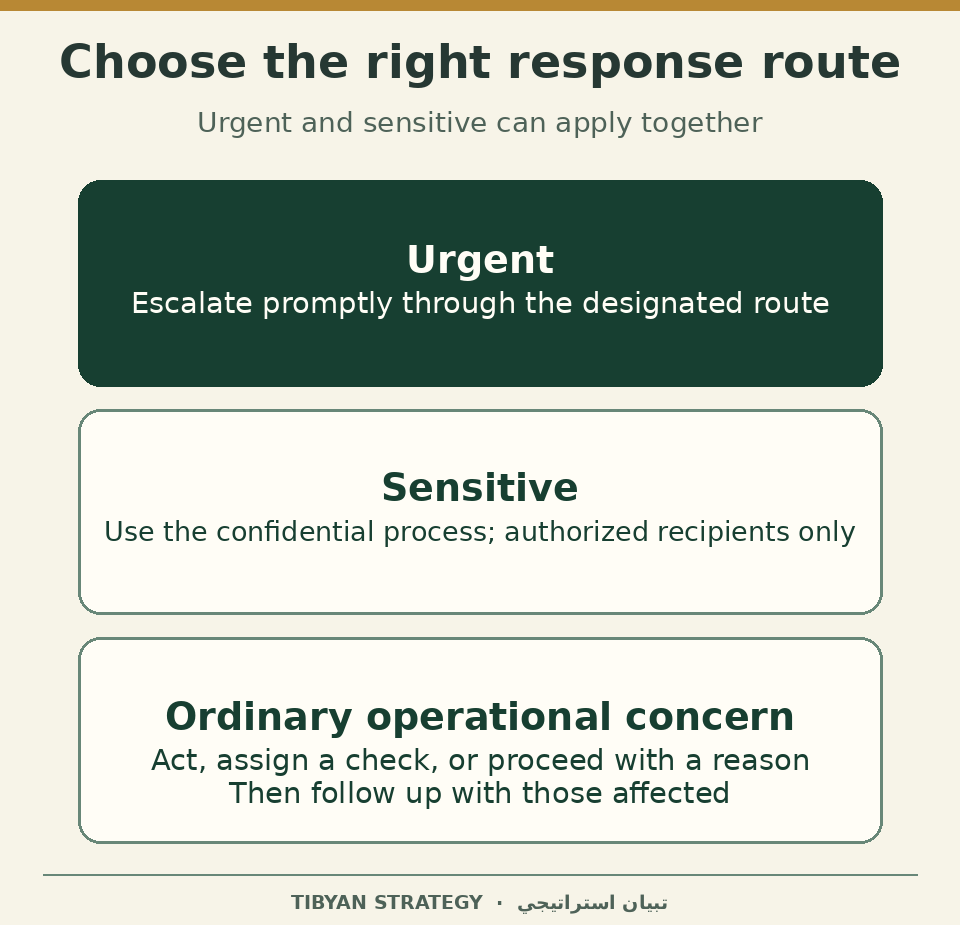
First decide which route applies. For an urgent issue, use the designated escalation route promptly. For a sensitive concern, use the appropriate confidential process and limit updates to authorized recipients and information that process permits. If both conditions apply, escalate promptly through the appropriate route and protect confidentiality.
For an ordinary operational concern, ask what the person observed, which outcome could be affected and when a decision is needed. Then act, assign a check and a reply date, or continue with a reason. In the scheduling example, the operations duty lead can verify whether both customers need the engineer at the same time, find qualified cover and report the outcome to those affected.
 Open the diagram full size ↗
An urgent concern can also be sensitive. Use the applicable process for both conditions.
| When | What the team lead can say |
|---|---|
| In the meeting | “Which tasks need the engineer, and do the windows overlap?” |
| When assigning the check | “The operations duty lead will confirm both windows and check for qualified cover by noon tomorrow.” |
| If the windows overlap | “We’ve assigned qualified cover to the second launch and updated the schedule.” |
| If the windows are separate | “We can keep both dates. The engineer is needed at different times. We’ll revisit the decision if either customer moves its window.” |
 Open the diagram full size ↗
Top: the goldfish spots the same overlap Rana does. Bottom: Sami assigns a check and a reply time in this routine scheduling case.
For a routine concern, the decision record can be one line: what was raised, who owns the check, when a reply is due, what was decided and who needs to hear it. Record and share sensitive matters through the appropriate process.
At your next review, pick one ordinary concern raised earlier. If the person who raised it is still waiting, assign the next action and give them a reply date.
Use Tibyan’s feedback conversation planner to prepare an ordinary private conversation. For routine decisions that the team needs to track, use a simple team decision record.
Take the next step
Free downloads. No registration. Each PDF includes instructions, an illustrative example and a reusable worksheet.
Tibyan Toolkit 05
Bring one observation, one question and one agreed next step.
PDF · 8 pages · 114 KB · Version 1
Download English PDFPractical worksheets, not validated assessments. Adapt the task and timing to your context. See each PDF for its revision date.
Explore the tools & toolkits library ↗
Practical perspective
Prepare a B2B quotation that procurement, finance, and operations can assess. Use Tibyan’s QUOTE Framework, an annotated example, and a 13-point checklist.
Read perspective
Talent Development
Check whether the task still matters, how people learn it and what gets in their way before you keep, redesign or retire a course.
Read perspective
Team development
Follow one customer case across teams and find which handoff lost the facts, ownership or promise.
Read perspective