Tibyan Toolkit 20
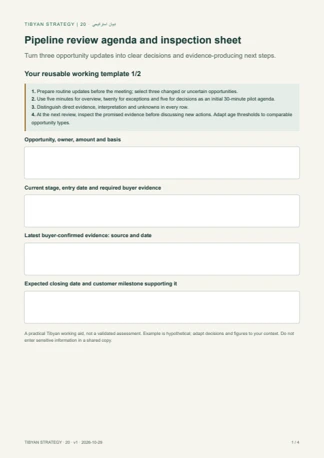
Pipeline review agenda and inspection sheet
Turn three opportunity updates into clear decisions and evidence-producing next steps.
PDF · 4 pages · 66 KB · Version 1
Download English PDF Open editable working template ↗Replace deal-by-deal reporting with a focused review of buyer evidence, stalled decisions and specific actions—using a practical agenda and inspection template.

A pipeline meeting can finish with every opportunity discussed and no decision improved. The team repeats amounts, expected closing dates and familiar assurances. Managers ask for more activity. The customer’s purchasing process remains just as uncertain.
A useful review changes what the team will do next. It may confirm an opportunity’s stage, expose a missing decision maker, remove an unrealistic closing date, secure specialist support or stop investing in a poor fit. The value lies in better decisions and follow-through, rather than a more impressive dashboard.
Learning outcome: use buyer evidence to inspect a small set of opportunities and leave with an action, owner and review date for each decision.
A pipeline describes opportunities and their progress. A forecast estimates what may close in a defined period. A coaching conversation develops a salesperson’s capability. These activities inform each other, but they need different questions.
In the pipeline review, ask: “What evidence supports progress, what prevents the next customer decision, and where should we spend effort?” In the forecast discussion, ask: “What is sufficiently supported to include in this period’s estimate?” Do not use the forecast target as evidence that an opportunity is ready.
Microsoft’s opportunity-stage guidance illustrates how stages can organize customer needs, stakeholders, proposals and decision dates. It describes a product workflow, not a universally validated sales process. Adapt the information requirements to your own sales motion. Microsoft Learn: opportunity stages.
Tibyan recommends describing each stage with a customer condition and a small amount of observable evidence. “Proposal sent” records seller activity. “Buyer confirms the proposal addresses the agreed scope and identifies the remaining approval steps” describes a more useful buying condition.
Evidence can include an agreed meeting note, a buyer-confirmed requirement, a completed technical review or an identified procurement milestone. Store a concise reference and date; avoid copying confidential customer information unnecessarily. An assumption can remain in the record, provided it is visibly marked as an assumption.
| Inspection area | Useful question | Possible decision |
|---|---|---|
| Stage | What buyer evidence meets this stage’s criteria? | Confirm or revise the stage |
| Timing | Which customer milestone supports the closing date? | Keep, revise or remove the date |
| Buying access | Who must approve, evaluate or implement? | Arrange a relevant conversation |
| Commercial fit | Can we serve the scope on acceptable terms? | Redesign, seek approval or stop |
| Next step | What has the buyer agreed to do next? | Assign a specific follow-up |
The aim is consistency, not administrative perfection. If a field does not change a decision, question whether it belongs in the review.
A long list encourages superficial updates. Before the meeting, identify the opportunities whose evidence or risk has changed: a closing date moved, a key sponsor left, a technical dependency emerged, a large amount increased or an agreed action became overdue.
Salesforce’s Pipeline Inspection documentation groups changes in amounts, stages, closing dates and forecast categories, and flags outdated next steps. This is a useful example of available inspection signals; software visibility does not establish that an opportunity is healthy. Salesforce Help: Pipeline Inspection.
Tibyan’s practical suggestion is to select a manageable number of exceptions for discussion and circulate routine updates beforehand. Use a separate session when a complex opportunity needs extended strategy or coaching.
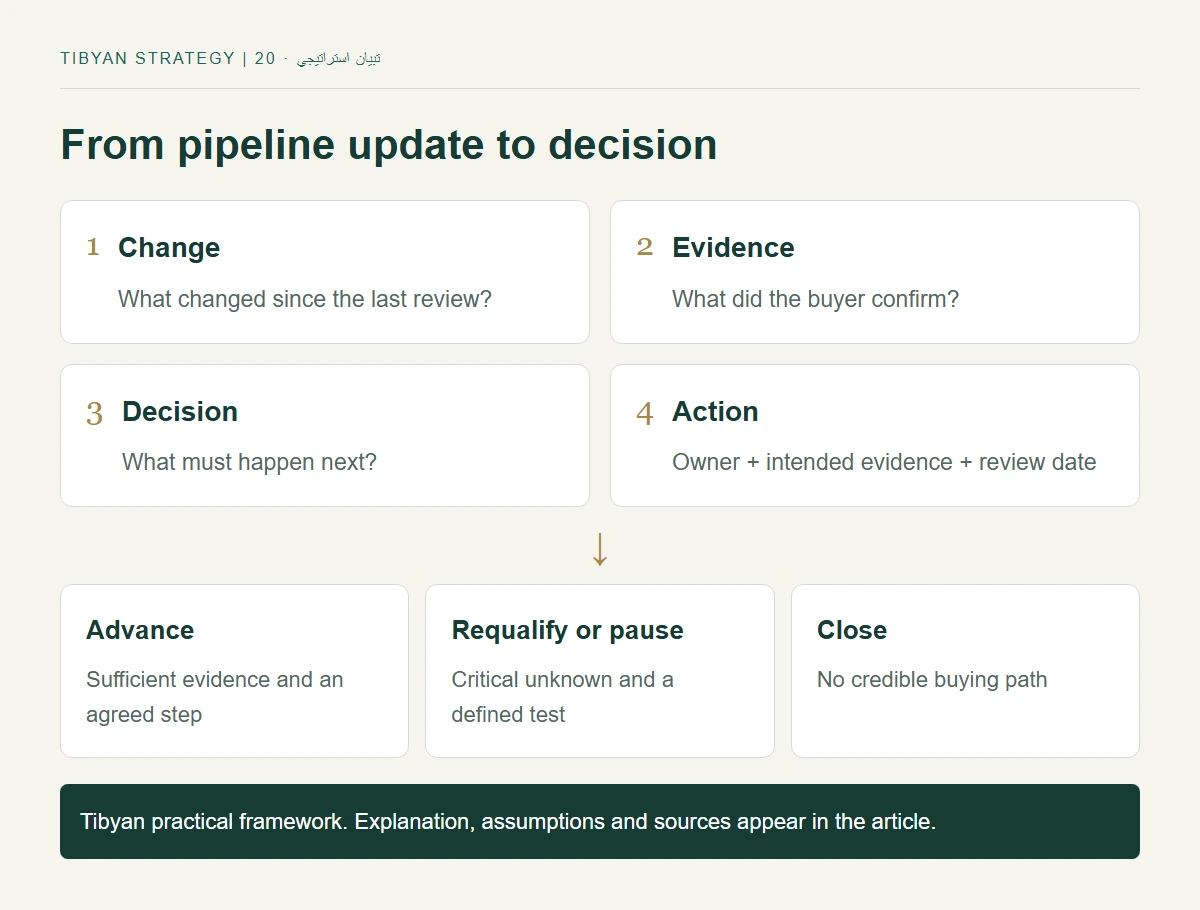
Ask the owner to state what changed since the last review in one or two sentences. “The buyer postponed the security review” is useful. “We are building a good relationship” requires more detail.
Ask where the information came from, when it was confirmed and what remains unknown. Distinguish a direct buyer commitment from the salesperson’s interpretation. A helpful manager tests the record without making uncertainty embarrassing.
Name the specific customer or internal decision that must occur. It might be whether the technical environment is suitable, whether the funding owner will sponsor a pilot or whether delivery can support the required date. “Follow up” is not a decision.
Choose an action that reduces the relevant uncertainty. A joint requirements call may help; another generic presentation may not. Specify the owner, the intended evidence and a date to review the result.
Record the decision while it is clear. If evidence does not support the current stage or date, correct it. This is a management adjustment, not a punishment for honest reporting.
 Open the diagram full size ↗
Conceptual diagram: Tibyan’s suggested inspection sequence. It is a practical meeting design, not a prediction model.
Suppose a maintenance-analytics supplier has an opportunity with a manufacturer. The salesperson lists a contract value of 100,000 currency units, “proposal” stage and a closing date at month-end. The operations manager likes the demonstration, but the security review has not started and procurement has not confirmed the purchase route.
The old meeting asks whether the salesperson can “push harder.” The revised review identifies two unsupported assumptions: that technical approval is straightforward and that a contract can be signed within the month.
The team retains the opportunity, removes the unsupported month-end closing date and excludes it from the current-period forecast until customer timing is confirmed. The salesperson will arrange a security-scoping call with the customer’s technical owner. A solution specialist will prepare the data-flow outline. The next review will inspect whether the customer has agreed the review requirements and timing.
This example does not predict a win. It shows how a review can replace pressure with an evidence-producing action.
As a starting design, Tibyan suggests a 30-minute weekly review: five minutes on changes in the overall picture, twenty minutes on selected exceptions and five minutes confirming decisions. Treat this as a pilot format, not a universal benchmark.
The minimum inspection view can contain opportunity, owner, amount and its basis, stage and entry date, expected closing date and its basis, latest buyer-confirmed evidence, unresolved dependency and next agreed action. Include links to the underlying records rather than duplicating a second database.
Define age as elapsed time using an agreed start point, such as entry into the current stage. Define slippage as a closing date moving beyond a previously recorded period. Compare like with like: a new-customer procurement cycle and a small renewal should not share an arbitrary warning threshold.
If the same obstacle appears repeatedly, investigate the sales system before prescribing more training. Distinguish a skill gap from a system problem.
Choose three opportunities: one apparently healthy, one slipping and one stalled. Use the free tool to inspect each. End with a decision and an evidence-producing action, or explicitly decide that no further effort is justified.
After two or three review cycles, discuss whether the format surfaces useful uncertainty and produces completed actions. These are initial process checks; they do not prove that the meeting caused revenue growth.
Download the free pipeline review agenda and inspection template.
For the broader diagnostic context, read Find your revenue bottleneck.
You can also use the editable, printable working template. Download an edited copy from your browser without submitting your entries.
Explore the Sales Training collection.
Cover: AI-generated conceptual artwork. Diagram and tool: original Tibyan editorial design.
Take the next step
Free downloads. No registration. Each PDF includes instructions, an illustrative example and a reusable worksheet.
Tibyan Toolkit 20
Turn three opportunity updates into clear decisions and evidence-producing next steps.
PDF · 4 pages · 66 KB · Version 1
Download English PDF Open editable working template ↗Practical worksheets, not validated assessments. Adapt the task and timing to your context. See each PDF for its revision date.
Explore the tools & toolkits library ↗
Practical perspective
Prepare a B2B quotation that procurement, finance, and operations can assess. Use Tibyan’s QUOTE Framework, an annotated example, and a 13-point checklist.
Read perspective
Talent Development
Check whether the task still matters, how people learn it and what gets in their way before you keep, redesign or retire a course.
Read perspective
Team development
Follow one customer case across teams and find which handoff lost the facts, ownership or promise.
Read perspective