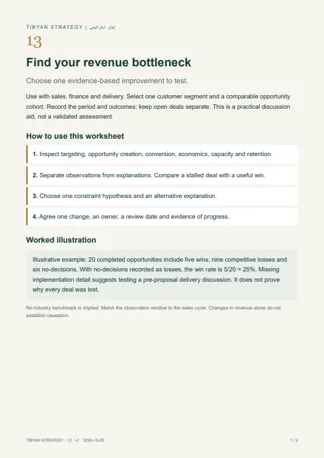
Tibyan Toolkit 13
Find your revenue bottleneck
Choose one evidence-based improvement to test.
PDF · 2 pages · 64 KB · Version 1
Download English PDFDiagnose whether B2B growth is constrained by targeting, opportunity creation, conversion, delivery capacity, or retention—and choose one measurable intervention.

Your revenue target has increased, the pipeline looks busy, and the obvious response is to recruit another salesperson. Before approving the role, ask a more precise question: which part of the commercial process needs additional capacity?
Hiring can be appropriate when qualified demand exceeds the team's ability to serve it. When the constraint is an unclear offer, poor qualification, or slow implementation, adding sellers may increase activity without resolving the underlying problem.
What you can put into practice: Identify one plausible revenue constraint and test an improvement. Start with comparable opportunities and a work sample, then agree an owner and a review date.
Tibyan recommends reviewing one customer segment and one reasonably comparable sales cohort at a time. Mixing small repeat orders with first-time enterprise purchases can conceal more than it reveals.
Use your customer relationship management system (CRM) to identify opportunities created in an agreed period. Track their outcomes through a consistent observation window. Keep open opportunities separate from completed ones. Revenue booked during a month may come from opportunities created much earlier.
For a completed cohort, count the wins and divide by all decided opportunities—wins plus losses—to calculate a win rate. Show the number of deals alongside the percentage. Record “no decision” consistently, and do not quietly remove it to improve the result.
The following diagnostic is Tibyan's practical working aid, not an industry benchmark.
| Possible constraint | Evidence to inspect | Question before acting |
|---|---|---|
| Targeting | Reasons for rejection and customer profitability | Are we pursuing buyers whose problems we can solve? |
| Opportunity creation | Relevant conversations and qualified opportunities | Are suitable accounts accessible through our current channels? |
| Conversion | Buyer-confirmed needs, stakeholders, loss reasons | Where does buyer progress stop? |
| Deal economics | Scope, discounts, implementation and support costs | Is a win commercially worthwhile? |
| Capacity | Response times, workload and delivery backlog | Which role or process is overloaded? |
| Retention | Renewals, adoption and reasons for departure | Are new wins replacing avoidable losses? |
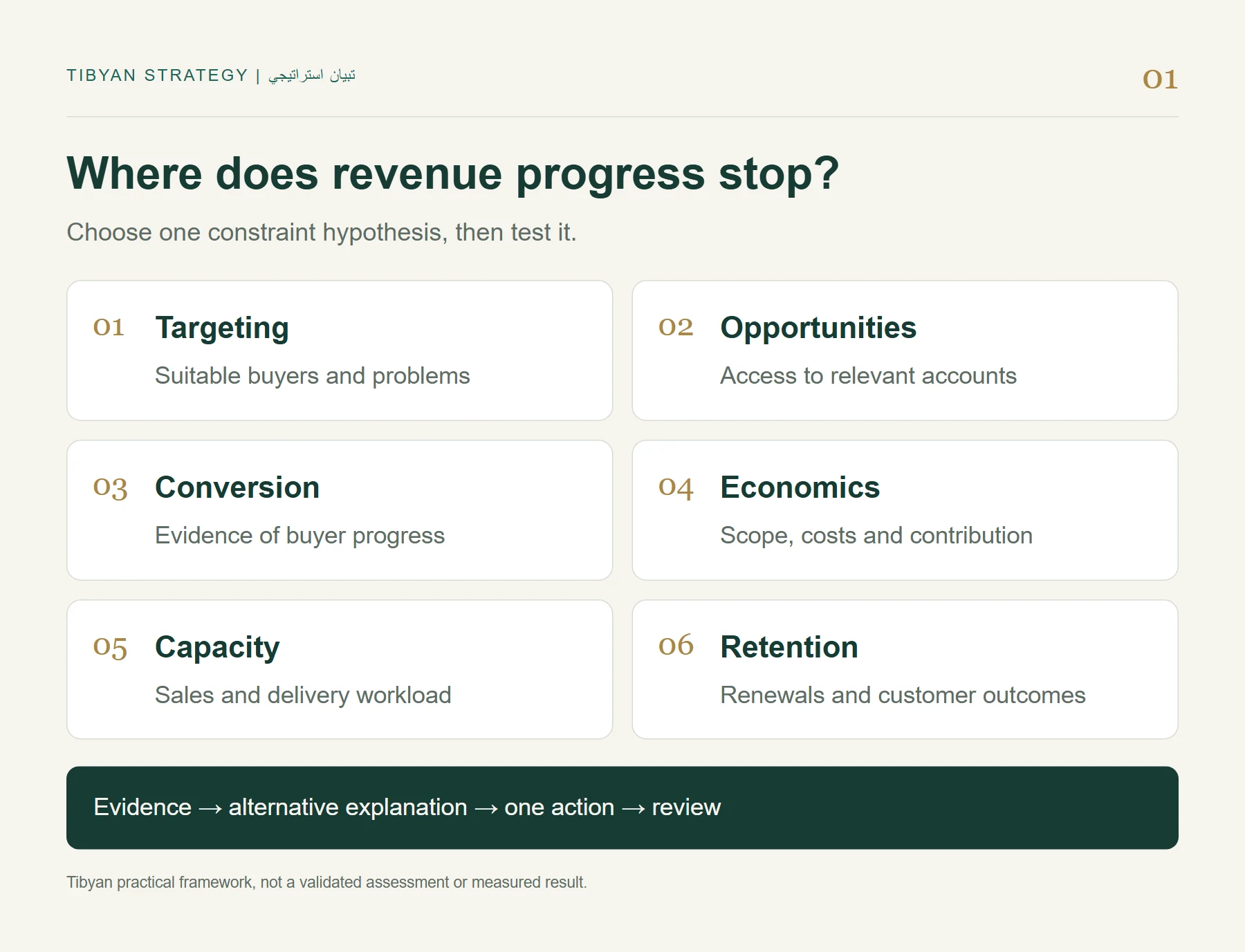 Open the diagram full size ↗
Tibyan practical framework. Open the diagram for a larger view; the steps and qualifications are explained in the text.
Inspect actual proposals and customer conversations, not only dashboard totals. A mandatory CRM field can be complete without containing useful evidence.
Channel choice belongs in this diagnosis. The International Trade Administration distinguishes direct and indirect selling and discusses their resource implications. Its guidance addresses exporting; it is a decision reference, not proof that a particular channel will work for your business. ITA: Sales Channels.
Hypothetical example—not a client result. A regional maintenance provider reviews 20 completed opportunities from a comparable segment: five wins, nine competitive losses, and six no-decisions. Its recorded win rate is 25%, including no-decisions as losses under its stated convention.
The manager initially attributes the shortfall to insufficient prospecting. Reviewing the proposals reveals a different hypothesis: several buyers could not establish the implementation schedule or who would support the service after launch.
This does not prove the cause of every loss. It suggests a test: add an implementation discussion before issuing proposals and record whether the buyer confirms responsibilities and a decision step. The team holds staffing constant during the test where practical and notes other changes.
Complete these fields before changing the process:
For a four-week review, buyer-confirmed next steps may be observable before revenue changes. Four weeks is an illustrative planning interval; match it to your sales cycle. A change in results alone does not establish causation.
Ask the team to bring one stalled deal and one successful deal from the same segment. Compare the work conditions and buyer evidence. If a skill gap emerges, investigate it before prescribing a course: CIPD recommends relating learning needs to business capability and considering responses beyond training. CIPD: Learning needs analysis.
Download the revenue diagnostic worksheet. Complete it with sales, finance, and delivery. Choose one constraint hypothesis, agree one improvement to test, and set a review date.
Need help preparing your team to apply this guide? Discuss the sales tasks, customer conversations, and practical learning your team needs. Discuss your team's development with Tibyan.
Explore the complete Sales Training collection.
Cover: AI-generated conceptual illustration. Explanatory diagram: Tibyan editorial design.
Sources checked: 29 October 2026. The diagnostic and example are Tibyan's practical synthesis.
Take the next step
Free downloads. No registration. Each PDF includes instructions, an illustrative example and a reusable worksheet.
Tibyan Toolkit 13
Choose one evidence-based improvement to test.
PDF · 2 pages · 64 KB · Version 1
Download English PDFPractical worksheets, not validated assessments. Adapt the task and timing to your context. See each PDF for its revision date.
Explore the tools & toolkits library ↗
Practical perspective
Prepare a B2B quotation that procurement, finance, and operations can assess. Use Tibyan’s QUOTE Framework, an annotated example, and a 13-point checklist.
Read perspective
Talent Development
Check whether the task still matters, how people learn it and what gets in their way before you keep, redesign or retire a course.
Read perspective
Team development
Follow one customer case across teams and find which handoff lost the facts, ownership or promise.
Read perspective