A sale can be commercially attractive and operationally impossible in its current form. The customer expects an accelerated start, the salesperson assumes the technical team can adapt, and delivery sees the agreed scope only after signature. Each group believes another group checked the details.
The answer is not to make every small sale wait for a large committee. It is to match the depth of review to the uncertainty and consequences of the promise, then carry the approved commitments into execution.
Learning outcome: use a short readiness review and shared handover record to verify what is being promised, who must provide what and how delivery will be accepted.
Start the handover before the signature
The Association for Project Management’s handover guidance treats handover as a process planned from the start, with specific requirements, measurable deliverables, end-user involvement and agreed information needs. These are professional lessons drawn from project handovers; they are not a universal sales-process standard. APM: factors for successful project handover.
Tibyan’s application to B2B sales is straightforward: involve delivery while the proposed promise can still change. A standard repeat order may need a brief capacity and scope check. A new integration, unusual support obligation or difficult deadline needs a deeper review by the relevant specialists.
Define the triggers in advance. Examples include custom development, a new geography, non-standard response times, third-party dependencies, a compressed schedule or an exception to the approved commercial package. These are suggested triggers; calibrate them to your actual delivery risks.
Separate the customer outcome from the deliverable
A customer may want fewer production interruptions. The supplier may commit to a configured maintenance-analytics service, agreed reports and specified training. The business outcome matters, but it depends on customer decisions and other conditions as well as the supplier’s work.
Define what the supplier will deliver, how the customer will test it and which outcome the work is intended to support. Do not promise a business result that the team cannot control or measure. Equally, do not make acceptance so narrow that the delivered item is technically complete but unusable for the agreed purpose.
APM defines project management around objectives and acceptance criteria within agreed parameters. Use that distinction to make completion observable, while recognizing the limits of applying general project guidance to a particular contract. APM: what is project management?.
Inspect six parts of the promise
A document is useful only when the responsible people understand and accept it. A salesperson should not infer delivery approval from silence, and delivery should not assume that the customer accepted an exclusion because it appears in an internal note.
Use three practical decision gates
Tibyan recommends three decisions for work with meaningful delivery uncertainty. Keep each decision proportional to the sale.
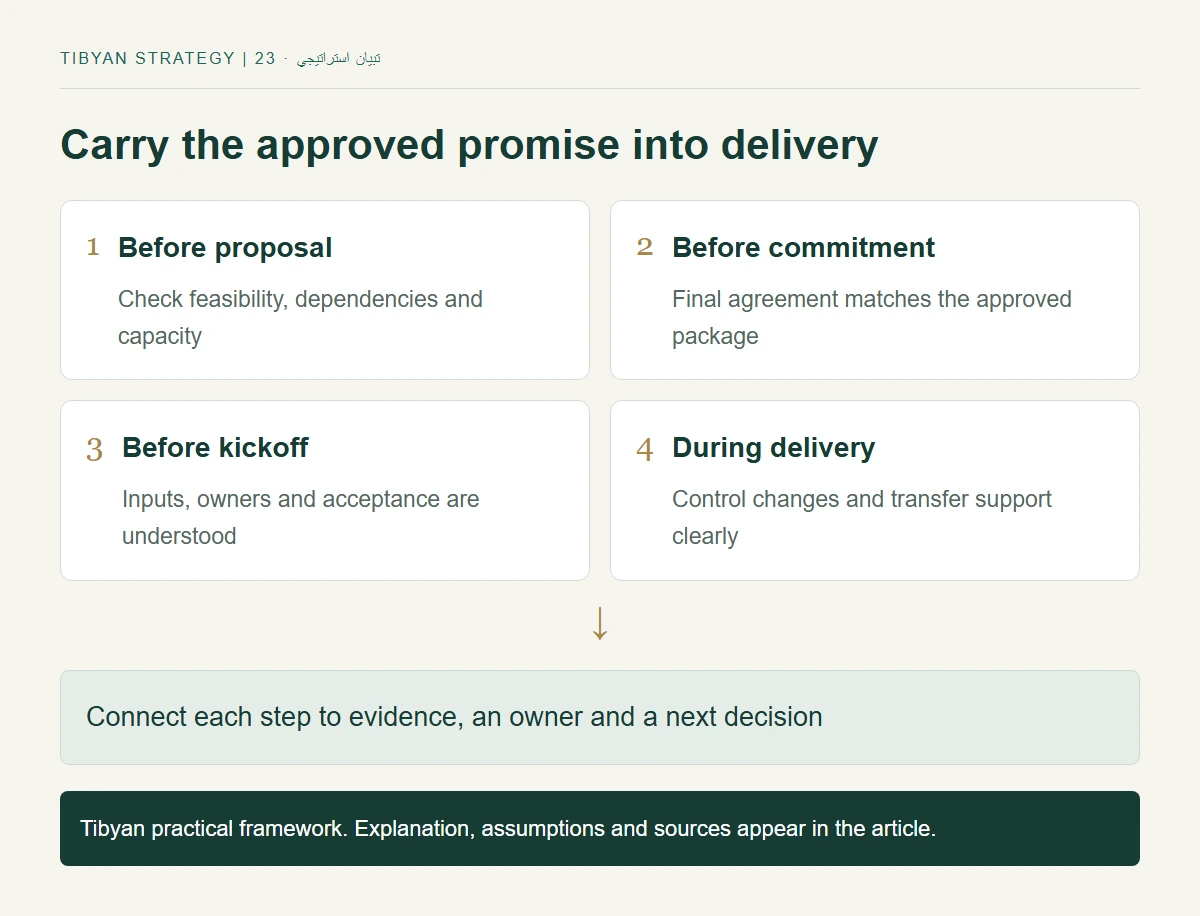
Gate 1: Is the offer feasible enough to propose?
Before sending a committed proposal, delivery checks the main assumptions, technical constraints and capacity. Finance or the authorized commercial owner checks unusual economic conditions. Where information is missing, state a bounded assumption or offer a discovery phase rather than an unconditional commitment.
Gate 2: Does the final agreement match the approved offer?
Before signature or the organization’s equivalent commitment point, compare the final scope, dates, service obligations and customer responsibilities with the approved version. Recheck changes made during negotiation. A small wording change can create a large delivery obligation.
Gate 3: Is execution ready to begin?
At kickoff, confirm that the delivery owner has the final documents, dependencies have owners and the customer understands the immediate next steps. If a dependency is not ready, record the impact and decision rather than silently holding the original deadline.
These gates are Tibyan’s suggested control points. They do not replace the organization’s contract, procurement or professional review requirements.
 Open the diagram full size ↗
Conceptual diagram: readiness decisions connect the proposed promise to the final agreement and execution. The gates are a practical aid, not a certification standard.
A worked hypothetical example
A maintenance-analytics supplier proposes a six-week pilot for a manufacturer. The salesperson wants to promise a fixed start date and a full connection to the customer’s maintenance system. Delivery has not yet inspected the data format or access requirements.
The first readiness review identifies an unresolved dependency: the customer’s technical team must provide a usable export and approve the proposed access method. Delivery can reserve a provisional slot but cannot confirm integration effort.
The team revises the proposal into two steps. An initial technical assessment checks the data and access conditions. The subsequent pilot schedule is confirmed after the agreed inputs are available. The scope states which reports and user session are included; a wider integration remains outside this phase.
For the pilot’s acceptance, the team proposes a test using agreed sample records, confirms who reviews the output and records how discrepancies will be handled. The customer’s responsible owner must agree those criteria. No percentage reduction in downtime is guaranteed.
Before commitment, sales and delivery compare the final proposal with the approved version. At kickoff, they use the same dependency record. This hypothetical example shows how uncertainty can be managed openly; it does not establish that every pilot should follow the same structure.
Make the handover record usable
The handover should answer the questions the receiving team actually has: Why did the customer buy? What has been agreed? What remains uncertain? Who must do what next? Where is the authoritative version?
Tibyan suggests one shared summary with links to the final scope and commercial documents. Include customer objectives, deliverables and exclusions, milestones, dependencies, acceptance criteria, owners, unresolved risks and the support transition. Preserve the difference between a confirmed commitment, a planning assumption and a pending approval.
Avoid copying an entire sales history into the handover. Include relevant decisions and context, while respecting confidentiality and access restrictions. The receiving owner should acknowledge the record and identify gaps before the work begins.
Control changes after the handover
Customer needs can change. The problem is not change itself; it is an additional promise made without examining its consequences.
For a requested change, describe what changes, assess the effect on effort, timing, cost and acceptance, identify the required approver and confirm the decision in writing. Do not let an informal “we can probably do that” become an unpriced obligation.
When an assumption fails, reopen the affected decision. If the customer cannot provide the required data, the team may need a revised sequence or scope. Avoid blaming the customer for a dependency that the original agreement never made clear.
Prevent the common failure patterns
- Handover after commitment: delivery receives an obligation it had no chance to assess.
- Unowned dependencies: everyone knows an input is needed, but nobody is accountable for obtaining it.
- Vague acceptance: “working as expected” leaves each party with a different completion test.
- Invisible negotiation changes: the final commercial package differs from the version delivery approved.
- No support transition: the project ends while the customer is unsure who handles the next issue.
If these patterns repeat, examine the operating system before treating the issue as an individual training deficit. Diagnose skill gaps and work-system barriers.
Test the process on one proposal
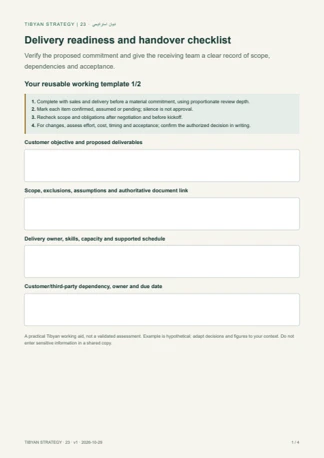
Choose a live proposal with a meaningful delivery dependency. Complete the free checklist with sales and delivery together. Identify one unresolved assumption and decide what evidence is required before it becomes a commitment.
Download the free delivery-readiness and handover checklist.
Use customer fit and profitability to revisit whether the account and scope are suitable before adding more commitments. For help developing shared sales-and-delivery practices, discuss a team learning need with Tibyan.
You can also use the editable, printable working template. Download an edited copy from your browser without submitting your entries.
Continue the learning path
Explore the Sales Training collection.
Cover: AI-generated conceptual artwork. Diagram and tool: original Tibyan editorial design.
Sources