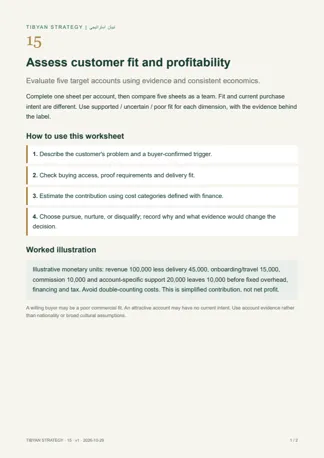
Tibyan Toolkit 15
Assess customer fit and profitability
Evaluate five target accounts using evidence and consistent economics.
PDF · 2 pages · 63 KB · Version 1
Download English PDFBuild an evidence-based ideal customer profile that combines customer need, buying access, delivery fit, and contribution rather than company size alone.

A familiar company name can attract attention long before anyone asks whether it is a suitable customer. The opportunity enters the pipeline, specialists join meetings, and a proposal is prepared. Only later does the team discover that the required support model would make the contract unattractive.
What you can put into practice: Assess customer need, buying access, delivery fit, and commercial viability. Use the same criteria to decide which accounts to pursue, nurture, or disqualify.
An ideal customer profile describes the organizations and situations your business is equipped to serve. Industry, size, and location help identify accounts, but do not explain why they should buy.
Tibyan recommends adding four questions: What costly problem can we address? What event makes action timely? What evidence can we provide? What must be true for delivery to be worthwhile?
Write a narrow first version: “Private multi-site distributors introducing a shared inventory process, where local managers need practical adoption support.” This is a hypothetical segment description, not a statement about regional demand.
Keep the profile revisable. It is a decision hypothesis grounded in available evidence, not a permanent label for a country or industry.
Review a deliberately mixed sample with sales, finance, and delivery. Examine useful wins, unprofitable wins, losses, and no-decisions. Record why each belongs in the sample so the team does not select only its favorite stories.
For each account, inspect the original problem, purchase trigger, access to decision makers, proof requested, acquisition effort, delivery burden, and payment behavior. Distinguish what the buyer said from the seller's interpretation.
Look for patterns that can be checked in future accounts. “Excellent relationship” is difficult to screen for. “Buyer provides an operations sponsor and agrees an implementation workshop before quotation” is more observable.
The following is Tibyan's suggested starting point.
| Dimension | Evidence to record |
|---|---|
| Problem fit | A named problem your offer can realistically address |
| Trigger and priority | A buyer-confirmed event or reason to act |
| Buying access | Relevant roles and a credible route to a decision |
| Proof fit | Whether you can meet required evidence and standards |
| Delivery fit | Capacity, language, implementation and service coverage |
| Economics | Expected contribution, acquisition effort and cash exposure |
Use “supported,” “uncertain,” or “poor fit” rather than creating an apparently precise total before you have enough evidence. A good-fit account can still have no current buying intention; a willing buyer can still be commercially unsuitable.
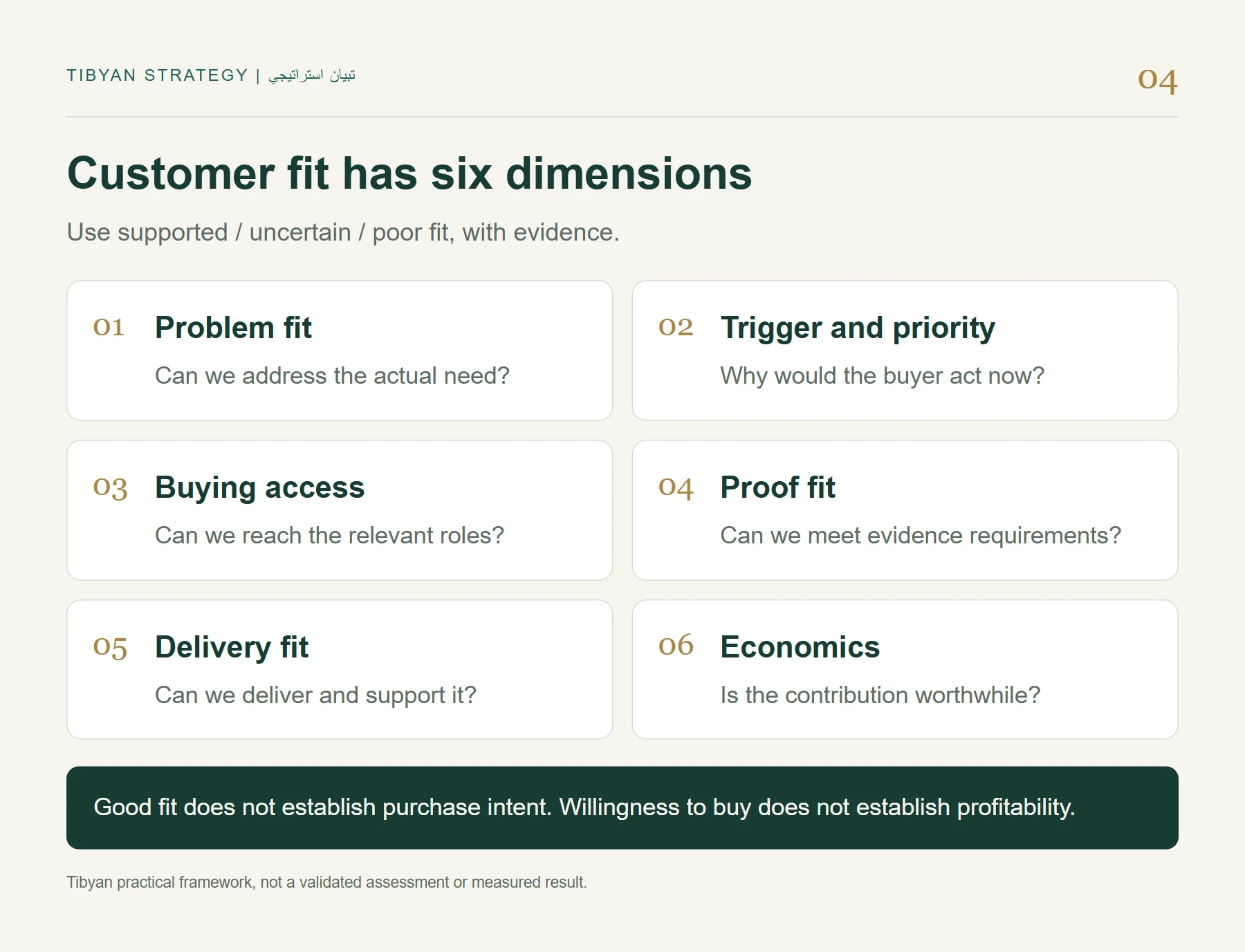 Open the diagram full size ↗
Tibyan practical framework. Open the diagram for a larger view; the steps and qualifications are explained in the text.
Channel partners need their own assessment. ITA's representative-selection checklist includes customer coverage, product conflicts, sales capacity, training, and service facilities. These are due-diligence questions, not a guarantee of a productive partnership. Choosing a Foreign Representative.
Hypothetical example; figures are illustrative monetary units. A service contract would generate 100,000 in revenue. Estimated incremental delivery costs are 45,000, onboarding and travel 15,000, partner commission 10,000, and account-specific support 20,000. That leaves 10,000 before fixed overhead, financing, and tax.
A second contract generates 80,000 but incurs 50,000 across those same cost categories, leaving 30,000 on the same basis.
The larger contract is not automatically the better choice. Check cost estimates, scope risks, capacity, payment timing, and strategic value. Finance should define the measure consistently; this simplified contribution calculation is not net profit.
Agree a small number of boundaries. Examples include requirements you cannot deliver, an essential authorization you lack, or payment exposure the company cannot finance.
Use “nurture” when the account fits but timing or access remains unresolved. Use “disqualify” when a material mismatch is established. Record the reason so marketing can improve targeting and managers can challenge inconsistent decisions.
Avoid using nationality or broad cultural assumptions as substitutes for account evidence.
In a 30-minute team exercise, independently assess five accounts, compare disagreements, and identify the missing evidence. This is a calibration exercise, not a statistically representative test.
For sales leaders, update the account selection rules. For trainers, turn disagreements into realistic qualification scenarios. For managers, review whether staff can access the information the profile requires.
Download the customer-fit and profitability worksheet. Assess five target accounts with the same criteria. Compare buyer evidence, delivery requirements, and contribution assumptions before choosing which accounts to pursue.
Need help preparing your team to apply this guide? Discuss the sales tasks, customer conversations, and practical learning your team needs. Discuss your team's development with Tibyan.
Explore the complete Sales Training collection.
Cover: AI-generated conceptual illustration. Explanatory diagram: Tibyan editorial design.
Sources checked: 29 October 2026. The profile, scorecard, exercise and financial illustration are Tibyan's practical recommendations.
Take the next step
Free downloads. No registration. Each PDF includes instructions, an illustrative example and a reusable worksheet.
Tibyan Toolkit 15
Evaluate five target accounts using evidence and consistent economics.
PDF · 2 pages · 63 KB · Version 1
Download English PDFPractical worksheets, not validated assessments. Adapt the task and timing to your context. See each PDF for its revision date.
Explore the tools & toolkits library ↗
Practical perspective
Prepare a B2B quotation that procurement, finance, and operations can assess. Use Tibyan’s QUOTE Framework, an annotated example, and a 13-point checklist.
Read perspective
Talent Development
Check whether the task still matters, how people learn it and what gets in their way before you keep, redesign or retire a course.
Read perspective
Team development
Follow one customer case across teams and find which handoff lost the facts, ownership or promise.
Read perspective