Tibyan Toolkit 36
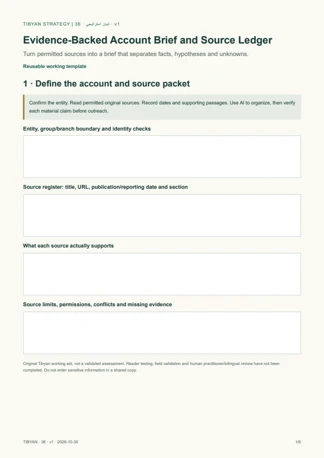
Evidence-Backed Account Brief and Source Ledger
Turn permitted sources into a brief that separates facts, hypotheses and unknowns.
PDF · 6 pages · 70 KB · Version 1
Download English PDF Open editable working template ↗Check what each source supports, then bring one question that could change your meeting plan.

A distributor announces plans to expand its warehouse. Its operations manager tells you the current site has spare space. Both statements could be true. The expansion might replace rented space, serve a different product line, or respond to a future contract. Your meeting improves when you know which assumption the answer would change.
Draw a tiny map with two pins. Put the manager’s comment on the current site. Where should the expansion pin go? Ask the buyer before giving the sales team directions.
In this fictional account, record what each source actually establishes. The announcement reports expansion plans. The manager describes current space at one site. A separate inference is that the company needs new inventory software. That inference is weak until you know which workflow is changing, for whom and by when.
| Signal and scope | Two plausible explanations | Evidence that would distinguish them |
|---|---|---|
| Expansion announcement and spare floor space at the current facility | The buyer may be replacing leased capacity or adding capacity for a new product line. | Which inventory, sites and processes will move, and which work will stay at the current site? |
Write down the date, entity and exact statement for each signal. If public material refers to the parent company and the contact describes one subsidiary, clarify the scope before trying to reconcile them. If the answer would change which colleague attends or what you bring to the meeting, put the question near the top of your brief. HM Treasury’s guidance on testing consequential uncertainties offers a principle you can adapt to this preparation. HM Treasury, Test and Learn
Try “I saw the expansion announcement, and you mentioned spare space at this site. Which part of the work do you expect to move?” If the buyer says nothing will move this year, ask whether any current process is worth discussing now. Update your meeting objective in light of the answer.
Try a fresh case. An annual report says procurement is centralized, while a branch manager says she chooses suppliers. Write two explanations and one question that distinguishes them. A strong question asks which purchase types and approval limits each statement covers. Review the brief by underlining every sentence a buyer could correct. Flag any remaining inference as a hypothesis.
Before your next buyer meeting, log the sources and the one uncertainty you want the buyer to clarify. Evidence-Backed Account Brief and Source Ledger
Take the next step
Free downloads. No registration. Each PDF includes instructions, an illustrative example and a reusable worksheet.
Tibyan Toolkit 36
Turn permitted sources into a brief that separates facts, hypotheses and unknowns.
PDF · 6 pages · 70 KB · Version 1
Download English PDF Open editable working template ↗Practical worksheets, not validated assessments. Adapt the task and timing to your context. See each PDF for its revision date.
Explore the tools & toolkits library ↗
Practical perspective
Prepare a B2B quotation that procurement, finance, and operations can assess. Use Tibyan’s QUOTE Framework, an annotated example, and a 13-point checklist.
Read perspective
Talent Development
Check whether the task still matters, how people learn it and what gets in their way before you keep, redesign or retire a course.
Read perspective
Team development
Follow one customer case across teams and find which handoff lost the facts, ownership or promise.
Read perspective