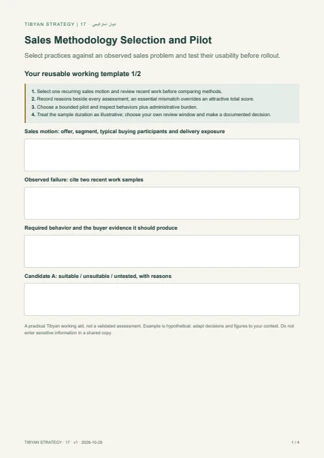
Tibyan Toolkit 17
Sales Methodology Selection and Pilot
Select practices against an observed sales problem and test their usability before rollout.
PDF · 4 pages · 67 KB · Version 1
Download English PDF Open editable working template ↗Match discovery, qualification and opportunity-management practices to your real sales work, then pilot the minimum useful approach before a wider rollout.

Your team has completed sales training, yet opportunity reviews still sound different from one manager to another. One seller presents a product demonstration as evidence of progress. Another has a detailed contact list but cannot explain why the buyer would change. Adding another branded methodology will not resolve these differences unless you know which work needs to improve.
By the end of this guide, you should be able to choose a practical combination of discovery, qualification and opportunity-management practices, then test it before a wider rollout. The objective is a usable way of working that helps sellers and managers make better decisions.
In this guide, a sales process describes the stages and responsibilities in your organization. A methodology guides how people perform important selling tasks. A qualification framework organizes evidence about whether an opportunity deserves further investment. These definitions are working distinctions: providers sometimes use the terms differently.
A process can tell a seller to complete discovery without helping them conduct a useful conversation. A framework can reveal that buying authority is unknown without teaching how to discuss it respectfully. A good operating system connects the conversation, the evidence recorded and the manager's next decision.
Before selecting an approach, review real work. Look at recent discovery notes, proposals, lost opportunities and handovers. Ask where decisions became weak: Was the problem superficial? Were evaluation requirements unclear? Did a promised signature depend on an undiscovered procurement step? Use these observations to define the selection problem. Tibyan's revenue bottleneck guide helps identify the priority before choosing training.
| Job | What good work produces | Warning sign |
|---|---|---|
| Discovery | A buyer-checked account of the problem, consequences and desired outcome | Detailed product interest without a clear reason to change |
| Qualification | Evidence about value, access, suitability and the buying decision | Confidence based on one enthusiastic contact |
| Opportunity management | Agreed next steps, responsibilities and unresolved dependencies | Seller activity advances while buyer decisions remain unchanged |
These jobs overlap, but one does not replace the others. Your team might need stronger discovery conversations while retaining an existing qualification checklist. Alternatively, skilled sellers may need clearer stage evidence and manager coaching rather than another conversation framework.
Huthwaite describes SPIN through four question types covering situation, problems, implications and the value of resolving them. Its explanation treats these as a flexible conversation framework. MEDDICC's description of MEDDPICC covers qualification information including value measures, buying authority, decision criteria, decision process and the path from decision to signature. These are their providers' descriptions, not independent proof that one approach will outperform another in your business. Huthwaite overview; MEDDICC overview.
The useful selection question is therefore specific: Which behaviors or evidence gaps would this approach address? Ask prospective training providers to demonstrate a realistic customer conversation and manager review using a scenario from your sales motion. Check the permission needed to reproduce or adapt their materials. A short comparison article does not substitute for professional training in a proprietary approach.
Tibyan suggests comparing candidates against your actual sales conditions rather than scoring brand familiarity. Examine:
Use a simple assessment of suitable, unsuitable or untested, with a reason beside each judgment. A numeric total can hide a critical mismatch: a high overall score does not overcome a missing capability you consider essential. Record those essential requirements separately.
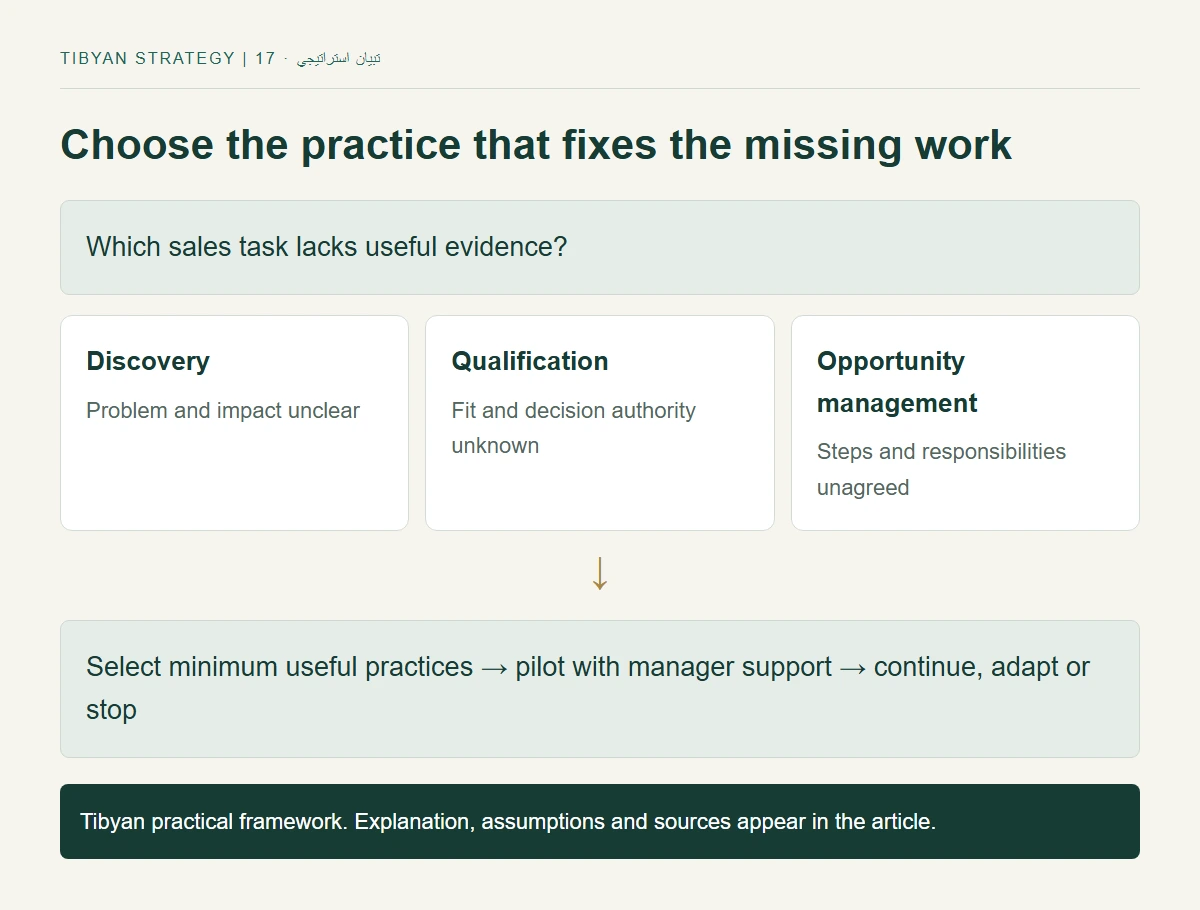 Open the diagram full size ↗
Original Tibyan decision aid: diagnose the missing work, choose the minimum useful practice, then test it. This is a practical recommendation, not a validated predictive model.
Imagine a company selling maintenance analytics to manufacturers. Its sellers explain dashboards clearly. However, opportunity reviews reveal that they rarely confirm how maintenance losses affect production, or who must approve access to operational data. This is an illustrative example, not a Tibyan client case.
The sales leader identifies two requirements. Sellers need a better discovery conversation about the operational problem and its consequences. They also need a small qualification record documenting the decision participants, access requirements and next evidence-gathering step. The leader does not mandate a large new form for every early contact.
The team pilots a problem-and-impact conversation guide alongside five evidence fields in its existing customer relationship management system. A seller records, for example: “Maintenance manager reports repeated unplanned stops; production impact not yet checked; operations director and IT review required; buyer agreed a joint evidence discussion.” Unknown information stays visibly unknown.
The manager now has something to coach: whether the seller explored consequences with the right people and agreed a useful next step. A completed form alone would not demonstrate either behavior.
Tibyan recommends a pilot with a defined group, a fixed review date and a small number of comparable opportunities. A six-week window may be a workable starting point for some teams; choose the duration around your opportunity flow and sales cycle. It is not a universal standard.
Before starting, record a baseline from recent work samples. Agree two or three behaviors to inspect, such as buyer-checked problem statements, named evidence gaps and buyer-agreed next steps. Define what counts as adequate evidence, and show examples of both strong and weak records.
During the pilot, managers should review a few actual work samples and rehearse difficult moments with sellers. Notice whether a field creates useful thinking or merely more typing. Track preparation effort, record quality, buyer feedback where available and whether managers use the information to change decisions.
Commercial results matter, but a short pilot rarely isolates the effect of a methodology. Compare opportunity context, avoid treating small-sample movements as proof, and allow enough time for outcomes to develop. The immediate decision is whether the approach is usable and improves the quality of work sufficiently to continue testing.
Agree who maintains the definitions, who coaches the practices and who can simplify unnecessary requirements. Integrate the minimum evidence into existing reviews. If management still rewards optimistic dates without checking buyer evidence, sellers receive conflicting instructions.
Use training to address observable behaviors, then provide workplace support. Tibyan's sales curriculum guide explains how to work backward from a real task. An L&D partner can help design practice; the sales leader remains responsible for the operating decisions the method should support.
Choose one segment or offer. Write the recurring failure you want to address, identify the missing behavior and define the evidence a manager should see. Compare two plausible approaches, including improving your existing practice. Name the pilot owner and review date before commissioning the rollout.
Download the free methodology selection matrix and pilot checklist. Use the completed example to understand the decisions, then complete the blank template with your sales and enablement colleagues. The pack is an original Tibyan working aid, not a reproduction of a provider's training materials.
You can also use the editable, printable working template. Download an edited copy from your browser without submitting your entries.
Explore the Sales Training collection.
Cover: AI-generated conceptual artwork. Diagram and tool: original Tibyan editorial design.
Provider descriptions were checked in October 2026. The selection matrix, pilot design and example above are Tibyan recommendations; they do not establish comparative effectiveness or guarantee revenue growth.
Take the next step
Free downloads. No registration. Each PDF includes instructions, an illustrative example and a reusable worksheet.
Tibyan Toolkit 17
Select practices against an observed sales problem and test their usability before rollout.
PDF · 4 pages · 67 KB · Version 1
Download English PDF Open editable working template ↗Practical worksheets, not validated assessments. Adapt the task and timing to your context. See each PDF for its revision date.
Explore the tools & toolkits library ↗
Practical perspective
Prepare a B2B quotation that procurement, finance, and operations can assess. Use Tibyan’s QUOTE Framework, an annotated example, and a 13-point checklist.
Read perspective
Talent Development
Check whether the task still matters, how people learn it and what gets in their way before you keep, redesign or retire a course.
Read perspective
Team development
Follow one customer case across teams and find which handoff lost the facts, ownership or promise.
Read perspective