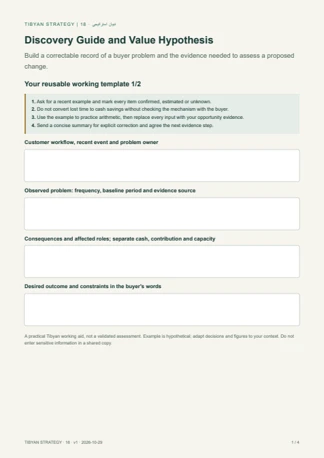
Tibyan Toolkit 18
Discovery Guide and Value Hypothesis
Build a correctable record of a buyer problem and the evidence needed to assess a proposed change.
PDF · 4 pages · 67 KB · Version 1
Download English PDF Open editable working template ↗Follow a buyer’s workflow from rework hours to capacity and payments. Use operating and payroll records to establish what would change.

A distributor’s order desk spends about 40 hours a month reworking incomplete orders. The finance controller records 32 paid overtime hours that month. If the order desk cuts 30 hours of rework, how much could finance save on payroll in a comparable month?
The answer depends on which work moves, which shifts are affected and which payments the distributor can cancel. In this fictional Saudi distributor, the same 30 hours of recovered time can lead to two different cash results. You can investigate the difference before you attach a value to your offer.
Follow one order that missed its release time. Find out where the order stopped and what people did to move it forward. At this distributor, incomplete orders are held at the order desk while staff obtain missing information. The records can show the frequency of affected orders, a time sample can estimate the added work, and the roster can show whether that work falls during paid overtime.
Ask the order-desk lead to check the denominator. The reference month shows 400 reworked orders out of 4,000 eligible orders, a 10% rework rate. The time sample puts each reworked order at an average of six extra minutes. That gives an estimated 40 hours of rework for the month, calculated as 400 × 6 ÷ 60. Keep the sample period and the definition of rework next to the estimate. A different branch, product mix or month may have a different rate.
This is part of understanding how a customer’s business operates. In interviews with sales managers, Terho and colleagues identified understanding the customer’s business model as one part of value-based selling. In a sales conversation, that can mean learning what sets fulfilment capacity, how the customer covers peaks, and what triggers an extra payment. Terho et al., study on value-based selling
 Open the diagram full size ↗
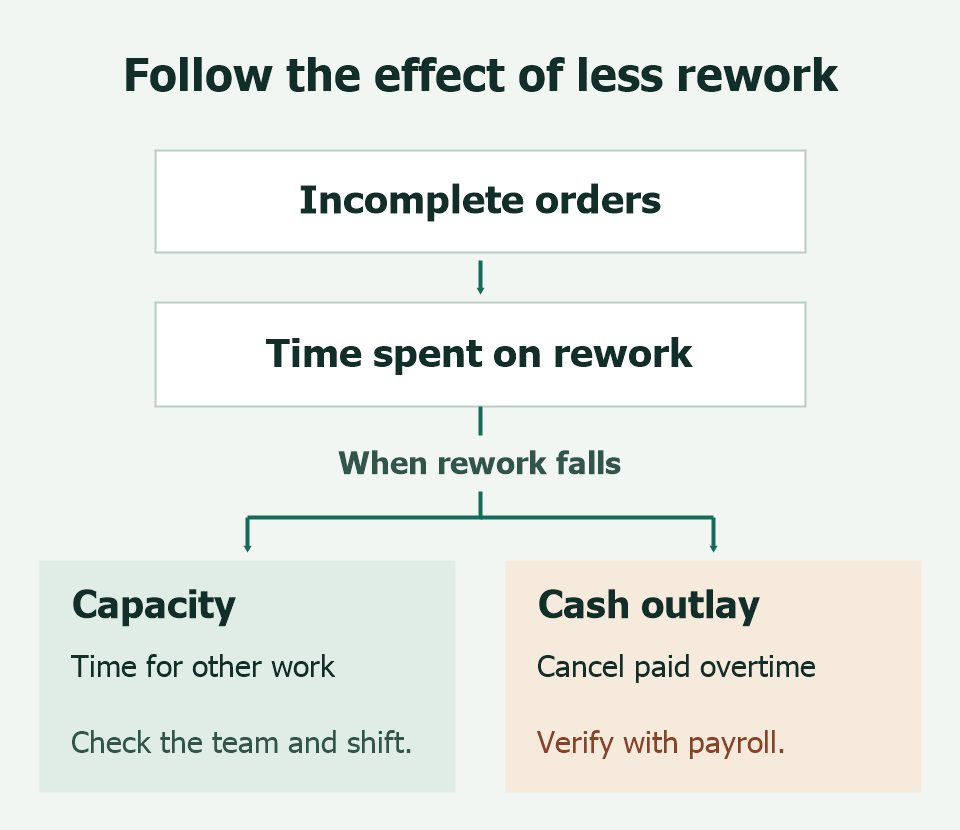
A change in the same workflow can affect available time and cash outlay in different ways.
Ask what happens if rework takes less time. If staff are on fixed salaries for the period and use the recovered time to clear orders before a dispatch cutoff, the operational question is whether on-time release improves. If the distributor can cancel paid overtime for the affected shifts, payroll can calculate a spending change. OpenStax describes this principle as comparing costs and revenues that differ across the alternatives. The time period matters because a commitment can be fixed this month and adjustable later. OpenStax on relevant and avoidable costs
The buyer’s priority determines which branch to pursue. Use these questions to decide what to check.
| If the buyer cares about… | Ask what changes | Record to request |
|---|---|---|
| Service capacity | Which team can use the hours, during which shift, and for what work? | Order queue and dispatch timestamps, checked by the order-desk lead |
| Staffing spend | Which hours or shifts can the buyer cancel, and in which payroll period? | Approved roster and pay records, checked by payroll or finance |
| Additional sales | What demand could the team serve, and what extra costs would come with those orders? | Order backlog and contribution estimate, checked by operations and finance |
| Timing of cash receipts | Does the workflow change when buyers are invoiced or when payment is due? | Release, invoice and collection dates, checked by accounts receivable |
For the distributor, finance initially has a monthly total of 32 paid overtime hours at SAR 220 per hour. The total is a ceiling for this reference month. Some of those hours may cover other work. Ask payroll to link proposed cancellations to a roster and confirm the payable rate before you include a saving.
The Deceptive Cat tries to feed 30 freed-up hours into the cash register. Hadi opens the payroll record and asks, “Which payment went down?” Answer his question for each of the two cases below.
Case A · The team has time to handle other orders. The revised workflow releases 30 staff hours this month and staffing payments stay the same. Record 30 hours of capacity and SAR 0 of staffing cash saving for the month. Ask the order-desk lead whether those hours are available during the shifts that need them. Compare the share of eligible orders released on time in comparable periods. A downstream constraint can still limit the improvement the buyer experiences.
Case B · Payroll confirms that overtime can be cancelled. The revised workflow also releases 30 staff hours, and finance verifies 18 scheduled overtime hours can be removed from that month’s payroll at SAR 220 per hour. Record 30 hours recovered and SAR 3,960 in potential avoided payroll for that month, calculated as 18 × 220. The other 12 hours are available for work within the existing schedule under these assumptions. Confirm via the subsequent pay record that the cancellation occurred, and account for any new spending introduced by the change before claiming a net cash benefit.
Write the result in two lines. The first line describes hours and who can use them. The second describes the payment that changes, the amount and the period. In Case B, the 18 paid overtime hours are part of the 30 hours released. Count their cash effect once. If you project a later month, ask the buyer first whether its order mix, staffing and overtime schedule are comparable.
Use one row for each consequence you want to claim. The first row shows Case B before the pay period closes. Fill in a second row for on-time release or a workflow you are examining with a buyer.
| Workflow issue | Baseline and unit | Operational effect | Cash mechanism and period | Record and owner | What could change the estimate? |
|---|---|---|---|---|---|
| Orders wait for missing fields | 400 of 4,000 orders reworked. Six minutes each on average. About 40 hours in the reference month. | The scenario releases 30 hours this month. Confirm which shifts and tasks benefit. | Up to SAR 3,960 in avoided payroll for 18 verified cancellable overtime hours this month. | Order desk owns order records and time sample. Payroll owns the roster and pay record. | The overtime serves another queue, the cancellation slips a pay period, or the revised workflow adds a cost. |
Try a different workflow. A returns team processes 500 returns in a month. It rechecks 60 of them at an average of eight minutes each. A new check at intake is expected to recover five hours that month. Staff payments stay the same. The manager hopes to issue refunds faster. Work out the baseline and record the estimated capacity and cash change. Name one outcome to verify and what evidence would support it.
Check your answer. The baseline is 12% rechecked and eight hours of work. The scenario releases five hours and shows SAR 0 of staffing cash saving. Faster refunds are a separate question. The returns lead could compare the time between receipt and refund approval for similar cases. Review whether the five hours are available at the point where refund decisions wait.
For a live opportunity, ask the buyer to correct the first row and name one record that could change the conclusion. A coach can review the attempt with two questions. “Which payment would actually change?” and “Would the answer still hold in a month with a different order mix?” If the cash effect remains open, record the operational consequence you can support and the next check.
Use the discovery worksheet to turn your economics map into a buyer-checkable hypothesis. Discovery Guide and Value Hypothesis
Take the next step
Free downloads. No registration. Each PDF includes instructions, an illustrative example and a reusable worksheet.
Tibyan Toolkit 18
Build a correctable record of a buyer problem and the evidence needed to assess a proposed change.
PDF · 4 pages · 67 KB · Version 1
Download English PDF Open editable working template ↗Practical worksheets, not validated assessments. Adapt the task and timing to your context. See each PDF for its revision date.
Explore the tools & toolkits library ↗
Practical perspective
Prepare a B2B quotation that procurement, finance, and operations can assess. Use Tibyan’s QUOTE Framework, an annotated example, and a 13-point checklist.
Read perspective
Talent Development
Check whether the task still matters, how people learn it and what gets in their way before you keep, redesign or retire a course.
Read perspective
Team development
Follow one customer case across teams and find which handoff lost the facts, ownership or promise.
Read perspective