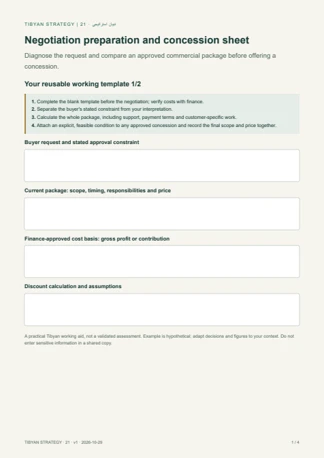
Tibyan Toolkit 21
Negotiation preparation and concession sheet
Diagnose the request and compare an approved commercial package before offering a concession.
PDF · 4 pages · 66 KB · Version 1
Download English PDF Open editable working template ↗Find out whether a price objection reflects funding, uncertain value, or a viable alternative before responding.

You quote SAR 60,000 for an order-management system. The buyer says, “That’s too expensive for us.” A smaller budget, weak evidence of value, and a credible internal alternative can all produce that response. Each calls for a different decision about what to do next.
Ask which comparison or condition makes the spend hard to approve. Reflect the answer back before proposing a response. Your aim is to help the buyer resolve the issue or decide the offer is unsuitable. In the fictional distributor examples below, the opening words stay the same and the evidence changes.
 Open the diagram full size ↗
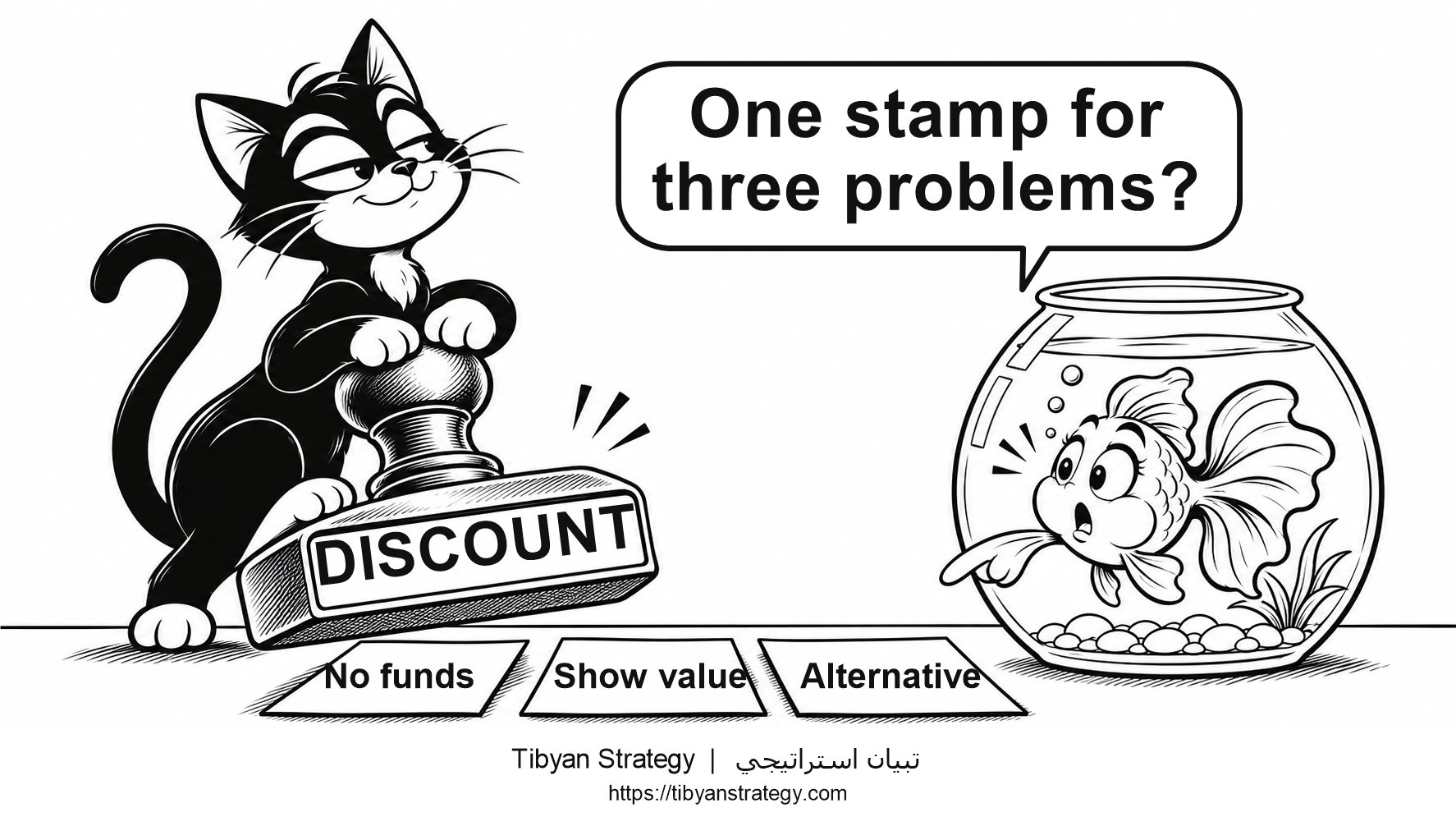
The Cat reaches for a discount. One buyer has no budget, another needs evidence of value, and a third has an alternative. The Fish asks, “One stamp for three problems?”
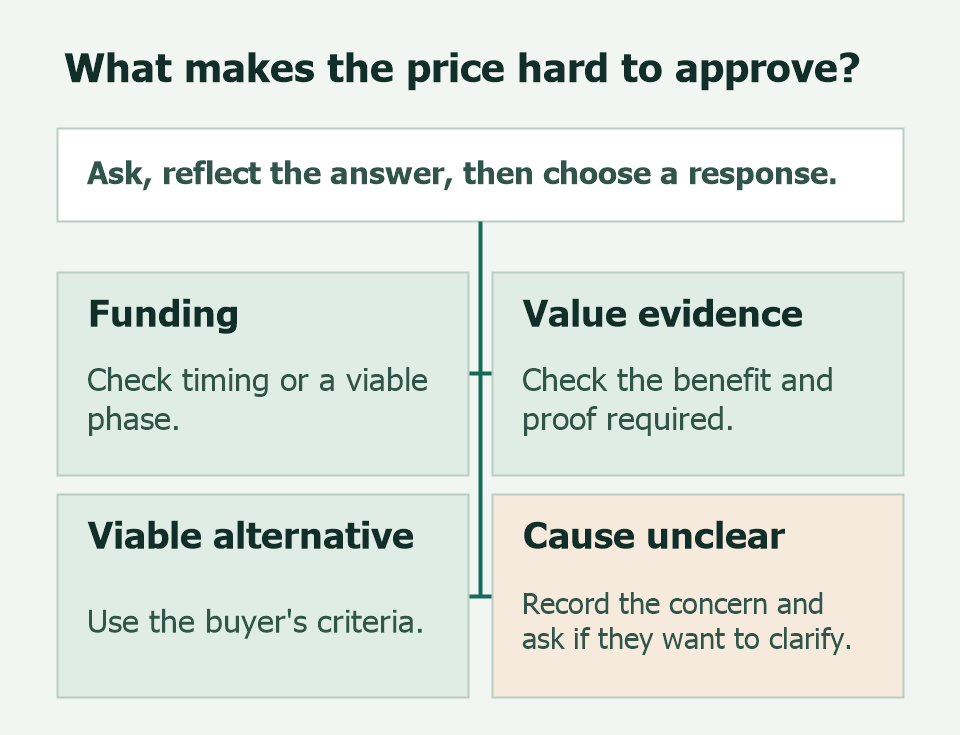
Try “What makes the spend difficult to approve at this stage?” If the answer is vague, check one plausible distinction at a time. “Is the difficulty funding it this year, or showing that it would deliver enough value?” If the buyer mentions another option, ask how they compare the work and results each option includes. Leave room for a reason you have missed.
In two negotiation experiments, Leigh Thompson examined exchanging information about interests and assessing the other party’s interests. The findings give a reason to pay attention to what the parties actually need. The questions and seller responses here are Tibyan’s teaching examples for a B2B discussion. Thompson, Information Exchange in Negotiation
 Open the diagram full size ↗
The buyer’s answer determines what to verify and whether it makes sense to continue.
Funding is unavailable in the current period. The buyer confirms that the current year’s spending allowance cannot cover the quoted scope. A smaller phase has yet to be approved and would need to work independently. Confirm when funds could be available and what outcome a smaller phase would have to deliver. Offer that discussion only if the buyer wants it and you have authority to discuss the change. A deferral can be the appropriate outcome.
Finance has yet to see enough evidence of value. The controller could support the purchase if the model holds, but can verify only 18 removable overtime hours per benefit month. Restate the condition. “The question is how much overtime we can credibly remove. Which record and approval requirement should we check together?” Use the buyer’s criteria. Once you know what the evidence shows, the buyer can decide whether to run a test, revisit the proposed scope or stop.
There is a viable internal alternative. Operations has assigned staff to test a required-field checklist and believes it can address the problem. Ask what result would justify retaining that option and whether the buyer wants help comparing it with software. If the internal fix looks suitable on current evidence, acknowledge that. Agree to revisit the decision only if the buyer wants a later comparison and can name what would trigger it.
If the reason stays unclear, record the concern as stated and ask whether the buyer wants to clarify it. This preserves the difference between a buyer’s words and the seller’s interpretation. A clear decline ends the discussion for this purchase.
Have a partner say “That’s too expensive for us.” Ask a question before they reveal one of the three constraints above. Then write your interpretation and the next action. Ask your partner to point to the words in your question that helped them explain the constraint. Try again with a different case. When working alone, write a question first, then use each case as the reply and draft the next step.
For a fresh attempt, the buyer tells you they have a lower written quote that excludes integration. Which question would you ask before considering a price change? One useful answer is “How will your team compare integration effort and what each supplier is responsible for?” Check what the buyer is comparing and what acceptance would require. Once the offers have comparable scope, price can be considered on those terms.
| Buyer’s words | Plausible reasons | Question to distinguish them | Confirmed constraint | Next action and reason |
|---|---|---|---|---|
| “That’s too expensive for us.” | Available funds, weak evidence of value, credible alternative | “What makes the spend difficult to approve at this stage?” | Finance can verify 18 removable overtime hours per benefit month and needs stronger evidence to justify the proposal. | Verify the model and approval requirement with finance, then share the evidence so the buyer can review the decision. |
When reviewing the work, look for whether the question could distinguish plausible reasons, whether the interpretation uses the actual answer, and whether the proposed action addresses it. Use your next suitable conversation to practise the move. Keep a permitted note of the question and the constraint the buyer confirmed.
Use the preparation sheet to record the buyer’s constraint and any terms you have authority to discuss. Negotiation preparation and concession sheet
Take the next step
Free downloads. No registration. Each PDF includes instructions, an illustrative example and a reusable worksheet.
Tibyan Toolkit 21
Diagnose the request and compare an approved commercial package before offering a concession.
PDF · 4 pages · 66 KB · Version 1
Download English PDF Open editable working template ↗Practical worksheets, not validated assessments. Adapt the task and timing to your context. See each PDF for its revision date.
Explore the tools & toolkits library ↗
Practical perspective
Prepare a B2B quotation that procurement, finance, and operations can assess. Use Tibyan’s QUOTE Framework, an annotated example, and a 13-point checklist.
Read perspective
Talent Development
Check whether the task still matters, how people learn it and what gets in their way before you keep, redesign or retire a course.
Read perspective
Team development
Follow one customer case across teams and find which handoff lost the facts, ownership or promise.
Read perspective