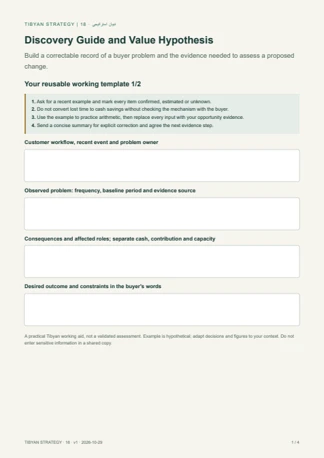
Tibyan Toolkit 18
Discovery Guide and Value Hypothesis
Build a correctable record of a buyer problem and the evidence needed to assess a proposed change.
PDF · 4 pages · 67 KB · Version 1
Download English PDF Open editable working template ↗Compare first-year buyer cash and show finance which assumptions could change the choice.

In the most favorable scenario, a distributor’s proposed order-management system beats an internal workflow fix by SAR 400 in first-year cash. If integration slips by a month, the internal fix leads by SAR 6,640. That difference gives finance and IT a concrete reason to check the launch plan together.
Use a model the buyer can reproduce. Give every option the same baseline and period, show who owns each input, and calculate the point at which the decision changes. The distributor and figures below are fictional.
Move the integration date by one square on a monthly calendar. Now run the comparison again. Which payments stay on the calendar, and which benefits move?
The distributor can retain the current process, run its own required-field checklist, or buy software that checks order data at entry. Use the current workflow as the baseline. Its incremental cash change is zero by definition in this comparison. The checklist costs SAR 12,000 in year one. The software costs SAR 60,000, made up of SAR 36,000 for the licence, SAR 18,000 for integration, and SAR 6,000 for training. Both options are assumed to deliver benefits for ten months of the first year. Confirm with procurement which outlays actually fall in that period.
The method borrows two principles. OpenStax’s managerial accounting guidance compares costs and revenues that differ between alternatives. The UK Treasury’s appraisal guidance calls for comparing options against a baseline and using sensitivity or switching values to expose an assumption that could change the choice. The example applies those principles to first-year buyer cash. Relevant costs and alternatives · The Green Book
The distributor estimates that 400 orders each month need manual rework and assumes six net minutes recovered for each affected order reached by the software. Estimate released capacity as 400 × 6 ÷ 60 × the share of affected orders reached. The share of all orders using the system is a useful proxy only if their mix and likelihood of rework are comparable. Check how much time exception handling takes after the change.
Finance estimates separately how many paid hours the buyer could cancel. The reference month contains 32 paid overtime hours at an avoidable rate of SAR 220 per hour. Use that count as the reference ceiling, and verify which hours can actually be removed. For each scenario, multiply the paid hours removed by SAR 220 and by the number of months that benefit. Subtract the first-year outlay to get the net cash difference versus the current workflow.
| Option | Affected orders reached | Capacity released per benefit month | Paid hours removed per benefit month | First-year cash benefit | First-year outlay | First-year net cash |
|---|---|---|---|---|---|---|
| Current process | Reference | 0 h | 0 h | SAR 0 | SAR 0 incremental | SAR 0 |
| Internal fix | Operations estimate | 16 h | 10 h | SAR 22,000 | SAR 12,000 | +SAR 10,000 |
| Software downside | 30% | 12 h | 0 h | SAR 0 | SAR 60,000 | −SAR 60,000 |
| Software base | 75% | 30 h | 18 h | SAR 39,600 | SAR 60,000 | −SAR 20,400 |
| Software upside | 90% | 36 h | 32 h | SAR 70,400 | SAR 60,000 | +SAR 10,400 |
Include other verified cash effects or costs if they change with the choice. Keep service quality and redeployed staff time visible. The same hours underlying an avoided payment should appear only once in the cash calculation. If the buyer needs a longer-horizon decision, finance can specify the timing and scope of the additional comparison.
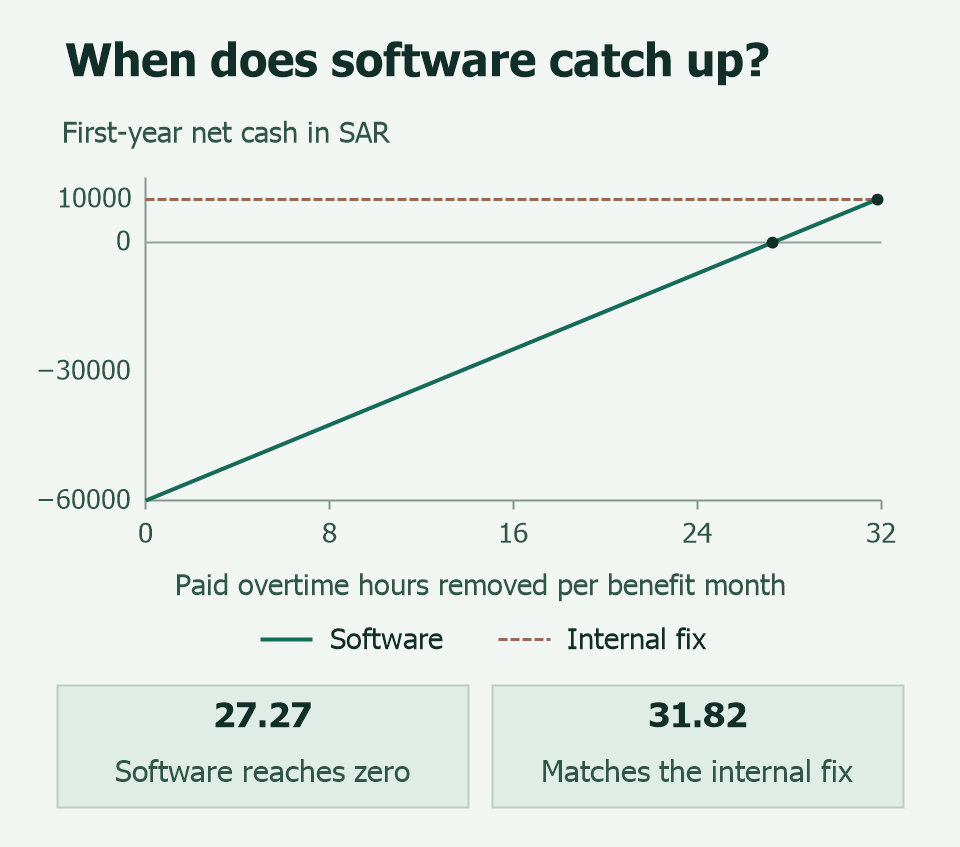 Open the diagram full size ↗
At ten benefit months and SAR 220 per hour, the software comes close to the reference overtime ceiling before it matches the internal fix.
Under the base assumptions, start with the internal trial. To justify reconsidering the software on cash alone, the buyer would need much stronger evidence that nearly all of the reference overtime is removable and that the installation can run to schedule. Read the upside as a scenario with conditions. Choose the option only after checking those conditions with the buyers who control them.
Try a changed assumption. IT adds one month to the integration schedule, leaving nine benefit months. Costs and the timing of the internal fix stay as shown. Recalculate the software upside. The answer is 32 × 220 × 9 − 60,000 = SAR 3,360, below the internal fix’s SAR 10,000 by SAR 6,640. Record the revised ranking and the dependency behind it.
| Option and period | Outlays and basis | Released time and paid hours removed | Net cash and comparison | Input to confirm, and owner |
|---|---|---|---|---|
| Software base, first year | SAR 60,000 from licence, integration and training | 30 h available. 18 paid h cancelled per month at SAR 220 for ten months. | −SAR 20,400 versus current. Internal fix leads on first-year cash. | Finance checks the roster and paid rate. IT checks benefit months. Procurement checks outlay timing. |
Ask a reviewer to reproduce the totals, confirm the cash period and test a credible change in timing or paid overtime. Use the discovery worksheet to confirm the buyer’s baseline and who can verify each assumption before taking the model to finance. Discovery Guide and Value Hypothesis
Take the next step
Free downloads. No registration. Each PDF includes instructions, an illustrative example and a reusable worksheet.
Tibyan Toolkit 18
Build a correctable record of a buyer problem and the evidence needed to assess a proposed change.
PDF · 4 pages · 67 KB · Version 1
Download English PDF Open editable working template ↗Practical worksheets, not validated assessments. Adapt the task and timing to your context. See each PDF for its revision date.
Explore the tools & toolkits library ↗
Practical perspective
Prepare a B2B quotation that procurement, finance, and operations can assess. Use Tibyan’s QUOTE Framework, an annotated example, and a 13-point checklist.
Read perspective
Talent Development
Check whether the task still matters, how people learn it and what gets in their way before you keep, redesign or retire a course.
Read perspective
Team development
Follow one customer case across teams and find which handoff lost the facts, ownership or promise.
Read perspective