A respected introducer says, “They want your solution.” The meeting is friendly, the contact is senior and a demonstration is requested. Your team creates an opportunity with a purchase value and an expected closing date. Yet nobody has confirmed an investment project, the affected workflow or who would evaluate a change.
An introduction can open a conversation. Qualification requires evidence about whether there is a relevant opportunity to investigate. Preserve the relationship by learning what the contact actually wants, rather than turning the introducer's confidence into facts the buyer has not confirmed.
Use this guide when: a referral, event or local connection has produced a conversation, and you must decide whether to develop an opportunity, continue exploration or step back.
Learning outcome: turn an introductory conversation into a correctable evidence record and a buyer-agreed next step, without inventing purchase intent.
Bring: what the introducer actually said, the source of each claim, a relevant offer, the contact's known role and any permission boundaries. Do not circulate private details merely because someone shared them informally.
Separate access, interest and a purchasing project
These signals answer different questions. Access means that a person is willing to engage. Interest may mean that a topic is relevant. An opportunity under your organization's process needs further evidence appropriate to the proposed commitment.
Salesforce's lead guidance distinguishes qualifying a lead from working an opportunity and states that the qualification criteria belong to the company's business process. This is vendor process guidance, not proof that a particular qualification method improves win rates. Salesforce Trailhead: Track Prospects with Leads.
Tibyan recommends keeping the initial evidence modest and explicit:
A contact may also be learning, benchmarking or helping a colleague. Those are legitimate reasons for discussion. You can provide value without assigning an unsupported buying stage.
Prepare an introduction record you can correct
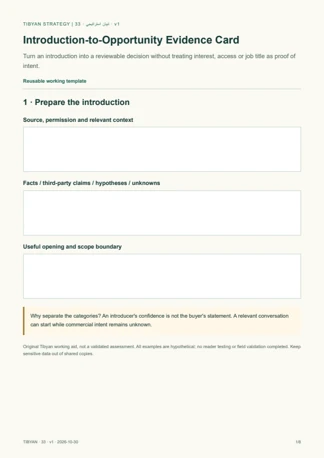
Before the meeting, separate three columns: confirmed information, information reported by the introducer and questions for the contact. Include the date and source. This prevents a repeated statement from acquiring false certainty as it moves through your team.
“The introducer believes reporting is a concern” differs from “the maintenance manager confirmed that weekly reconciliation delays a specific task.” Both may matter; only the second is direct evidence from that conversation, and even it may need detail or corroboration.
Agree how to acknowledge the introduction and what can be shared back. Do not promise to report confidential discussion to the introducer unless the contact permits it. Check names, roles and organizational boundaries, especially where similar company names or group subsidiaries could be confused.
Open with relevance and permission
Explain why you requested the conversation, then invite correction. A useful opening could be: “We were introduced because reporting may be a concern. I would like to understand whether that is relevant to your work and whether there is a useful next question for us to explore.”
That is an original example, not a script with a proven conversion effect. Adapt it to the actual introduction and the buyer's task. Avoid claiming to understand the organization before listening to it.
For trust-building in this guide, focus on observable conduct: represent what you know accurately, honor the agreed boundaries, acknowledge uncertainty and follow through on a useful next action. Do not substitute a claim about regional culture for these behaviors. A title, nationality or warm conversation does not establish another person's priorities.
Ask about the work before presenting the answer
GOV.UK's interviewing guidance recommends open, neutral questions and concrete examples. Here, those principles are adapted to an introductory sales conversation; they are not a validated sales qualification instrument. GOV.UK: In-depth interviews.
Start with a recent situation. “How was the last reporting cycle handled?” gives the contact room to describe the process. “Would our platform solve your reporting problem?” presumes both a problem and a solution.
Explore what happened, who was involved, what consequences the contact observed and how they currently respond. When a consequence is unclear, keep it unclear in the record. Ask which information would clarify it instead of inserting a financial impact yourself.
Then explore the status of change. Is the organization examining alternatives, running an approved project or simply discussing a concern? Who would need to help evaluate the next question? Ask about timing and resources in a way that fits the conversation; unknown budget is not permission to invent a budget, and one incomplete conversation need not mean there is no future opportunity.
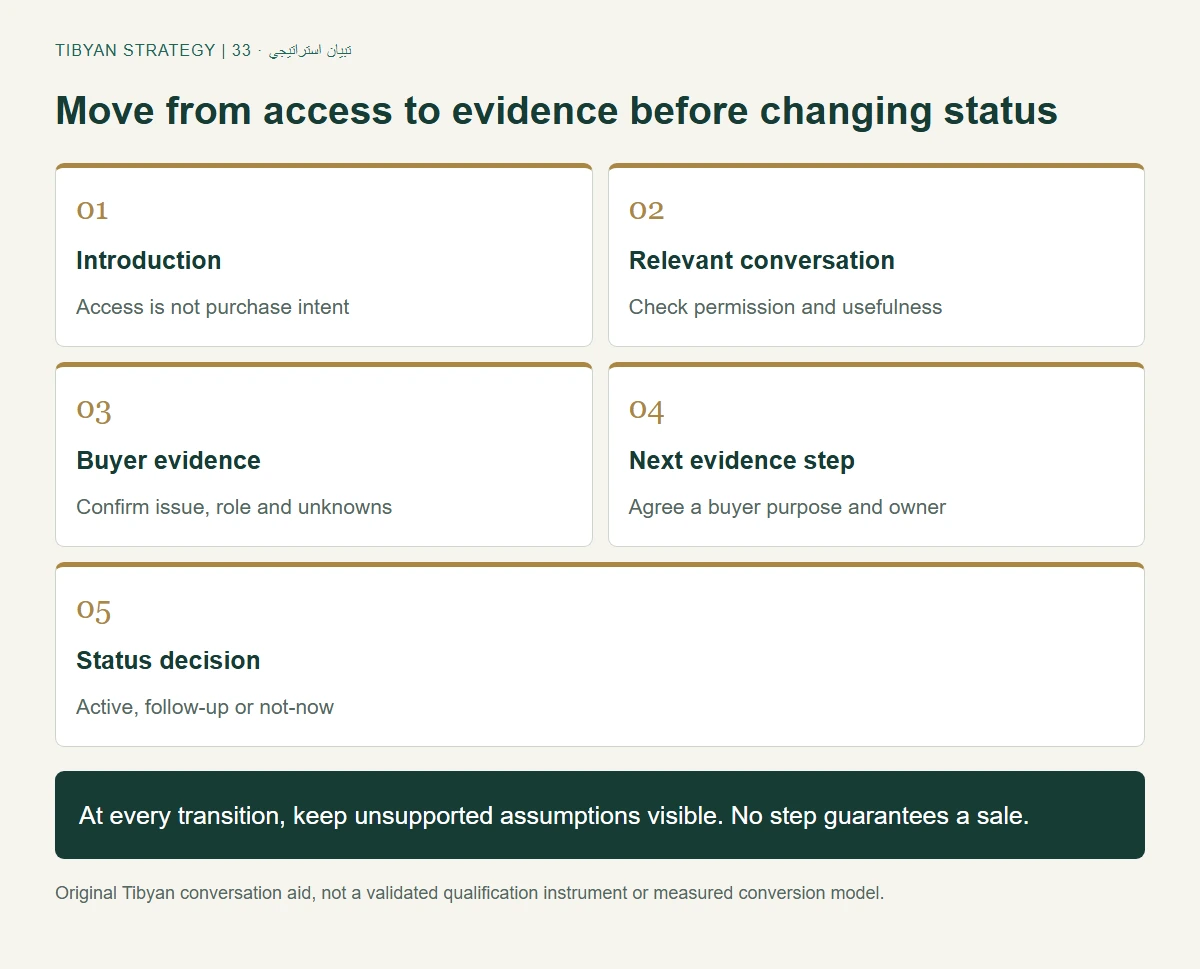 Open the diagram full size ↗
Original Tibyan evidence flow. A useful next investigation can follow an introduction without implying that a purchasing project exists. Buyer agreement and factual corrections remain essential.
Hypothetical example: reporting concern, not an approved purchase
The company, contact, introduction and conversation are invented. This is not a client case or a measured gain in trust or conversion. A local introducer says a maintenance manager “wants the monitoring solution.” In the fictional meeting, the manager explains that reporting is difficult, but has not agreed an investment project. Operations and IT would need to assess any change.
The seller could mark budget and timing “to be confirmed” while still assigning a large opportunity value and a near-term closing date. That would preserve uncertainty in one field while ignoring it in the forecast. A better record states what the meeting supports: an exploratory contact and a reporting issue that deserves clarification.
Weak record: “Senior contact, positive meeting, qualified opportunity.”
Stronger record: “The manager described a current reporting concern and is open to a scoped workflow review involving the relevant operator. Whether an investment project exists, who could approve it and when a decision might occur remain unverified.”
If the contact agrees, the next step is a review with a purpose: understand one reporting task, its consequences and whether further evaluation is worthwhile. The manager should confirm the appropriate participant and timing. Do not write an invitation on another person's behalf or claim that the operator has agreed before that happens.
Make the next step useful to the buyer
“Send a proposal” may be premature when scope and decision roles remain unknown. “Follow up next week” describes seller activity but not buyer value. Define the question the next interaction should resolve and why the contact would spend time on it.
Record five things: the question, the intended output, the relevant participants, the agreed owner and the timing or condition for confirming timing. Keep proposed actions separate from agreed actions.
For example: “With your permission, review the current reporting workflow with the operator you identify, to check whether the issue warrants a technical assessment.” This does not promise a return on investment, a diagnosis or a purchase. It proposes a bounded investigation.
Send a concise factual recap through an authorized channel when the contact has agreed to that follow-up. Invite corrections to the problem statement and next step. This guide provides a preparation method; it does not authorize unsolicited outreach or disclosure of contact details.
Choose the appropriate internal action
Use your actual sales-stage definitions. Tibyan suggests documenting one of three immediate decisions, with the evidence behind it:
- Continue exploration: relevance is plausible, but the problem, project or next step needs clarification.
- Develop the opportunity: the available evidence meets your defined entry criteria and justifies the next selling commitment.
- Pause or close this pursuit: the contact has declined, the fit is poor or there is no useful agreed next step under current conditions.
These are working decisions, not universal CRM stages. Avoid a score that lets a senior title cancel out missing buyer evidence. If your stage requires a buyer-confirmed need and a defined evaluation step, record the absence of either rather than awarding points for friendliness.
Review the record with the manager. Ask, “What did the buyer confirm, and what are we assuming?” Preserve a courteous refusal, a misunderstanding and a canceled next step. They inform the next decision and should not disappear from the evidence.
Common mistakes to avoid
- Repeating the introducer as the buyer: retain the source of each statement.
- Using a demonstration as a qualification shortcut: establish the task the demonstration should address.
- Treating unknown budget as a known number: distinguish hypotheses from confirmed facts.
- Confusing seniority with a decision role: ask how the relevant decision would be made.
- Forcing a next step: allow the contact to correct, decline or propose something different.
Apply the meeting and qualification guide
Use the free Introduction-to-Opportunity Evidence Card (PDF) to prepare the conversation, record what was confirmed and agree a useful next step. It includes blank working pages and a clearly hypothetical completed example.
Take one recent authorized introduction and rewrite the internal record in three columns: what the buyer said, what someone else reported and what remains unknown. Remove unsupported forecast assumptions. Then decide the next permitted evidence action with the account owner.
For deeper exploration after relevance is established, use discovery that builds a business case. For the people needed in a real decision, use the buying-group guide. If the team struggles to turn contacts into disciplined next actions, you can discuss the operating issue with Tibyan.
Evidence limits
The source guidance supports process distinctions and interviewing practices. The record, decision labels and hypothetical dialogue are original teaching aids. No actual customer conversation, trust measure or qualification outcome was observed. Reader testing in Arabic and English, practitioner/bilingual review and permissioned field examples are still needed; none of these materials establish a revenue effect.
Cover: original AI-generated conceptual artwork. Diagram and working pack: original Tibyan editorial designs.
Related free resource: supporting working tool.
You can also use the editable, printable working pack and download your edited copy.
Sources
Sources checked 30 October 2026.