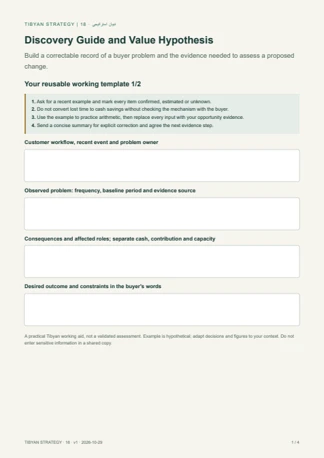
Tibyan Toolkit 18
Discovery Guide and Value Hypothesis
Build a correctable record of a buyer problem and the evidence needed to assess a proposed change.
PDF · 4 pages · 67 KB · Version 1
Download English PDF Open editable working template ↗Turn buyer conversations into a checked problem statement, a defensible value hypothesis and a clear next step for gathering evidence.

A buyer says, “We need better reporting.” Your seller demonstrates a dashboard, sends a proposal and waits. The conversation feels productive, but no one has established which decision reporting should improve, what the current problem costs or who will verify the proposed benefit. Interest has become a forecast before it has become a business case.
After using this guide, you should be able to conduct a discovery conversation that produces a buyer-checked problem statement, a defensible value hypothesis and a useful next evidence-gathering step. The aim is to help the buyer assess a decision, including the possibility that your solution is unsuitable.
Treat discovery as joint investigation. The seller brings relevant preparation and questions; the buyer contributes operational knowledge and decides what matters. A useful output separates what is known, what is estimated and what remains untested. It should be possible for another colleague to read the notes and understand why a change deserves investigation.
Huthwaite's SPIN explanation distinguishes questions about context, difficulties, consequences and the value of resolving them. That is a useful reminder to move beyond gathering facts; it does not mean reading a fixed sequence of questions or importing the provider's performance claims. Huthwaite's framework overview.
The discovery process below is Tibyan's practical working approach. It is not a substitute for a buyer's financial appraisal or their internal investment approval process.
Before the meeting, review reliable public information and what the customer has already shared. Prepare a short note with three columns: known facts, plausible hypotheses and questions to resolve. Identify the role you are meeting and the limits of that person's knowledge.
For a manufacturer, an annual report might mention operational efficiency. That does not establish that one plant has a maintenance problem or that a particular manager owns a budget. A useful opening is: “You mentioned improving equipment availability. Which part of the operation needs attention, if any?” An unhelpful opening assumes your diagnosis: “Your downtime must be costing millions.”
Agree the meeting's purpose. Ask permission to explore how the work happens, where difficulties arise and whether further investigation would be worthwhile. Let the buyer correct the agenda. If the conversation involves sensitive operational data, begin with an appropriate level of detail and follow the customer's sharing rules.
Use questions as prompts, then follow the answer. Ask for a recent instance and trace what happened. A broad complaint such as “reporting is slow” becomes more useful when you understand who waited, which decision was delayed and what workaround followed.
| Explore | Useful prompt | Evidence to capture |
|---|---|---|
| Current work | “Walk me through the last time this happened.” | Workflow and a specific recent instance |
| Problem | “Where did the work become difficult?” | Observable issue, frequency and affected people |
| Consequence | “What happened next, and who noticed?” | Operational effects and dependencies |
| Desired outcome | “What would an acceptable improvement look like?” | Buyer-defined result and constraints |
| Decision | “What would you need to know before deciding?” | Required evidence and the people who can verify it |
Do not make the buyer calculate a business case on demand. If a value is uncertain, record its owner and a route to check it. A useful discussion can end with a modest evidence request rather than an immediate proposal.
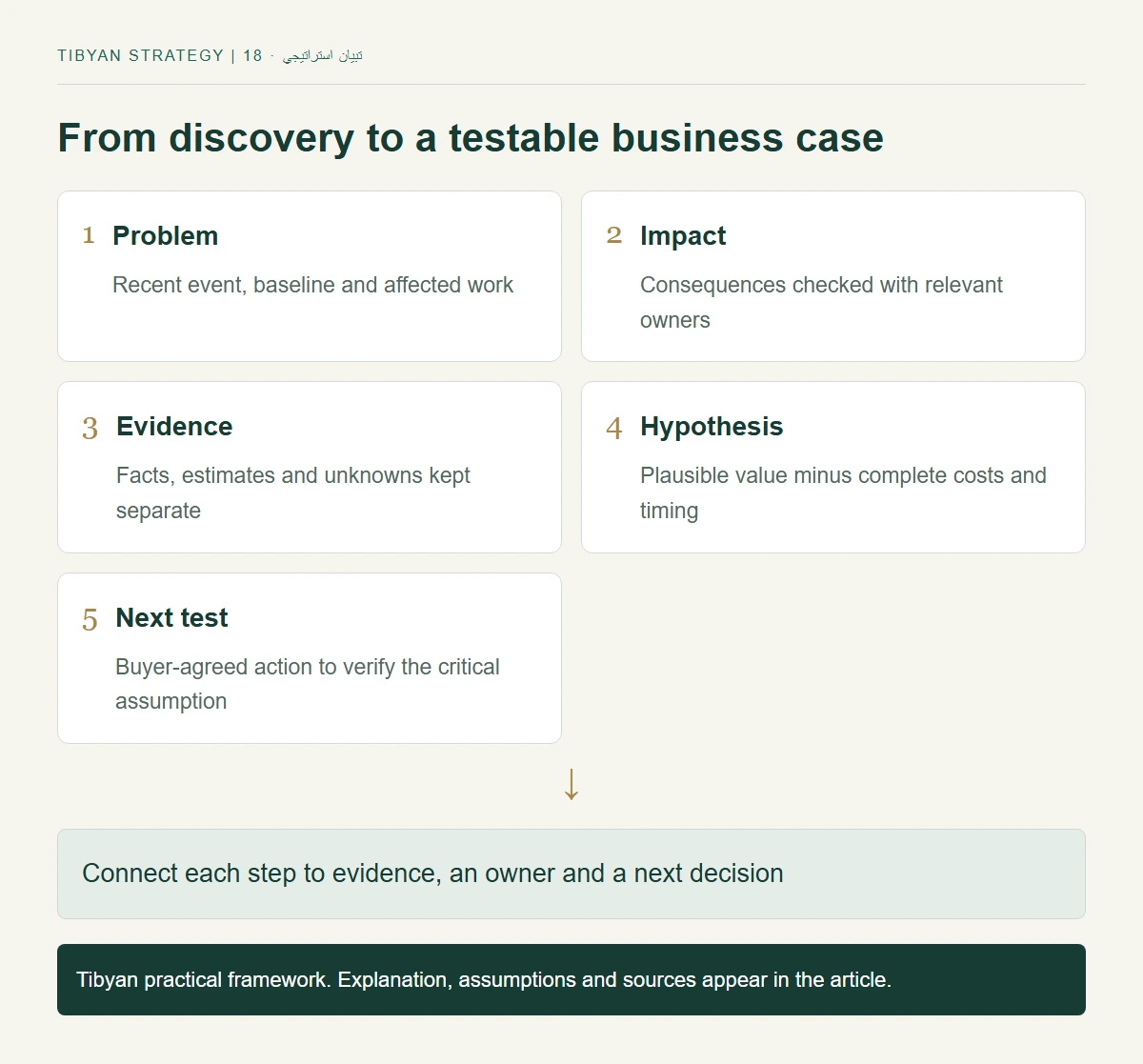 Open the diagram full size ↗
Original Tibyan discovery map. Each transition requires checking evidence with the buyer; a problem statement does not by itself establish a financial return.
A defensible value hypothesis states a mechanism, a baseline, a plausible change, the costs of achieving it and the uncertainty. It also identifies who will confirm the assumptions. Keep revenue, contribution, capacity and cash effects distinct.
For example, time released is not automatically payroll savings. Production capacity is not automatically extra sales. Avoid adding the same benefit twice: fewer stopped production hours and the resulting output contribution may describe the same underlying improvement. Ask the buyer's finance or operational owner which measure is appropriate.
As a public-sector example of disciplined appraisal, UK Cabinet Office business-case guidance considers costs, benefits, risks and timing in proportion to the decision. Its requirements apply to the specified UK grants context; they are not a B2B purchasing rule or an Arab-region regulation. The transferable lesson here is simply to make a decision case explicit and testable. Cabinet Office guidance.
Imagine a company selling maintenance analytics to a factory. The maintenance manager reports ten hours of unplanned stoppage per month on one line. The operations manager estimates that each affected hour represents 2,000 monetary units of contribution, after relevant variable costs. These are invented teaching inputs, not customer results or market benchmarks.
The initial arithmetic is 10 × 2,000 = 20,000 units of monthly contribution exposure. It is not a saving and does not mean the analytics can eliminate those losses. The team still needs to verify whether production can be recovered later, whether demand exists for extra output and which stoppages the proposed intervention could influence.
Suppose a pilot planning hypothesis is that two hours per month could be avoided. The associated potential contribution is 2 × 2,000 = 4,000 units per month before solution costs, internal effort and uncertainty. If annual subscription and implementation cost 30,000 units in the first year, a full-year two-hour assumption would produce 48,000 − 30,000 = 18,000 units before internal costs. That calculation assumes twelve months of benefit and therefore overstates the first year if implementation or learning delays occur.
The seller should not present the 18,000 as a forecast return. First ask Operations to check which stoppages the proposed change could prevent and whether the plant already recovers the lost output later. Ask Finance to check whether demand would support any additional output and to verify the contribution and complete first-year costs. If those checks show a benefit worth testing, agree a limited pilot with the buyer. Define the baseline, measurement period and result that would justify another investment. If the buyer already recovers the output or cannot sell more of it, revise the value hypothesis before asking for a pilot. The business case remains a hypothesis until the evidence supports it.
Ask what makes the issue worth addressing now. A real deadline might arise from a scheduled operational change or an internal planning decision. Confirm what happens if the date moves and whether the buyer considers the consequence material. Your own quarter-end target is not the customer's urgency.
Explore alternatives. Could the buyer improve maintenance routines, change an existing report or use another supplier? Keeping the current approach is also an option. A fair business case explains why the proposed change is preferable to feasible alternatives, rather than comparing a polished solution with an exaggerated disaster.
When entering a new Arab market, ask about the specific organization's approval, procurement, language and implementation requirements. Do not infer them from the country or a contact's title. Use the demand validation guide when the underlying market assumptions are still untested.
Summarize the problem in the buyer's terms. State which observations are confirmed, which numbers are estimates, what remains unknown and what would justify further investigation. Ask: “What have I misunderstood, and who else should verify this?”
Agree one next step with an owner and a target date. For example: the buyer will introduce operations and finance for a baseline review; the seller will send a short list of needed inputs before the meeting. A demonstration may be appropriate, but specify what question it should answer.
Afterward, send a concise summary for correction. Silence is not approval. Record whether the customer explicitly agreed with the summary, and retain open questions. This provides a stronger foundation for qualification than a generic note that the buyer “liked the solution.”
Take one live opportunity. Rewrite its problem statement in two sentences without naming your product. Mark each number as confirmed, estimated or unknown. Then name the person and action needed to test the most important assumption. If you cannot do this, revisit discovery before refining your proposal.
Download the free discovery guide and value-hypothesis worksheet. It includes a blank record and the worked maintenance example so your team can practice separating evidence from optimistic arithmetic. For earlier targeting questions, use customer fit and profitability.
You can also use the editable, printable working template. Download an edited copy from your browser without submitting your entries.
Explore the Sales Training collection.
Cover: AI-generated conceptual artwork. Diagram and tool: original Tibyan editorial design.
Sources were checked in October 2026. The questions, worksheet and calculations are original educational examples and recommendations, not measured outcomes or an investment forecast.
Take the next step
Free downloads. No registration. Each PDF includes instructions, an illustrative example and a reusable worksheet.
Tibyan Toolkit 18
Build a correctable record of a buyer problem and the evidence needed to assess a proposed change.
PDF · 4 pages · 67 KB · Version 1
Download English PDF Open editable working template ↗Practical worksheets, not validated assessments. Adapt the task and timing to your context. See each PDF for its revision date.
Explore the tools & toolkits library ↗
Practical perspective
Prepare a B2B quotation that procurement, finance, and operations can assess. Use Tibyan’s QUOTE Framework, an annotated example, and a 13-point checklist.
Read perspective
Talent Development
Check whether the task still matters, how people learn it and what gets in their way before you keep, redesign or retire a course.
Read perspective
Team development
Follow one customer case across teams and find which handoff lost the facts, ownership or promise.
Read perspective