The sales-enablement program has run. Participants completed the activities, managers received a coaching guide, and a requirements aid is available. The next question is a decision: should the organization continue, change part of the system, or expand it? A dashboard helps only if its evidence can inform that choice.
This guide helps sales leaders and learning designers build a measurement plan connecting a decision to a question, measure, data source, owner, timing and limitation. Bring the intended behavior, baseline information, assessment outputs, application opportunities and relevant operating changes. Start with a decision you genuinely expect to make.
State the design hypothesis
Hypothetical teaching case: a regional B2B services company wants clearer implementation proposals. Its proposed enablement system combines practice in confirming requirements, a job aid that preserves unknowns, manager coaching and a specialist verification route. The company and all interpretation examples below are fictional; no results are reported.
The hypothesis is that sellers will recognize important dependencies, document uncertainty accurately, obtain suitable verification and produce proposals with fewer avoidable clarification problems. Each connection needs evidence. A completed course does not show that the aid was accessible or the specialist answered.
Write the assumptions alongside the proposed chain. For example: sellers encounter suitable work; managers can review samples; delivery has capacity; and the chosen behavior addresses a real cause of proposal rework. If an assumption fails, revise the system rather than force the evidence into the original story.
HM Treasury’s Test and Learn guidance distinguishes early testing and adaptation from later evaluation of impact. We adapt that distinction from government policy to this business design decision; it is not evidence of a sales outcome. HM Treasury: Test and Learn.
Keep evidence levels distinguishable
Ask what each measure can establish and what it cannot.
CDC recommends assessing learning and workplace application as distinct questions. This informs our separation of evidence, with the sales measures proposed by Tibyan. CDC: Measuring Effectiveness.
Keep participant feedback useful without asking it to do more than it can. A seller’s account of an inaccessible guide can identify a barrier. Their confidence alone does not demonstrate an accurate requirements summary.
Define measures before collecting more data
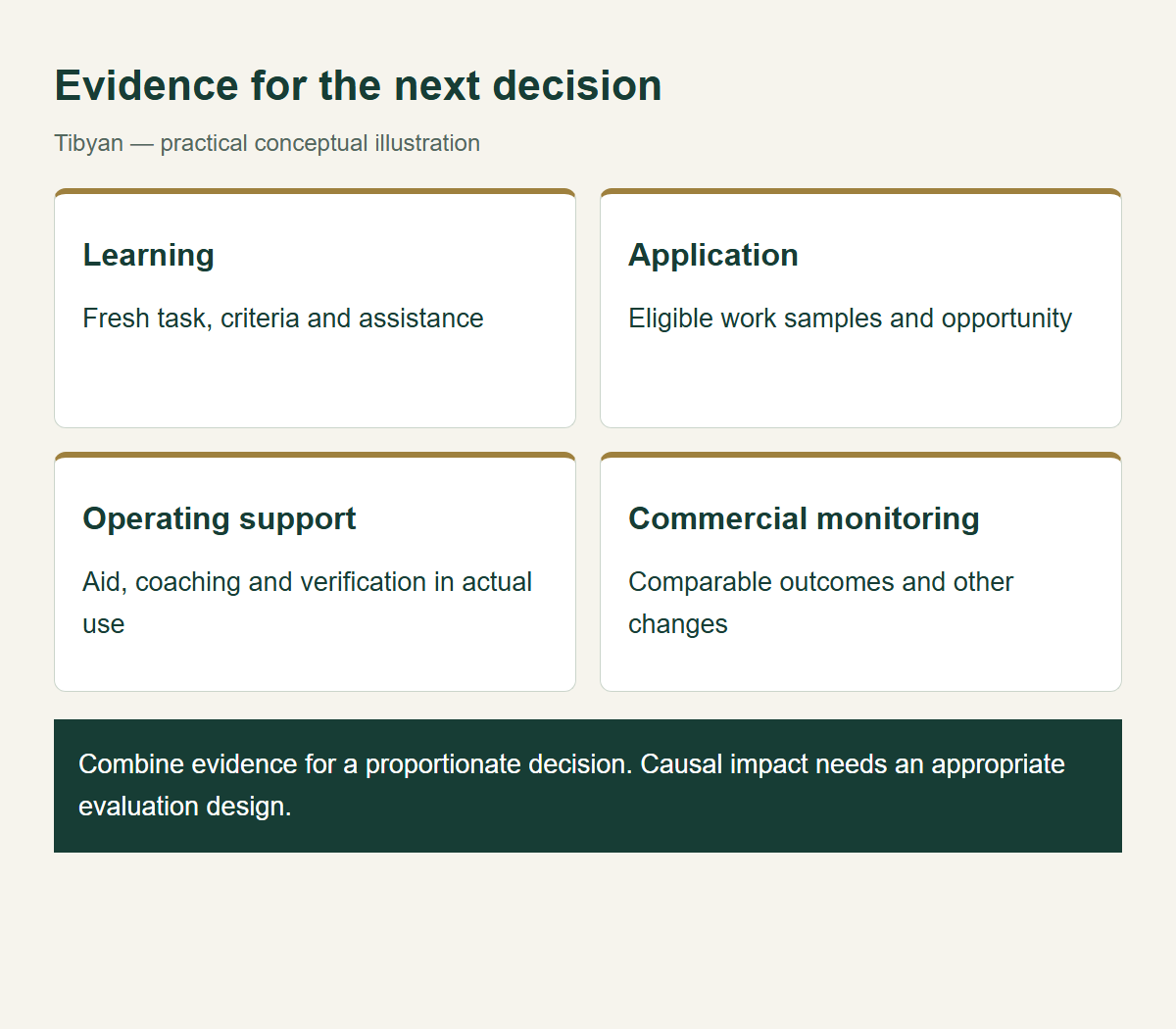
For learning, inspect a fresh task against the behavior criteria and record assistance. If a comparable baseline task is available, it can help interpret change. Without it, an end-of-program score describes demonstrated performance, not necessarily improvement from training.
For application, define eligible work samples. The denominator might be reviewed proposals that should contain the relevant requirement and have enough evidence to judge it. Record proposals excluded because the records are incomplete and sellers who had no suitable opportunity.
For operating support, examine whether the seller found the current aid, whether the specialist route worked, and whether coaching addressed a specific behavior. Counts of downloads or coaching meetings are activity evidence; inspect a sample of actual use.
For commercial monitoring, separate avoidable clarification from customer-led scope changes. A proposal revised because the buyer changed the project is different from one that omitted an already known dependency. Agree definitions with sales operations and delivery before comparing periods.
Make ownership and timing feasible
The designer owns collection and interpretation of learning evidence with relevant reviewers. Managers provide work samples and application context. Sales operations checks definitions, records and comparability. Delivery reports verification issues. The business sponsor makes the program decision.
Choose review timing around the task and decision. A seller with frequent proposals may generate evidence sooner than one managing a long complex opportunity. Do not classify absence of opportunity as failure or success.
Document what data can be collected within existing access permissions. Use the minimum detail needed for the decision, and keep customer and employee information in approved systems. A measurement plan that requires unavailable records must change before it becomes an assurance claim.
Build a blank measurement plan
Use one row per question and add the program version and intended decision above the table.
Illustrative completed row: the decision is whether to revise the requirements aid. The question is whether sellers can use it to preserve unresolved dependencies. The evidence is suitable reviewed summaries, the current aid version and recorded assistance. The manager and designer compare outputs; operations checks eligibility. The review occurs after suitable attempts, with lack of opportunity recorded. If users understand the task but the aid hides the uncertainty field, revise the aid and test that change.
Annotation: this row can inform an aid decision without claiming a revenue effect. “Track win rate after training” is too distant to explain whether the aid works and leaves the comparison undefined.
 Open the diagram full size ↗
Tibyan conceptual evidence map. The categories are connected questions, not an automatic causal chain from attendance to revenue.
Interpret mixed findings as useful information
Consider three hypothetical patterns, without assuming that any has occurred:
- Strong assessment, weak application: inspect opportunity, guide access, coaching and approval rules. Also check whether the simulation represented real work well enough.
- Better work samples, unchanged proposal outcomes: investigate the original causal hypothesis, sample comparability and the time needed for outcomes. The behavior may be useful without addressing the main source of delay.
- Better proposals alongside process changes: report the observed pattern and the changes made. The evidence does not reveal how much training, specialist capacity or other influences contributed.
Ask for evidence that challenges the preferred interpretation. Review contrasting samples and cases with missing records. A favorable average can conceal an unusable aid for one role or a persistent handoff problem in one project type.
Match causal claims to the evaluation design
If the decision requires an estimate of program impact, involve evaluation expertise early. Consider a feasible comparison strategy, such as a carefully planned staggered rollout or other appropriate design. Assignment, baseline differences, sample size, contamination and concurrent changes all affect interpretation.
HM Treasury’s guidance explains why early testing complements rather than replaces robust impact evaluation. We use that methodological boundary here, without treating government examples as proof for sales enablement. Test and Learn: evaluation guidance.
A before-and-after comparison alone cannot isolate training when pricing, targeting, staffing, product or customer mix changes. A comparison group also needs scrutiny; simply choosing another team does not make it comparable.
Do not calculate financial ROI merely because revenue data exists. First establish what benefit can credibly be attributed to the intervention, what costs belong in the calculation and what uncertainty remains. If those inputs are unavailable, report a narrower decision and the evidence needed next.
Record the decision and the revision
Write a short decision note: evidence reviewed, important limitations, action chosen, responsible owner and next review. Keep the intervention version visible so the next reader knows which guide, scenario and support arrangement produced the evidence.
Continue when the available evidence supports the next bounded step. Adapt when it identifies a fixable design or operating problem. Pause or stop a component when the underlying need is absent, the task cannot be made appropriate, or the support is not feasible. Define the criteria before reviewing results so favorable stories do not replace the agreed decision.
When evidence is inconclusive, say why. Missing work samples call for a collection fix; no application opportunity calls for more appropriate timing; inconsistent scoring calls for rubric review. “Insufficient evidence” can lead to a useful action without being converted into a claim of success or failure.
Use the review to improve the whole system
Choose one pending program decision and complete the plan. Ask the data owner whether the evidence exists, the manager whether the work opportunity is plausible, and the designer whether the measure reflects the intended behavior. Remove measures that cannot inform the decision.
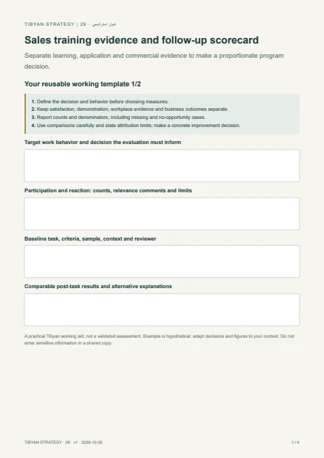
Use Sales training evidence and follow-up scorecard to separate learning, application and commercial evidence. Add the definitions, owners and interpretation rules above. For complementary reading, see Measure Sales Training Beyond Attendance and Satisfaction.
This closes the series’ design loop: diagnose a bounded need, specify role behavior, extract useful expertise, build practice and assessment, arrange support, then revise using evidence. The purpose is a justified next decision with clear responsibility.
Cover: AI-generated conceptual illustration. Measurement templates and fictional patterns are Tibyan recommendations, not evaluated findings.
Sources
Sources checked November 2, 2026. No causal commercial effect or financial return is reported for the proposed system.