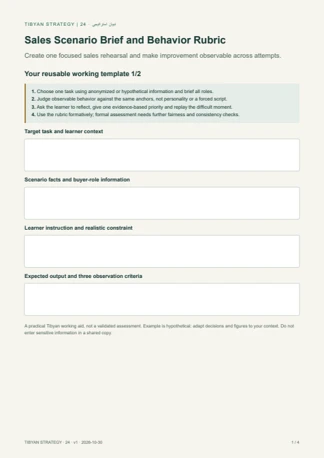
Tibyan Toolkit 24
Sales Scenario Brief and Behavior Rubric
Create one focused sales rehearsal and make improvement observable across attempts.
PDF · 4 pages · 67 KB · Version 1
Download English PDF Open editable working template ↗Connect a realistic sales scenario to observable criteria, useful feedback, a retry and a fresh assessment task.

A role-play can feel lively while revealing little about the skill the program intends to develop. If the buyer is too cooperative, the seller can succeed without investigating. If the observer rewards confidence rather than evidence, a fluent but inaccurate answer can receive the highest score. Design the task and its assessment together so success means something useful.
This guide helps sales leaders and learning designers create a practice scenario, behavioral rubric, feedback cycle, and fresh assessment task. Bring one observable performance outcome, the tools available at work, common errors, and a subject matter expert who can check the scenario. Start with a single consequential sales decision.
Hypothetical teaching case: a regional B2B services company prepares multi-site implementation proposals. Sellers need to distinguish confirmed requirements from unresolved dependencies before proposing scope. The fictional case, practice materials and criteria below are teaching examples, not client results or validated certification standards.
Use an outcome such as: given a buyer brief, a discovery exchange and the approved requirements guide, the seller will produce a summary that preserves confirmed facts, identifies material unknowns, and agrees verification actions without inventing customer commitments.
The manager confirms that this reflects needed work. Delivery checks what makes a dependency material. The designer ensures that the activity and assessment actually require the intended judgment.
Carnegie Mellon’s Eberly Center describes alignment among objectives, assessment and instructional strategies. This educational principle supports the design connection here; our sales task is an adaptation. Eberly Center: Learning objectives.
Decide what an observer must see or hear. The output might be a written requirements summary plus an explanation of the seller’s next action. Speaking smoothly is relevant only if communication quality belongs in the intended outcome.
Tibyan suggests four criteria for this task:
| Criterion | Observable evidence |
|---|---|
| Accuracy | Records the buyer’s meaning without adding unverified facts |
| Judgment | Identifies the dependency that matters to the proposed scope |
| Uncertainty | States what is not known and how it will be checked |
| Next action | Agrees a purpose, responsible person and appropriate follow-up |
Discuss acceptable variations. A buyer may decline a question or lack authority to answer. A competent seller can acknowledge that limit and arrange verification rather than force an answer.
Keep evidence distinct from inference. A summary that names a data owner is not accurate if the buyer never confirmed that person’s responsibility. Review the source information, not just whether a field is complete.
The seller brief states the task, known customer context, permitted aids and expected output. The buyer brief adds information that should emerge only through appropriate questions. Give the role-player a consistent response guide so different participants face comparable demands.
For the practice case, the buyer requests a fixed implementation date. They know the target date but have not assigned data-preparation ownership. If asked, they explain that an internal operations discussion is needed. They can agree to identify the responsible colleague; they cannot credibly approve a technical estimate.
Avoid a hidden trick unrelated to the outcome. The learner should encounter realistic uncertainty, not guess an arbitrary secret. Delivery checks plausibility; the designer checks whether the information allows a defensible decision.
Begin with a brief demonstration or annotated example. Ask the learner to attempt the task and prepare the summary. Invite their own account of the decision before giving feedback.
Use a specific observation: “The summary presents the start date as agreed, although the buyer described it as a target.” Ask what led to that wording, explain the consequence for scope clarity, and agree what to change in the next attempt.
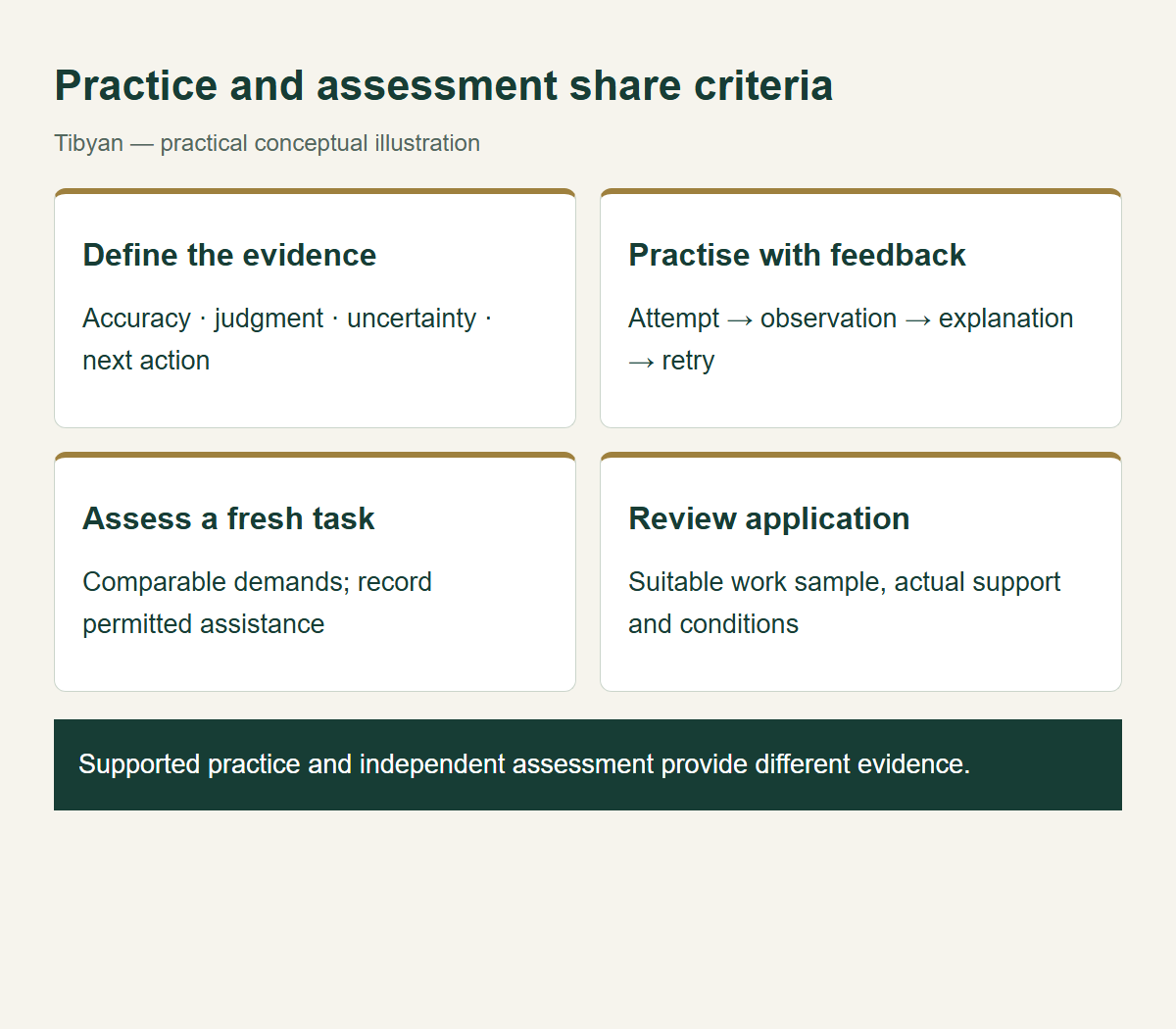
Allow a retry. It might revisit the same decision with a changed customer response or use a short comparable case. Record how much prompting was needed. Improvement after coaching helps direct learning; it should not silently be counted as independent assessment.
 Open the diagram full size ↗
Tibyan conceptual design. Practice and assessment share criteria while using different situations and support conditions.
Write descriptions that help an observer distinguish performance levels. Avoid a scale whose only difference is “poor,” “good” and “excellent.” The blank structure below can be adapted to each criterion.
| Level | Description to complete |
|---|---|
| Not yet demonstrated | Which important action or quality is absent or inaccurate? |
| Demonstrated with support | What can the learner do after which prompt or assistance? |
| Demonstrated independently | What must be visible without task-specific prompting? |
| Evidence note | What was actually said, written or done? |
Completed example for uncertainty: not yet demonstrated means an unresolved dependency is presented as confirmed. With support means the learner identifies it after an observer asks what remains unverified. Independently means the learner identifies the unknown, preserves it in the summary and proposes a suitable verification action without that prompt.
Annotation: the distinction concerns the observed task and level of assistance, not the learner’s character or overall potential. An inaccurate statement requires correction, even if the rest of the performance is fluent.
If a critical error should block a proficiency decision, specify and justify it in advance. For this exercise, inventing a buyer commitment might require another attempt regardless of other strengths. That is a proposed rule to test with stakeholders, not an industry-wide pass standard.
Ask two reviewers to assess the same fictional output independently. Compare evidence notes, not just totals. If one reviewer treats a suggested follow-up as buyer agreement and another does not, clarify the criterion and scenario information.
Try the rubric with a small set of contrasting samples: an accurate but incomplete summary, a polished summary with invented certainty, and a stronger evidence-based summary. Check whether the descriptions distinguish the intended behavior.
Calibration can improve shared interpretation; it does not automatically establish reliability or validity for certification. If the assessment affects formal authorization or employment decisions, use the organization’s appropriate assessment expertise and procedures.
CDC’s standards call for assessment related to learning objectives and relevant task situations. We apply that public-health guidance to this sales rehearsal without claiming commercial efficacy. CDC: Quality Training Standards.
Change the customer setting while preserving comparable judgment demands. After practising a data-preparation dependency, an assessment might involve site access that must be confirmed before rollout. Supply the information and approved aids the learner would reasonably have.
Keep the assessed behavior stable: distinguish facts from assumptions, identify a material unresolved prerequisite, and arrange verification within authority. Do not make the new case substantially harder without recognizing the effect on interpretation.
State the assistance allowed. An observer can clarify an unclear instruction without coaching the answer; record the clarification. If they give task-specific hints, document them and interpret the attempt as supported.
The completed summary is the main evidence. A short explanation of reasoning can reveal why the learner chose a next step, but it cannot retroactively repair an inaccurate customer record without an explicit revision.
Ask intended learners to attempt the activity. Observe whether they understand the task, can access the guide, have enough information and can use the time realistically. Check whether role-players respond consistently and reviewers can apply the rubric.
A confusing instruction or missing fact is a design problem to investigate. Record revisions and test the changed element. Do not use early pilot difficulty to label participants incapable.
Try each language edition separately. Preserve the decision challenge and evidence criteria while using natural customer dialogue. Technical terms should match the learner’s actual working vocabulary.
Before the learning ends, agree a suitable workplace opportunity, reviewer and support. Review the next appropriate requirements summary with the same criteria, recording actual conditions and assistance. A simulation result establishes performance in that task; real-work review examines application.
If the opportunity does not occur, record that and arrange protected practice or a later review. Do not equate attendance, confidence or certification with consistent field use.
Use Sales Scenario Brief and Behavior Rubric to draft the first attempt and assessment criteria. Before full delivery, ask a colleague to score a sample and an intended learner to try the task. For an optional technology-supported rehearsal, see Use AI Role-Play to Practice Difficult Sales Conversations; retain human judgment over accuracy and scoring.
Cover: AI-generated conceptual illustration. Scenarios, rubric descriptions and progression rules are Tibyan teaching recommendations.
Sources checked November 2, 2026. The proposed rubric and sales assessment have not been empirically validated.
Take the next step
Free downloads. No registration. Each PDF includes instructions, an illustrative example and a reusable worksheet.
Tibyan Toolkit 24
Create one focused sales rehearsal and make improvement observable across attempts.
PDF · 4 pages · 67 KB · Version 1
Download English PDF Open editable working template ↗Practical worksheets, not validated assessments. Adapt the task and timing to your context. See each PDF for its revision date.
Explore the tools & toolkits library ↗
Practical perspective
Prepare a B2B quotation that procurement, finance, and operations can assess. Use Tibyan’s QUOTE Framework, an annotated example, and a 13-point checklist.
Read perspective
Talent Development
Check whether the task still matters, how people learn it and what gets in their way before you keep, redesign or retire a course.
Read perspective
Team development
Follow one customer case across teams and find which handoff lost the facts, ownership or promise.
Read perspective