Tibyan Toolkit 06
Your seven-day practice plan
Turn one learning goal into attempts you can review.
PDF · 8 pages · 113 KB · Version 1
Download English PDFPick one recurring sales behavior, improve it through feedback, and use a work sample to check whether it carries over to a real buyer conversation.

The operations director tells you orders are taking too long to release. You put “warehouse picking is causing delays” in the meeting recap. It sounds plausible, but the director was describing the interval before the warehouse receives an order. Your team is now preparing to talk about the wrong part of the process.
In this fictional case, the seller’s most useful move is to reopen the recap and check the cause with the buyer. You can practise that move, compare your attempts, and look for the same behavior in a real meeting. Over four weeks, work on one recurring sales behavior and collect enough evidence to decide what to improve next.
Picture the replay of your next buyer call. Where would you hit pause to show the skill? Mark the moment you invite the buyer to correct your explanation of the delay.
Pick a task you are likely to encounter again. “Get better at discovery” could cover preparation, listening, or deciding what to investigate. A tighter aim is “When I write that something is causing a buyer’s problem, I ask which step is affected and give the buyer a chance to correct me.” You can hear that question in a rehearsal and inspect what happened to the claim in the recap.
Add the second behavior that gives the question its value. When the buyer corrects you, update the record. Capture who offered the explanation and what you can check next. If the buyer’s explanation changes the problem your team would investigate, update the working assumption before anyone uses it to design a proposal.
The seller asks the operations director, “I wrote that picking is causing the delay. At which step are the orders actually waiting?” The director explains that some orders arrive with required fields missing and wait at the order desk.
The revised recap reads, “Operations reports that incomplete information is holding orders before release. We’ll ask the order-desk lead to compare order entry and release timestamps and check the recorded reasons for held orders.” The question made the original assumption explicit. The recap now preserves the buyer’s account and identifies the evidence that could confirm or revise it.
Try both versions with a partner. First ask the vague question, “Have I got that right?” Then ask which step is causing the wait. Ask your partner to show you where the wording helped them make a correction. Rewrite the recap immediately and have them check whether it reflects what they said.
Comparing examples is one way to practise a behavior. In a meta-analysis of behavior-modeling training, Taylor, Russ-Eft and Chan reported larger effects on learning than on job behavior and measured results. The study supports treating those as separate observations. The four-week practice schedule and criteria below are Tibyan’s proposed way to make that distinction practical in sales. Behavior-modeling training meta-analysis
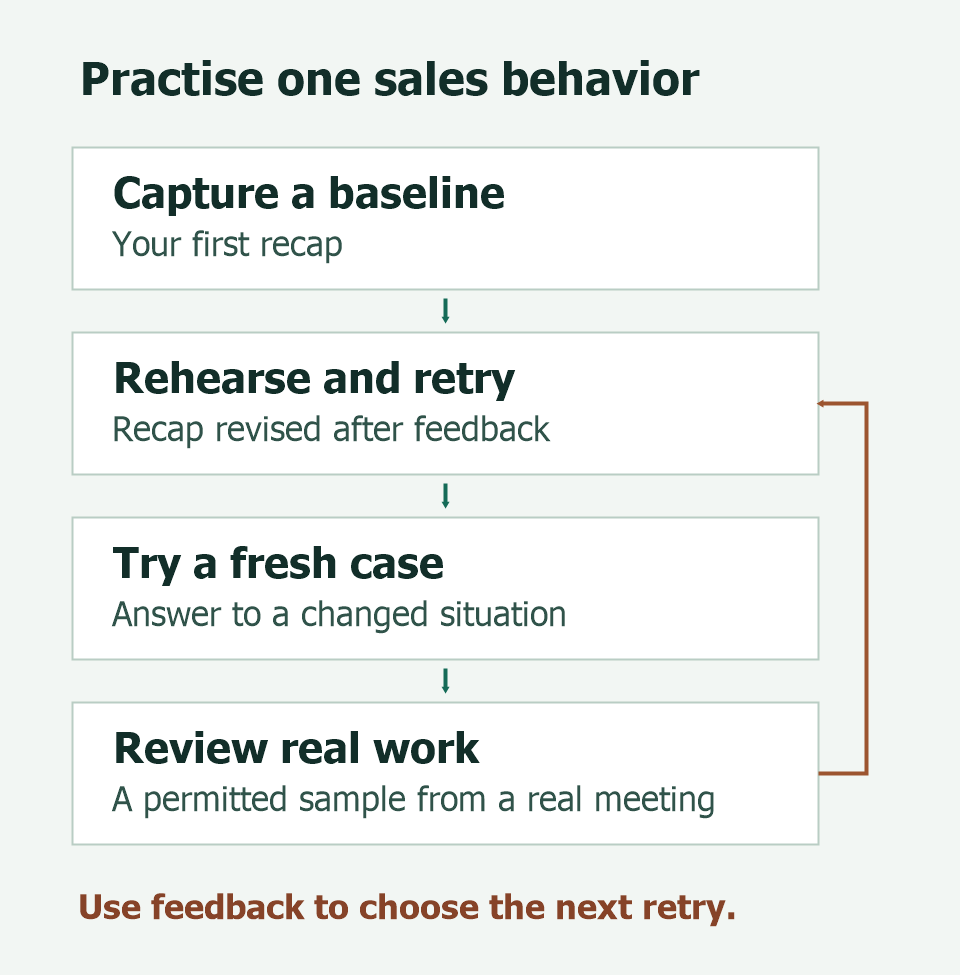 Open the diagram full size ↗
Practise one behavior and keep a work sample from each stage.
1. Week 1 · Capture a baseline. Pick a permitted recap or write one from a short scenario before reviewing a model. Preserve the question you asked and how you recorded the answer. If you lack a suitable workplace sample, label your starting attempt a simulation. 2. Week 2 · Rehearse and retry. Compare a vague question with a specific one. Ask a colleague to flag one behavior that would make the recap more accurate. Try again while the feedback is fresh. Keep both attempts so you can see the change. 3. Week 3 · Change the situation. Imagine that a forwarded recap blames missing inventory data for delays in Jeddah. Write the question you would ask. Then use this reply from the local lead. “The inventory data is available. We wait for a credit override before release.” Rewrite the recap and identify the record and person who can check the wait. 4. Week 4 · Review work evidence. Choose a real buyer meeting where a causal assumption could be corrected. Use a permitted recap or ask a colleague who attends to observe the question. Agree when you will review the sample together. Where a suitable meeting has yet to take place, record that and set the next review around an actual opportunity.
Use the table to evaluate the two behaviors. Mark each one independently. A useful reviewer points to a specific phrase or part of the recap and asks for one change.
| Behavior | Absent | Partial | Clear |
|---|---|---|---|
| Invites correction | States a cause as settled. | Asks for agreement without identifying what needs checking. | Names the disputed step or assumption and gives the buyer a specific opportunity to correct it. |
| Uses the correction | Leaves the original explanation in the record. | Notes disagreement but leaves the working account unclear. | Updates the explanation, attributes it, and identifies the record and person for the next check. |
For the Jeddah exercise, a clear recap says the local lead reported a wait for a credit override and asks the credit team to compare request and approval timestamps. That evidence might show where the wait occurs. It takes a further check to know whether that delay explains the wider problem the buyer wants to solve.
Keep four observations in view. Can you explain how to check an assumption? Can you ask the question and use the answer in a rehearsal? Does the same behavior show up in an actual opportunity? Did anything relevant change for the buyer or the deal? This last question is useful for learning, even when other factors prevent you from attributing the change to your practice. A buyer-confirmed correction can show immediate progress. A change in conversion or revenue calls for stronger evidence.
If a seller performs the task in practice but has no access to customer meetings or records, agree on a suitable opportunity and what evidence can be collected. If the organization’s recap template has no place for sources or open questions, change the template or agree where to record them. A meta-analysis by Hughes and colleagues found positive associations between transfer and support from peers, supervisors and the organization. For a manager, reserving time to review a sample is one practical form of support. Training sustainment meta-analysis · Diagnose the sales performance problem
Copy the record below. Fill in the first three fields now and book a review with a manager or colleague. If you work independently, compare your two samples against the criteria and note where the evidence is ambiguous.
| Task and context | Baseline sample | Behavior to develop | Feedback and retry | Fresh sample | Workplace evidence | Review date |
|---|---|---|---|---|---|---|
| Check the cause of a release delay | Recap states that warehouse picking caused the delay | Ask which step is affected and update the recap | Colleague flags the untested cause. Retry with a specific question. | Jeddah lead identifies credit override. Seller updates the recap and names an evidence check. | Review an approved recap from the next relevant buyer meeting | Agree a date after the meeting |
Use the practice planner to schedule your first attempt, your feedback and your retry. Your seven-day practice plan
Take the next step
Free downloads. No registration. Each PDF includes instructions, an illustrative example and a reusable worksheet.
Tibyan Toolkit 06
Turn one learning goal into attempts you can review.
PDF · 8 pages · 113 KB · Version 1
Download English PDFPractical worksheets, not validated assessments. Adapt the task and timing to your context. See each PDF for its revision date.
Explore the tools & toolkits library ↗
Practical perspective
Prepare a B2B quotation that procurement, finance, and operations can assess. Use Tibyan’s QUOTE Framework, an annotated example, and a 13-point checklist.
Read perspective
Talent Development
Check whether the task still matters, how people learn it and what gets in their way before you keep, redesign or retire a course.
Read perspective
Team development
Follow one customer case across teams and find which handoff lost the facts, ownership or promise.
Read perspective