By the end of this guide, you can: Produce a decision record that connects options, evidence, uncertainty and a reviewable commitment.
Bring to the task: A decision owner, deadline, feasible alternatives and the information currently available.
A team asks, “Which option has the highest score?” before agreeing on what matters. A polished matrix can hide uncertain estimates, omit the current arrangement and give a weak assumption the appearance of precision. Better decision questions make the choice and its consequences explicit before adding numbers.
Write the decision in one sentence: who chooses what, by when, within which constraints? Distinguish a reversible trial from a large commitment. Include the option of keeping the current arrangement or deferring the decision when either is genuinely feasible. Delay also has consequences and should be examined rather than treated as free.
Define what would justify a choice
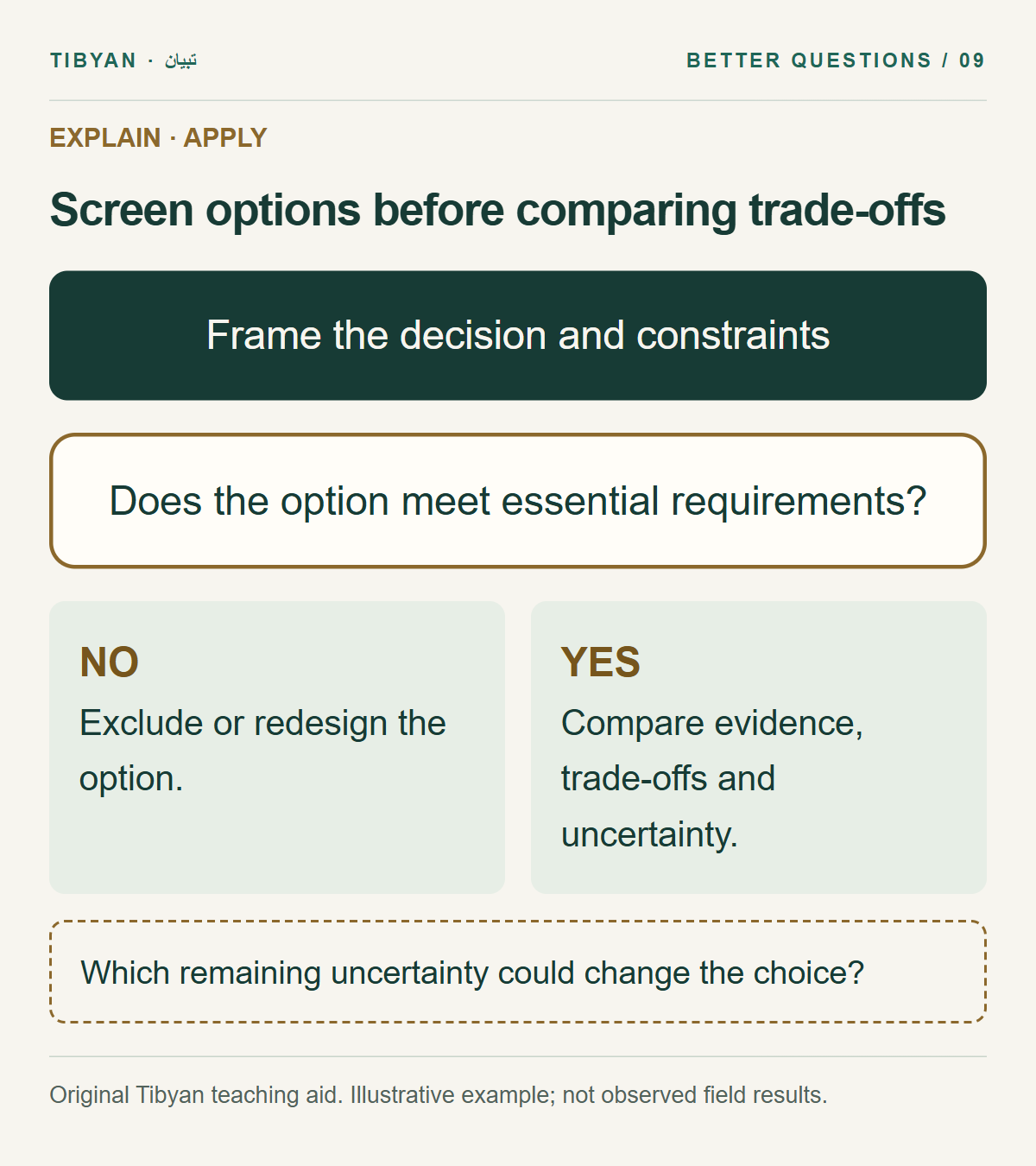
Identify the outcomes, minimum requirements and trade-offs. Ask which requirements an option must satisfy before it deserves comparison. Then determine how to judge the remaining differences. A cheap option that cannot perform an essential task should not win because unrelated strengths compensate for the failure.
 Open the diagram full size ↗
A failed essential requirement is a reason to exclude or redesign an option. A high score elsewhere should not hide that failure.
- Screen options before comparing trade-offs
- Frame the decision and constraints
- Does the option meet essential requirements?
- NOExclude or redesign the option.
- YESCompare evidence, trade-offs and uncertainty.
- Which remaining uncertainty could change the choice?
- Original Tibyan teaching aid. Illustrative example; not observed field results.
Appraise the evidence behind each judgment. A current operational record, a customer account, professional experience and published research can contribute differently. CIPD’s guidance supports combining sources with critical appraisal; it does not imply that adding more sources automatically improves a decision. CIPD.
Make uncertainty visible in the comparison
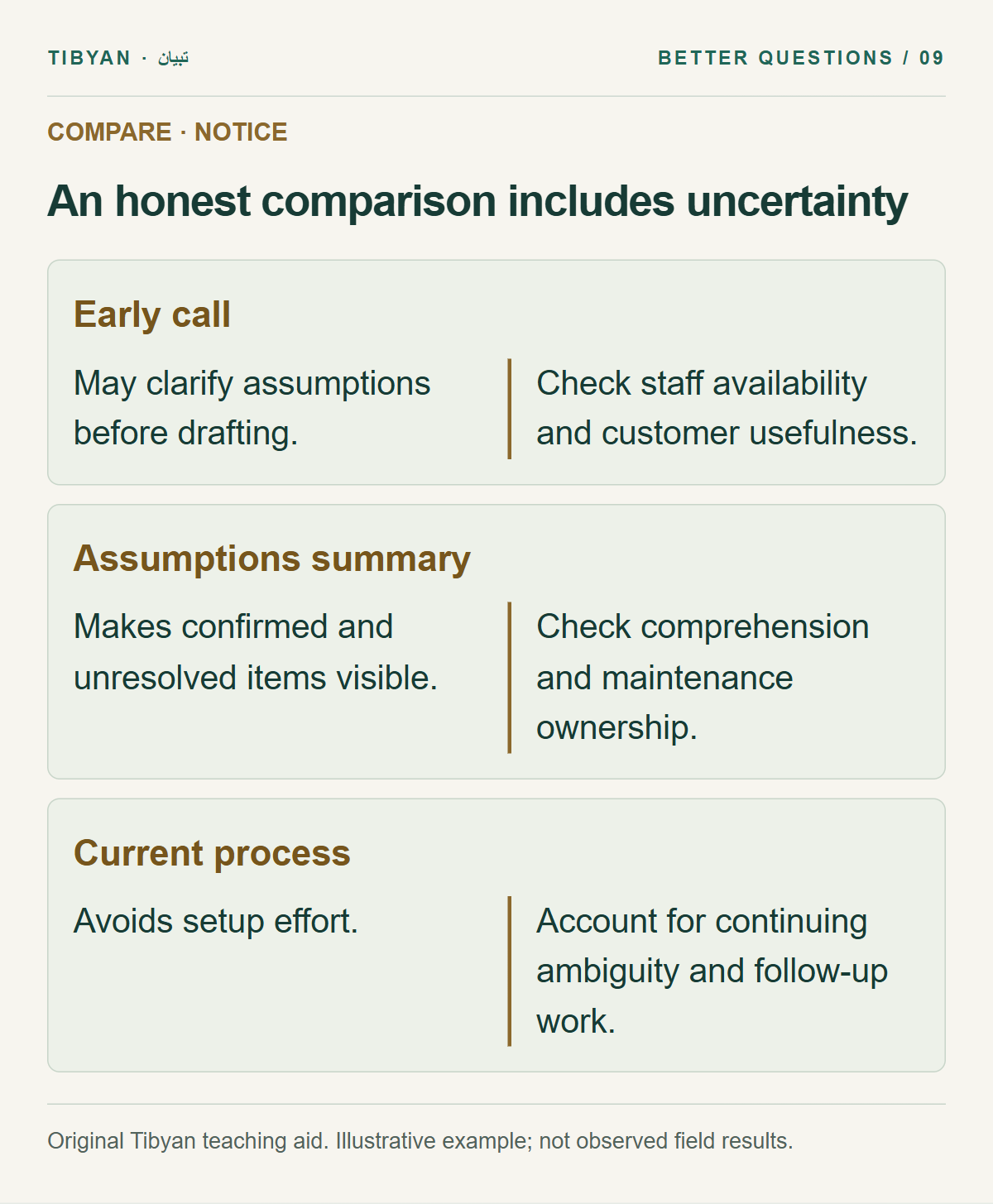
Use an explicit “unknown” where information is missing. Distinguish an estimate from an observation and record its basis. If you use scores or weights, explain what they mean and check whether a reasonable change would reverse the recommendation. Do not let the total conceal a disputed criterion.
 Open the diagram full size ↗
Keep the baseline visible. Mark the evidence behind each judgment and ask which unknown could reverse the preferred choice.
- An honest comparison includes uncertainty
- Early call
- May clarify assumptions before drafting.
- Check staff availability and customer usefulness.
- Assumptions summary
- Makes confirmed and unresolved items visible.
- Check comprehension and maintenance ownership.
- Current process
- Avoids setup effort.
- Account for continuing ambiguity and follow-up work.
- Original Tibyan teaching aid. Illustrative example; not observed field results.
Ask which missing information could change the choice
Not every uncertainty merits another investigation. Ask whether plausible answers would lead to different decisions and whether the information can arrive in time. If the choice depends on whether buyers understand the summary, observe that task with a realistic fictional example. If every feasible answer leads to the same bounded action, further research may add little now.
Set a proportionate commitment. HM Treasury’s Test and Learn guidance emphasizes testing consequential uncertainties and using learning to guide development. Applied here, that means stating what you are testing, what evidence you will collect and the decision it will inform. It is not a claim that a small business pilot proves causal impact. Test and Learn.
Invite a challenge before commitment
Ask a colleague to argue for another feasible option. What important condition might make it better? What evidence would make you reverse your view? Record the strongest objection in the decision note rather than quietly dropping it after the meeting.
Close with the chosen action, its rationale, owner, resource limit and review trigger. A trigger might be a failed essential requirement, repeated confusion or the arrival of information that changes the comparison. The decision owner remains responsible; the worksheet supports judgment rather than replacing it.
For practice, compare three real alternatives, identify one unsupported estimate and design the smallest useful check. Present the recommendation with its strongest limitation. A good decision record should allow another person to understand why the choice was reasonable at the time, even if the outcome later disappoints.
Make an auditable options comparison
Fictional decision exercise. Salma, Namaa's operations manager, must choose a bounded way to prepare the next two suitable proposal approvals by 12 November 2026. Her team can spend at most 30 minutes on extra preparation for this exercise. This is an invented resource bound, not a recommended universal limit.
The essential requirements are: a written distinction between confirmed and unresolved commitments; an owner who keeps the record current; and a feasible preparation workload. Comprehension must then be tested. An attractive score cannot compensate for a missing essential requirement.
Prototype entry for B: “Implementation support outside business hours: unresolved. Technical estimator to confirm coverage before issue; Huda tracks the reply.” It keeps an unconfirmed commitment visible without promising it.
Decision note: Salma selects B for two simulated approval tasks, keeps the existing approval safeguard and makes no live customer commitment from the prototype. The strongest objection is that readers may mistake the summary's presence for confirmation. Her review is due 14 November, or immediately if anyone reads an unresolved item as confirmed.
Two possible findings: if readers identify status correctly and the measured effort remains within the exercise's bound, proceed to a small, permissioned work trial. If interpretation fails, revise the wording or reconsider A with a written record. If effort exceeds the bound, simplify or rescope rather than silently changing the limit.
Weak recommendation: “B looks professional and is cheapest.” Improved recommendation: “B is the most feasible test candidate on current evidence; comprehension and effort remain unresolved, so limit the commitment.” The decision is defensible without claiming a guaranteed outcome.
Your reusable working record
Open the editable working tool · Download the printable pack
- Decision owner, choice and deadline: State who can commit resources and by when.
- Essential requirements and resource bound: Screen requirements before weighing preferences.
- Option A: requirement, evidence, trade-off and uncertainty: Do not let an attractive feature conceal a failed condition.
- Option B: requirement, evidence, trade-off and uncertainty: Label estimates; do not substitute them for observations.
- Baseline/current arrangement: Include the current arrangement without assuming that delay is free.
- Strongest objection and decision-sensitive unknown: Ask which plausible finding would reverse your view.
- Bounded commitment and rationale: State what is selected now and what is not yet justified.
- Review condition and next decision: Use an observable event as well as a calendar point.
Practice and retry
Complete the three-option comparison, then receive a new fictional observation: preparing each summary took 14 minutes, in addition to the 10-minute setup. Recalculate 10 + 2×14 = 38 minutes, compare it with the 30-minute bound and revise the commitment. Do not keep the original recommendation unchanged by relabeling the estimate as fact.
Common error and corrective feedback
Common errors: summing scores before screening essentials; replacing “unknown” with a convenient estimate; excluding the baseline; judging the original reasoning solely from a favorable outcome.
Independent-study alternative
Write your recommendation and strongest objection before reading the worked note. After revealing the 38-minute result, write a second dated note explaining the change rather than erasing the first.
Check your work
- The choice and constraints are explicit.
- Alternatives are genuinely feasible.
- Estimates and observations are distinguished.
- The recommendation includes a review trigger.
Apply and review
Revisit the record at the agreed trigger and document what changed, including information that contradicts the original choice.
Continue the learning route
Previous: Use Questions to Generate Ideas and Explore Opportunities · Series overview · Next: Use AI to Develop a Better Inquiry
Sources and further reading