By the end of this guide, you can: Produce alternative problem frames and turn one promising idea into a bounded learning test.
Bring to the task: A specific user or customer task, observations about the difficulty and meaningful constraints.
“How can we make our proposal template shorter?” invites edits to a document. “How can a buyer find the information needed for a decision?” invites changes to navigation, timing, conversations or the document itself. Both may be useful, but they open different spaces for action.
Innovation questioning begins by reconsidering the frame: who is trying to achieve what, where does difficulty occur and which assumptions have selected the current approach? Reframing is not permission to ignore evidence. It should explain the same observed situation in another useful way.
Change the frame deliberately
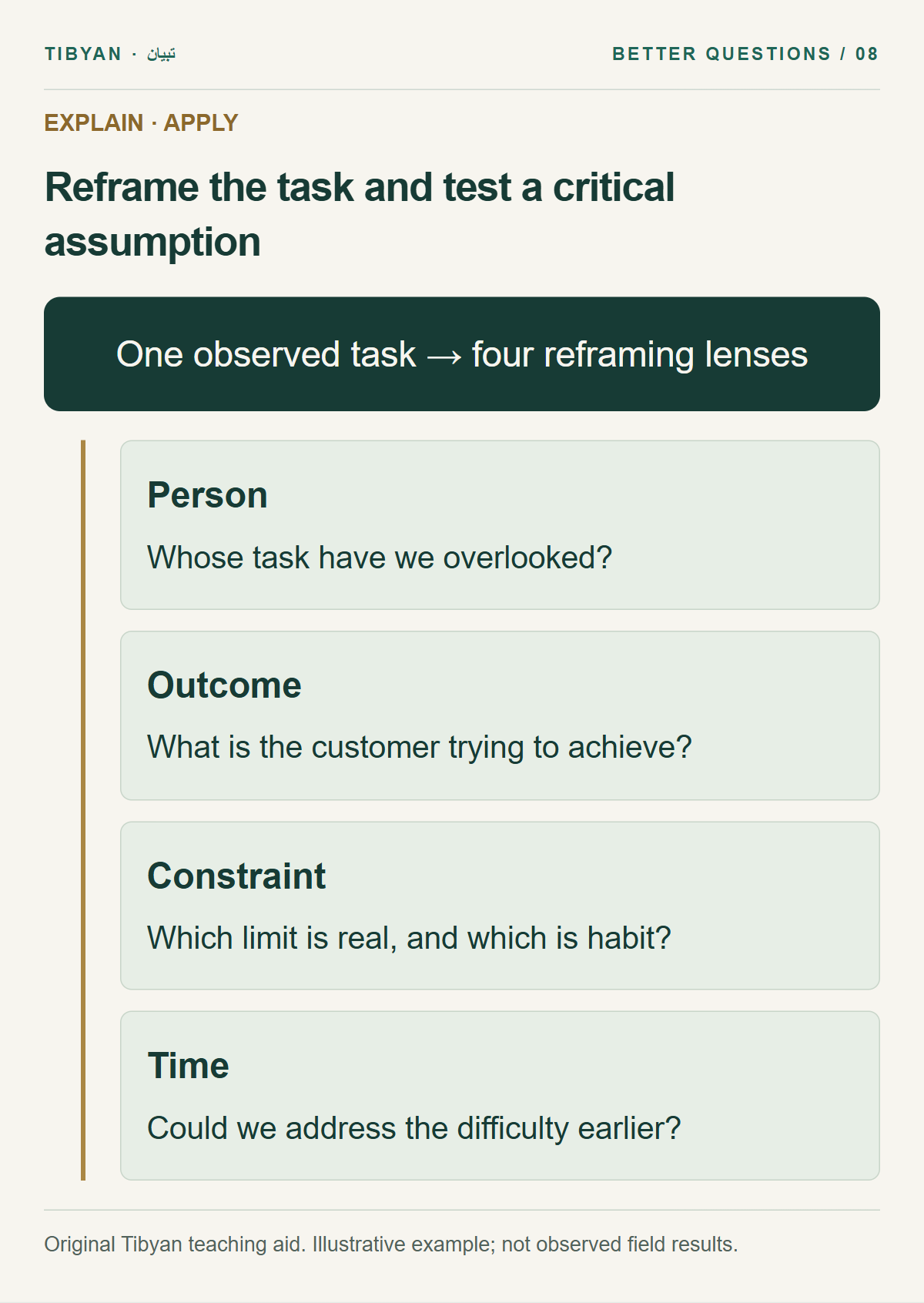
Try four lenses. Change the person: whose task have we overlooked? Change the outcome: what is the customer trying to achieve beyond receiving the document? Change the constraint: which limit is real, and which is inherited habit? Change the time: could the difficulty be addressed before it appears?
An integrative review of problem framing connects creative work with the interplay of representations, knowledge, stimuli and creative approaches. Its implication is to examine how the challenge is understood, not simply produce a longer list of solutions. It does not validate a prescribed set of innovation questions. Magistretti and colleagues, 2025.
 Open the diagram full size ↗
Reframing should illuminate the observed task. Move from distinct approaches to the one assumption that needs a useful test now.
- Reframe the task and test a critical assumption
- One observed task → four reframing lenses
- Person
- Whose task have we overlooked?
- Outcome
- What is the customer trying to achieve?
- Constraint
- Which limit is real, and which is habit?
- Time
- Could we address the difficulty earlier?
- Original Tibyan teaching aid. Illustrative example; not observed field results.
Keep the question grounded and open
Stanford d.school’s “How Might We” tool offers strategies for creating several productive framings. Keep the question specific enough to investigate and open enough to allow different responses. A question that names your preferred software is already close to a solution brief. Stanford d.school.
Separate idea generation from selection. First create alternatives that differ in how they work. Then evaluate them against the user task, constraints, feasibility and uncertainty. Ten cosmetic variations of a checklist do not provide the same range as a checklist, an earlier conversation and a changed approval sequence.
Test an assumption, not enthusiasm
Choose the uncertainty most likely to change your commitment. If you do not know whether the buyer can identify the unresolved assumptions, use a fictional proposal and observe that task. If the uncertainty concerns internal capacity, test whether the proposed handoff can be performed under realistic conditions.
State what the test can show. A task walkthrough may expose confusion and help improve the design. It does not demonstrate willingness to pay, long-term adoption or revenue impact. Seek the appropriate evidence for each subsequent decision rather than stretching one favorable observation across the entire business case.
Preserve useful disagreement
Invite a colleague to explain why the favorite idea might fail. Ask them to identify a condition rather than dismiss the idea generally. Record the objection as a testable concern. An idea may survive by changing the design, narrowing the intended user or acknowledging a limit.
For practice, write three substantially different questions about one task, generate a different approach from each and choose the assumption you will examine first. Keep a record of the alternatives you set aside and the evidence that would make you reconsider them.
 Open the diagram full size ↗
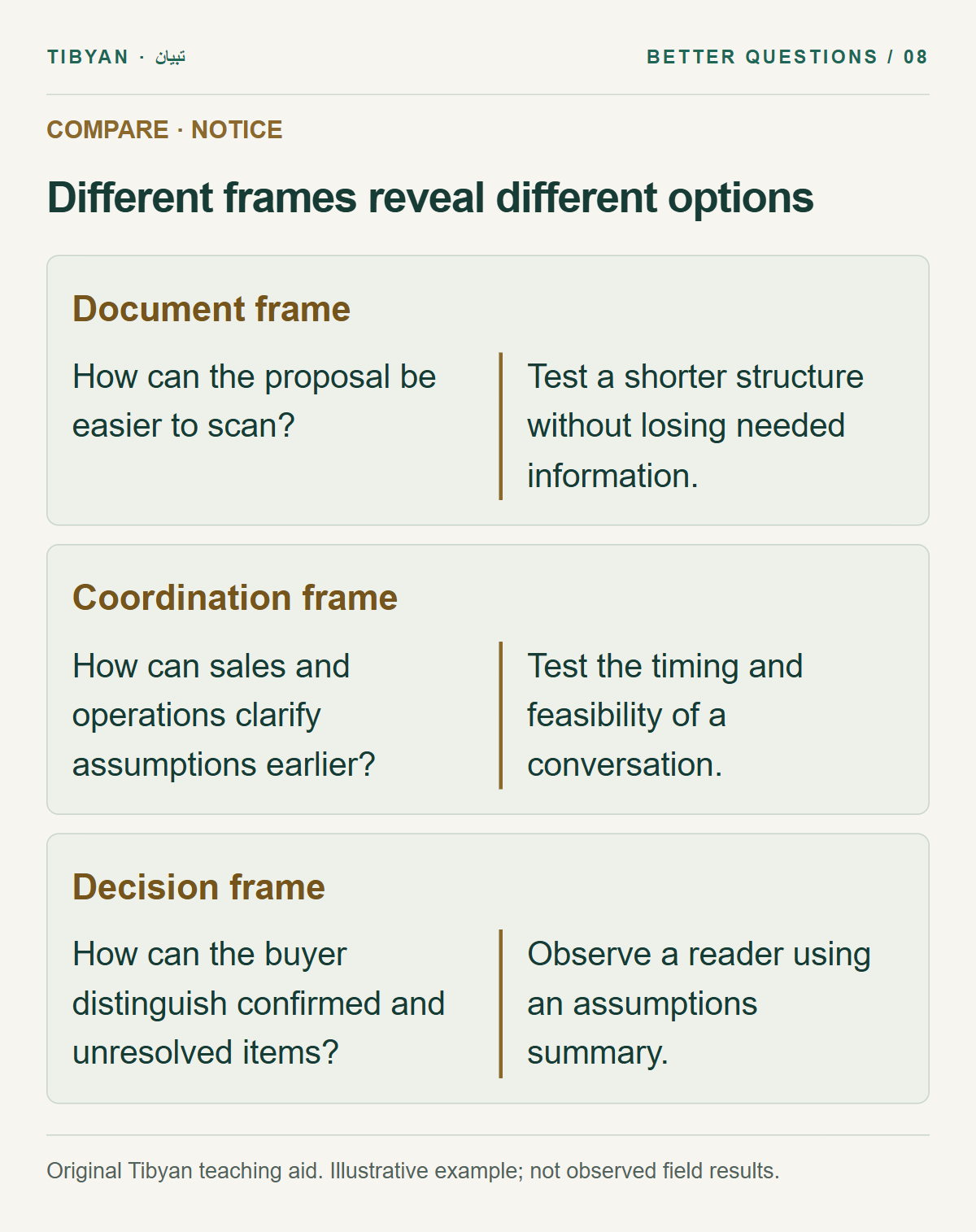
Compare mechanisms, not cosmetic variations. For each approach, identify what must be true and choose evidence that can change the next commitment.
- Different frames reveal different options
- Document frame
- How can the proposal be easier to scan?
- Test a shorter structure without losing needed information.
- Coordination frame
- How can sales and operations clarify assumptions earlier?
- Test the timing and feasibility of a conversation.
- Decision frame
- How can the buyer distinguish confirmed and unresolved items?
- Observe a reader using an assumptions summary.
- Original Tibyan teaching aid. Illustrative example; not observed field results.
Reframe a customer-onboarding task
Fictional teaching case. Namaa's new customers receive a welcome email and a setup form. In three invented walkthroughs, two customers could not identify who would confirm their first-week setup date. This tiny packet identifies a design question; it does not estimate how common the problem is.
“Which welcome-email color will customers prefer?” is an attractive but weak reframing here: color preference may leave the observed ownership problem untouched. A defensible frame still explains the original difficulty.
A complete bounded test card
Selected approach: a fictional status card. Assumption: a new customer can distinguish a proposed date from a confirmed date and identify the person who can change it.
Exhibit C1 — original card text: “First-week setup: 15 November 2026, 09:00. State: proposed. Confirmation owner: Hana, delivery coordinator. Next action: await Hana’s written confirmation before treating the date as agreed. Request date changes from Hana.” All times use this fictional team’s business clock. The team can maintain one named confirmation owner for this exercise.
Task: give three relevant colleagues playing new customers a fictional card; ask each to name the date state, the confirmation owner and the next action without hints. These are simulated users; a later test with intended customers is still required.
Decision rule for this design exercise: all three must identify the state, owner and next action correctly before the team takes the card to a small intended-customer trial. Any misunderstanding of a confirmed commitment triggers a revision. This is a conservative, fictional screening choice for this task, not a universal usability threshold.
Invented result: two people identify all three correctly; the third reads “proposed” as confirmed. Product coordinator Dina changes the label to “Proposed — awaiting confirmation from Hana” and retests the changed task. She does not recommend rollout or infer demand.
Exhibit C2 and answer key — reveal after the attempt: keep C1’s date, owner and next action, but replace the state line with “Proposed — awaiting confirmation from Hana.” The correct reading of either version is: the date is not confirmed; Hana owns confirmation and receives change requests; the customer waits for her written confirmation before treating the date as agreed.
What would change the next action? Accurate interpretation with substantial coordination effort would shift attention to workload. Accurate interpretation at manageable effort would justify a limited customer trial. Continued misunderstanding would require redesign or a different approach. None of these outcomes establishes willingness to pay, sustained adoption or business impact.
Weak record: “Three people liked the card, so customers will buy.” Improved record: “The exercise exposed one commitment-state error; revise the label before testing with intended users.” The changed decision follows the observation.
Your reusable working record
Open the editable working tool · Download the printable pack
- Observed user/task and limit: Describe the difficulty before proposing the product.
- Frame → question → approach: Write at least three different mechanisms.
- Constraints and excluded frame: Keep real limits and explain a rejected frame.
- Critical assumption and task: Choose the uncertainty that controls the next commitment.
- Participants, materials and procedure: Separate simulation from intended-user evidence.
- Decision rule before the test: Explain why the criterion fits this particular decision.
- Observation, next decision and owner: Report errors and the changed choice, not just liking.
- Limits and review trigger: State what the test cannot establish.
Practice and retry
Before reading the test result, choose a frame and write a decision rule. Then use the invented result to decide what changes. Add a new constraint: no staff time is available for an extra call. Reconsider feasibility without pretending that the constraint proves the card works.
Common error and corrective feedback
Common errors: changing the task until the favored idea wins; counting cosmetic variants as distinct mechanisms; interpreting praise as adoption; inventing a threshold after seeing the result.
Independent-study alternative
Use the supplied observations and write your frames before revealing the example. Read the fictional results only after committing to a rule. Record the change you made and why.
Check your work
- Frames relate to observed work.
- Approaches differ in mechanism.
- Constraints are explicit.
- The test answers a specific uncertainty.
Apply and review
Review what the test revealed and decide whether to develop, revise or set aside the approach.
Continue the learning route
Previous: Diagnose the Problem Before Choosing a Solution · Series overview · Next: Ask Better Questions Before Making Business Decisions
Sources and further reading