Tibyan Toolkit 05
Prepare a useful feedback conversation
Bring one observation, one question and one agreed next step.
PDF · 8 pages · 114 KB · Version 1
Download English PDFGive a newly promoted manager one recurring decision to hand over, then review how the team handles it.

On Tuesday morning, a field service team has a technician ready, a customer waiting and two jobs that could change places. The dispatcher knows the routes and the service windows. She still waits for the new manager to approve the swap.
In this hypothetical team, the manager used to be its best specialist. As a specialist, he made dispatch decisions quickly. After the promotion, the same decision still waits for him, alongside staffing, coaching and customer escalations. His director can help him make room for the new role by moving one recurring decision to the person closest to the work.
A dispatcher who collects the facts and recommends a route still depends on the manager if every routine change needs approval. Define which route changes the dispatcher can authorize, what she must record, and which circumstances require the manager’s involvement. The manager still owns the rules, reviews exceptions and provides support.
Lee, Willis and Tian’s meta-analysis found positive relationships between empowering leadership and several performance-related outcomes at individual and team levels. In a survey of 215 unit managers in professional services, Van Triest and Williams found that managers delegated more authority when employees had more task-specific knowledge and when oversight cost less. Use those findings to ask whether the dispatcher has the information and support to decide. The one-week dispatch trial is Tibyan’s practical proposal. Lee, Willis and Tian, 2018 · Van Triest and Williams, 2024
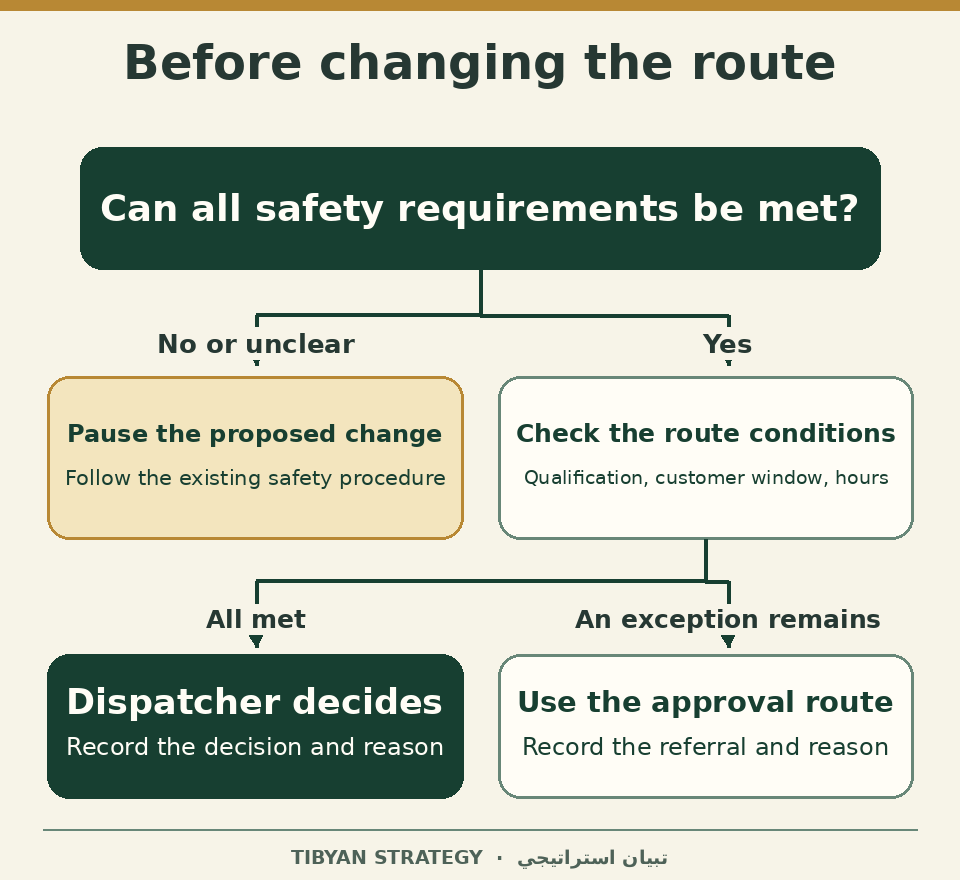
Check safety first. If a requirement is unclear or cannot be met, pause the proposed route change and follow the existing safety procedure. The trial gives the dispatcher no authority to bypass safety requirements.
The dispatcher can swap two routine jobs when both customer windows are protected, the assigned technician has the required qualification and the route fits normal staffing hours. A change to a promised window, an overtime request or the need for a different qualified technician goes to the authorized lead. A task still requires a qualified technician. If that lead is unavailable, use the team's designated fallback. Record what was decided or referred and why.
 Open the diagram full size ↗
Illustrative dispatch decisions. Follow the applicable safety and approval procedures.
| When | What to do |
|---|---|
| Before the trial | Choose a frequent decision. Confirm the dispatcher has the required access. Use two recent examples to agree what falls within the trial, where exceptions go and which recent jobs make a fair comparison. |
| During the trial | For every route-change request, record the date, whether it falls within the trial, who decided, elapsed decision time and whether there was rework or a missed customer window. Record ordinary referrals and safety stops separately. |
| At the review | Compare routine approvals per request within the trial and decision times with recent similar jobs. Check rework and missed windows, and route any safety findings through the designated procedure. Decide whether to keep, narrow or extend the trial. |
 Open the diagram full size ↗
Rana spots the office cat trying to stamp the overtime request. A routine route swap is within her authority. Overtime follows the approval route.
If the team still waits for approval, ask where it got stuck. The dispatcher may lack access to the schedule, or the boundary may leave too much room for interpretation. A week gives you cases to inspect. If eligible decisions rarely occur, gather more examples before deciding how widely to delegate.
Take one request that reached the new manager this week. Write down who should decide it next time and which exception would bring it back.
Use Tibyan’s feedback conversation planner for a private end-of-week conversation between the manager and dispatcher. For more on choosing when to direct or coach, read Questions for Leadership, Coaching, and Team Learning.
Take the next step
Free downloads. No registration. Each PDF includes instructions, an illustrative example and a reusable worksheet.
Tibyan Toolkit 05
Bring one observation, one question and one agreed next step.
PDF · 8 pages · 114 KB · Version 1
Download English PDFPractical worksheets, not validated assessments. Adapt the task and timing to your context. See each PDF for its revision date.
Explore the tools & toolkits library ↗
Practical perspective
Prepare a B2B quotation that procurement, finance, and operations can assess. Use Tibyan’s QUOTE Framework, an annotated example, and a 13-point checklist.
Read perspective
Talent Development
Check whether the task still matters, how people learn it and what gets in their way before you keep, redesign or retire a course.
Read perspective
Team development
Follow one customer case across teams and find which handoff lost the facts, ownership or promise.
Read perspective