By the end of this guide, you can: Choose between direction, coaching and a team debrief, then guide a conversation toward an accountable action.
Bring to the task: One observable work situation, the person’s responsibilities and any non-negotiable requirements.
Here, coaching means a developmental conversation with genuine room for the employee’s judgment; direction means a clear managerial instruction or fixed requirement.
A manager asks, “What do you think we should do?” The employee suggests an approach and discovers that the manager had already decided on another. A question presented as an invitation has become a test of whether the employee can guess the preferred answer. Good leadership questioning starts with honesty about who owns the decision.
Sometimes a manager should give direction: a required procedure, a firm deadline or a decision within the manager’s accountability. Sometimes a person needs instruction or access to a specialist. Coaching is useful when the person has room to think, explore options and take responsibility for an action. State which kind of conversation you are having.
Establish an agreement for the conversation
Name the situation and the expected outcome. “I need the next proposal to meet our agreed submission standard. Let us examine what happened and identify the support you need.” Explain what is fixed and what the employee can decide. Ask what would make the discussion useful, and agree how you will follow up.
ICF’s competencies emphasize agreements, client agency and translating insight into action. A managerial adaptation must also acknowledge performance responsibilities and the power difference. This article is not a substitute for professional coaching preparation or a claim of ICF endorsement. ICF, 2025.
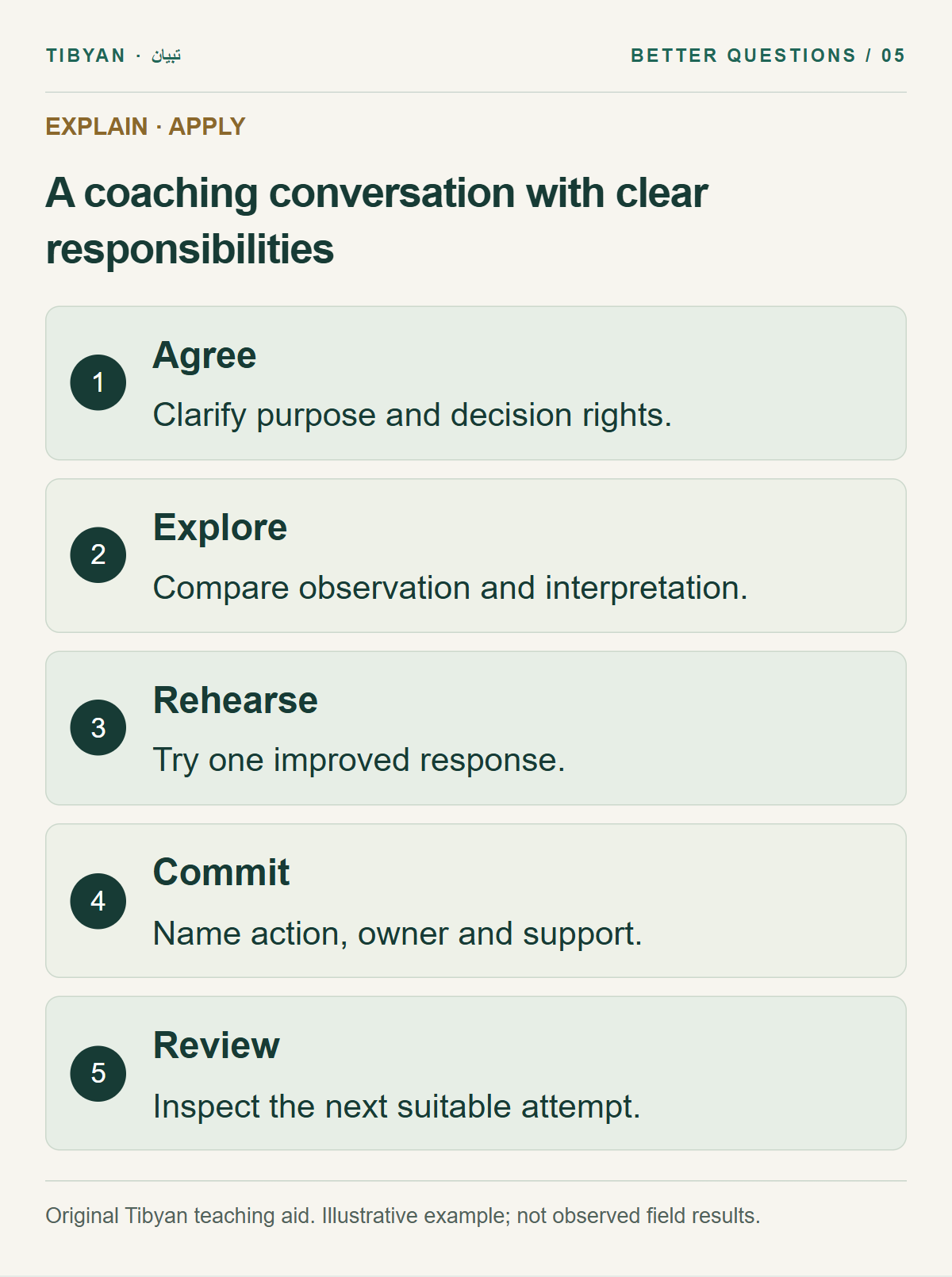 Open the diagram full size ↗
Clarify fixed requirements and real choices before exploration. Rehearse one observable behavior and assign support as well as employee action.
- A coaching conversation with clear responsibilities
- 1. Agree
- Clarify purpose and decision rights.
- 2. Explore
- Compare observation and interpretation.
- 3. Rehearse
- Try one improved response.
- 4. Commit
- Name action, owner and support.
- 5. Review
- Inspect the next suitable attempt.
- Original Tibyan teaching aid. Illustrative example; not observed field results.
Connect observation, reflection and rehearsal
Describe one observable event without assigning a trait: “The customer asked twice for the implementation assumptions.” Ask how the employee understood the situation and what information guided their response. Explore another option and its trade-offs. Then rehearse a short part of the task, such as explaining an assumption or asking a customer for clarification.
A question can reveal a support problem that coaching alone cannot solve. If staff lack access to current information or authority to confirm delivery commitments, the manager must address that condition. Repeatedly asking an employee to reflect will not create missing resources.
Turn a team event into learning
A debrief examines a shared event rather than assigning a winner. Ask what the team intended, what happened, which conditions helped or hindered the work, what should change and who will check the next attempt. Start with specific records, then compare interpretations. Invite the people nearest the work to correct the sequence.
WHO’s after-action-review guidance describes structured reflection and follow-up in public-health response. The business debrief here is an adaptation of that general approach, not a public-health requirement applied to companies. WHO guidance.
Make accountability concrete
Close with an action, owner, opportunity and review point. “Ask better questions next time” is too vague. “Before issuing the next draft, confirm whether the estimate includes implementation support; record unresolved assumptions for the approver” is observable. Ask what could prevent the action and who is responsible for removing that barrier.
Avoid turning every conversation into coaching. When someone asks for a fact you know, answer it. When you must make a decision, make it and explain the reasoning. Use inquiry where it helps people understand the task, exercise judgment and learn from experience.
In practice, work in groups of three: manager, employee and observer. Use the example, then change one condition so the employee needs instruction or organizational support rather than another reflective question. Discuss how the manager’s response should change.
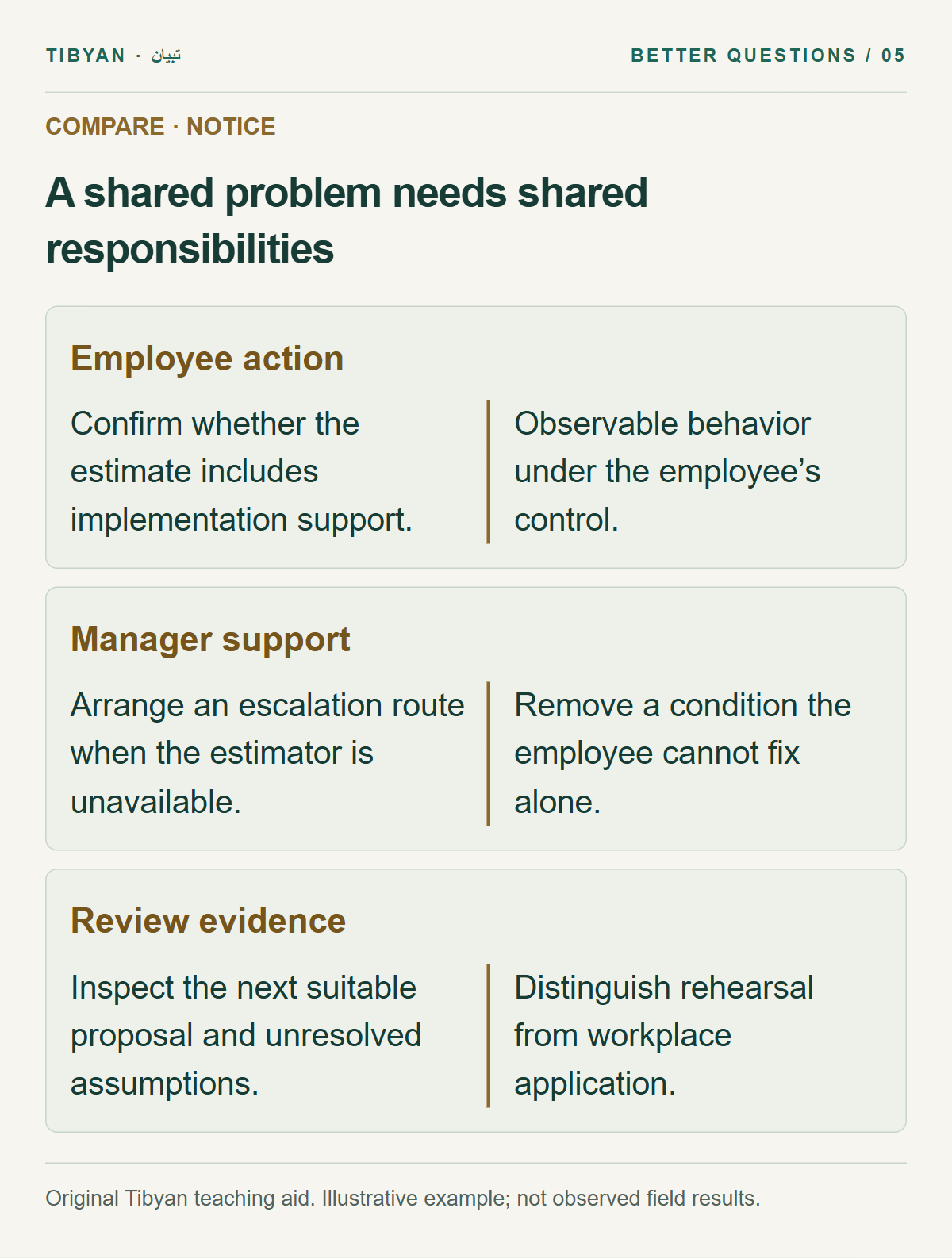 Open the diagram full size ↗
Do not put organizational barriers into an employee reflection task. Give each action to the role able to perform it and inspect the next suitable attempt.
- A shared problem needs shared responsibilities
- Employee action
- Confirm whether the estimate includes implementation support.
- Observable behavior under the employee’s control.
- Manager support
- Arrange an escalation route when the estimator is unavailable.
- Remove a condition the employee cannot fix alone.
- Review evidence
- Inspect the next suitable proposal and unresolved assumptions.
- Distinguish rehearsal from workplace application.
- Original Tibyan teaching aid. Illustrative example; not observed field results.
Choose the conversation before choosing the question
Original fictional teaching cases, revised 11 November 2026. A manager's question is useful only when it matches the work and the decision space.
A complete coaching agreement and attempt
The fictional next draft is due at 16:00 on 12 November. Mariam states the fixed rule: every unresolved estimate assumption must be visibly marked before release. Huda may choose how to seek confirmation; she cannot remove an unresolved item merely to make the document look complete. They agree to rehearse a confirmation request and inspect the next draft together. They will share the task note with each other and Omar, who owns the estimate; Mariam does not promise absolute confidentiality beyond her managerial responsibilities.
Huda explains that an earlier fictional reply from Omar said “looks fine”; she had taken that general reassurance as confirmation of the support period. Her first request in the rehearsal is, “Is this all fine?” Mariam asks, “What would a useful answer need to distinguish?” Huda identifies the support period and the confirmation status. Her revised request is: “Please confirm whether the estimate includes support through the stated implementation period. If this is not confirmed, I will mark it unresolved for the approver. Who can respond if you are unavailable?”
They rehearse Omar replying, “I have not checked that period.” Huda then marks it unresolved rather than treating silence as approval. Huda owns the request; Mariam owns the backup route to Lina when Omar cannot respond. They review the draft and response record at 16:30 on 12 November. The planned criterion is whether the specific commitment was confirmed or visibly unresolved before release. A successful rehearsal is practice evidence; the next draft is the opportunity to examine workplace use.
A separate team debrief
For P3, the intended outcome was submission by 16:00 on 10 November. The draft history shows submission at 18:00; Huda reports a scope change at 14:30, and Omar reports that the changed support period needed confirmation. Mariam asks, “Which parts do the records establish, and which are accounts we still need to check?”
Huda: “The version history can establish when the scope changed.” Omar: “We need to check who could authorize the new commitment.” Mariam: “For the next eligible scope change, Huda will record the changed assumption and named response owner; I will confirm the authority and backup route. At our next handoff review, we will compare the expected sequence with the actual record.” This is a bounded team action, not a conclusion that one person caused the delay.
Your reusable working record
Open the editable working tool · Download the printable pack
- Conversation type and reason: Choose instruction, direction, coaching or debrief.
- Fixed requirement and genuine choices: Write both sides of the agreement.
- Outcome and information agreement: State the outcome, note use and decision authority.
- Employee’s first interpretation: Keep the employee’s reasoning visible.
- Rehearsed behavior and response: Write the actual new action and a challenging reply.
- Employee action: Name the person, artifact and opportunity.
- Manager support: Assign what the employee cannot provide alone.
- Application evidence and review: Define what will be reviewed and when.
- Team debrief: intended and actual event: Keep this record separate from coaching.
- Team debrief: conditions and unknowns: Compare accounts and identify the missing check.
- Team debrief: action and support owners: Assign a bounded shared change.
- Team debrief: review opportunity: State the record to bring back.
Practice and retry
Classify the four situations before choosing a question. In triads, run a ten-minute coaching attempt with one rehearsal and specific feedback, then change the condition so the employee lacks the rule and requires instruction. Finish with a separate short team-debrief record using the P3 packet.
Common error and corrective feedback
Do not score agreement with the manager as learning. Do not ask the employee to reflect repeatedly when the barrier is missing authority or information. In the debrief, distinguish what the version record shows from what each participant reports.
Independent-study alternative
Classify the situation cards, write a direct instruction for the missing-knowledge case and a coaching question for the genuine-choice case. Rehearse both sides of the unconfirmed reply aloud, then complete the separate debrief fields and compare with the model.
Check your work
- Fixed requirements and choices are explicit.
- The employee’s reasoning is explored.
- The practice targets one observable behavior.
- Both employee action and manager support have owners.
Apply and review
Review the next appropriate attempt and identify whether the obstacle concerned skill, information, authority or another condition.
Continue the learning route
Previous: Listen Carefully and Ask Better Follow-Up Questions · Series overview · Next: Customer Discovery: Ask Questions That Reveal Real Needs
Sources and further reading