Suppose your sellers score higher the second time they practice handling price objections with AI. Would you fund a rollout on that result?
Give them a buyer scenario they haven’t seen and switch off the coaching prompts. Can they ask a question that reveals what’s behind the objection? Then look for the same behavior in real calls where buyers raise a similar concern. The platform score shows how sellers performed in the exercise. The unfamiliar case shows what they can do without prompts. Call reviews show whether they use the skill at work.
Check what the research measured
In a November 2026 working paper, Manzoor and colleagues report a field experiment that randomly assigned 187 new hires at a Chinese medical equipment manufacturer to practice with AI or with peers. The main follow-up was two weeks after training. The team counted sales calls from hire through that point. The authors estimate that differences in time employed accounted for 61.0–64.7% of the increase in calls per recruit. For your pilot, count calls and track who had the opportunity to make them. To assess how a seller handles a price objection, have a reviewer score the behavior directly. Manzoor et al., The Workforce Selection Effects of Training with AI
Coaching after training is worth tracking, too. Hughes and colleagues’ meta-analysis found that support from peers, supervisors and the organization was associated with greater use of learned skills on the job. Record the follow-up coaching each group gets so you can interpret differences in how often sellers use the skill. Hughes et al., The Role of Work Environment in Training Sustainment
Follow one skill from practice to customer calls
Imagine a buyer says, “The price is too high.” In this hypothetical pilot, the seller should ask whether the buyer faces a budget limit or needs evidence to justify the purchase. Then the seller checks their understanding and proposes a next step that fits. Ask sellers to demonstrate the skill before training so you have a baseline.
Set the same learning goal, similar practice time, and the same evaluation window for both groups. Assign sellers at random where feasible. If you match the groups, document differences that could affect the comparison. Use a scenario sellers haven’t seen and ask an independent reviewer to score responses without knowing which group the seller was in.
Use the results to decide whether to expand
Before the pilot, agree what would justify extending it. For example, look for better independent ratings on the new case and enough comparable calls to assess workplace use. If reviewers disagree, have them score shared examples and agree what each rating means. Record who remains employed, who had eligible calls and how you handled missing observations.
Report how many calls were eligible, how many you reviewed and what share of the reviewed calls showed the target behavior. For the budget decision, count the staff time spent building cases, checking feedback, arranging peer practice and reviewing calls.
Suppose simulation scores and call volume rise while the independent ratings stay flat. Check whether the new case and scoring criteria capture the intended skill, and whether both groups had comparable chances to use it. Keep the rollout decision open until you have evidence that answers the question you started with.
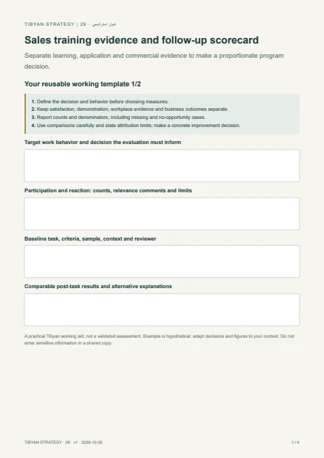
Use the training follow-up scorecard to record practice, application on the job and business results. Sales training evidence and follow-up scorecard
Sources and further reading