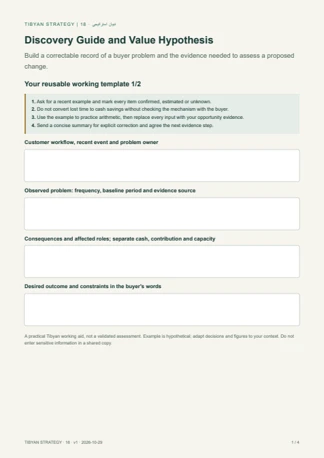
Tibyan Toolkit 18
Discovery Guide and Value Hypothesis
Build a correctable record of a buyer problem and the evidence needed to assess a proposed change.
PDF · 4 pages · 67 KB · Version 1
Download English PDF Open editable working template ↗Agree on a credible alternative, a shared measure, and evidence that would change the purchase decision.

An order-management vendor can show that its software catches missing fields. The operations director at a distributor needs a different answer. Will the software release more orders correctly than a simple checklist the distributor can introduce itself?
Agree on how the buyer will answer that question before proposing a purchase. Write down the current process, a credible alternative, the change you expect, and the evidence that would make either of you reconsider. That is a value hypothesis the buyer can review and test.
Imagine the dashboard throws confetti because fewer orders need rework. Before you join the celebration, ask Operations how many orders went out with errors. Check both measures before deciding.
Consider a fictional Saudi distributor. In one reference month, 400 of its 4,000 eligible orders needed rework. Some required information was missing before release. Operations can keep the current workflow, introduce a required-field checklist with a person responsible for exceptions, or test software that flags missing data at order entry.
Begin with the simplest option that can answer a useful question. In this case, the operations team can run the checklist and investigate why fields are missed. If errors continue and the buyer can support a limited software trial, compare software against the checklist as it is actually used. The current workflow still provides a reference when the buyer needs to judge the cost of keeping things as they are.
In interviews with sales managers, Terho and colleagues identified understanding the customer’s business model, shaping the value proposition, and communicating customer value as parts of value-based selling. The test here turns part of that framework into a working question the distributor can answer. Terho et al. on value-based selling
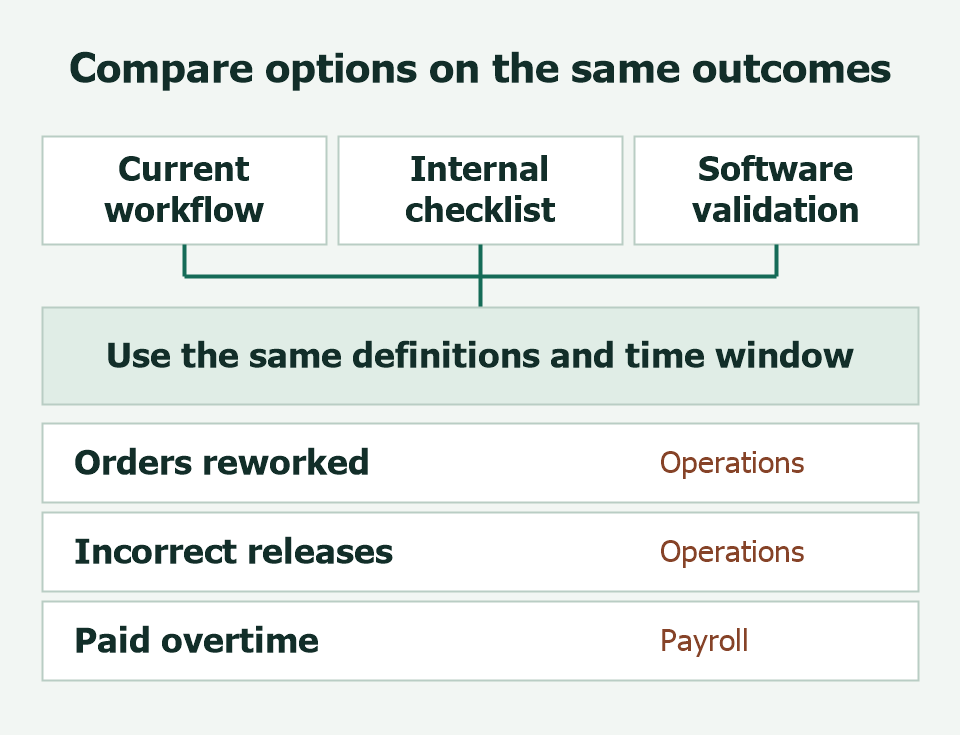 Open the diagram full size ↗
A useful comparison puts each option against the same buyer outcomes.
Use a short hypothesis the buyer can correct. “The checklist should reduce manual rework by catching incomplete orders before release. Operations will compare rework and incorrect releases per eligible order for two comparable queues. Payroll will check any change in paid overtime separately.”
In this illustration, operations proposes a four-week trial. Compare order types, staffing and the distribution of work across shifts before selecting the queues. Record differences that remain. Use the order as the unit and define both rates before starting. The rework rate measures the share of eligible orders that need manual correction. The incorrect-release rate measures the share released with a missing or wrong field. Each rate uses all eligible orders in its group as the denominator.
Agree what improvement would matter and what increase in release errors would make the buyer stop and investigate. A limit should reflect the buyer’s tolerance for errors and consequences. For example, errors on orders with tight delivery commitments could warrant a separate review. In public-policy guidance, HM Treasury recommends testing assumptions where uncertainty and consequences are greatest. The comparison here adapts that principle to one operating decision. HM Treasury’s Test and Learn guidance
Imagine the buyer collects the following data. The comparison queue continues its current process. The test queue uses the internal checklist.
| Measure | Comparison queue | Test queue |
|---|---|---|
| Eligible orders | 1,000 | 1,000 |
| Orders reworked | 100 · 10% | 48 · 4.8% |
| Orders released incorrectly | 5 · 0.5% | 12 · 1.2% |
The test queue has less recorded rework and more incorrect releases. Paid overtime stayed the same during observation. Ask whether the checklist caught omissions or whether some orders bypassed rework and went out with errors. Have the operations lead inspect the additional incorrect releases and check whether the two queues handled similar work. Review the evidence with the buyer before extending the trial. The queue comparison helps decide what to investigate. A stronger design would be needed to isolate the checklist’s effect from other differences between the queues.
The outcome still helps the buyer. It shows where to inspect the mechanism and which claim remains open. If the operations lead finds a correctable problem with the checklist, fix it and repeat the comparison with the current process. If the revised checklist meets the buyer’s targets for rework and release accuracy, keep using it. Consider a software trial if a material problem remains or the buyer identifies a specific benefit worth testing.
Before the software trial, agree how much improvement over the checklist would justify switching and what release-error rate would stop the trial. Compare software with the checklist as staff actually use it, using comparable orders, the same observation period and the same measures for rework and incorrect releases. Switch only if the software meets the agreed improvement and quality criteria and the benefit justifies the full cost of switching. Finance should count payroll savings only where it can verify that paid hours or a scheduled shift can be cancelled.
Fill one row with the buyer. Ask the record owner to check the denominator, the comparator and the result that would change the decision.
| Buyer outcome | Options and expected mechanism | Sample and evidence owner | Quality limit and decision rule |
|---|---|---|---|
| Fewer orders reworked with accurate releases | Compare the current process with a checklist that catches missing fields before release | Two comparable queues over four weeks. Operations checks both rates. Payroll checks overtime. | Set the tolerance before the trial. If release errors rise, inspect them before extending. |
Try the decision again. Suppose rework falls in the test queue and release accuracy holds, but payroll is unchanged. State the claim you would make to operations and the one you would make to finance. A defensible answer proposes a wider operational trial if the target was met, subject to checking comparable queues, and records that cash savings remain unverified. If you cannot name a finding that would change your recommendation, revise the hypothesis with the buyer.
Use the worksheet to record your comparison, the mechanism and the evidence the buyer still needs. Discovery Guide and Value Hypothesis
Take the next step
Free downloads. No registration. Each PDF includes instructions, an illustrative example and a reusable worksheet.
Tibyan Toolkit 18
Build a correctable record of a buyer problem and the evidence needed to assess a proposed change.
PDF · 4 pages · 67 KB · Version 1
Download English PDF Open editable working template ↗Practical worksheets, not validated assessments. Adapt the task and timing to your context. See each PDF for its revision date.
Explore the tools & toolkits library ↗
Practical perspective
Prepare a B2B quotation that procurement, finance, and operations can assess. Use Tibyan’s QUOTE Framework, an annotated example, and a 13-point checklist.
Read perspective
Talent Development
Check whether the task still matters, how people learn it and what gets in their way before you keep, redesign or retire a course.
Read perspective
Team development
Follow one customer case across teams and find which handoff lost the facts, ownership or promise.
Read perspective