Tibyan Toolkit 07
Five questions after an activity
Help participants move from an experience to a practical next step.
PDF · 8 pages · 114 KB · Version 1
Download English PDFGive the next team a chance to run the pilot with its own staff and ordinary support before deciding whether to roll it out.

In a hypothetical equipment supplier, one branch pilots a new way to assign incoming maintenance requests. The branch reports faster assignment during the pilot. The project lead was also there every morning to repair the routing sheet and settle disputed cases. When another branch asks to adopt the method, the operations director has a question. Could that team get similar results with the support it would have on an ordinary week?
Run a second-site test that makes the expected support visible. The work may require a routing rule and an owner for exceptions. It may also require a daily level of specialist attention the organization cannot supply everywhere.
WHO and ExpandNet’s scale-up guide starts from interventions whose effectiveness and feasibility have been tested in context. A review by Milat and colleagues identified feasible delivery, local context and resources among recurring considerations in public-health scale-up. These sources inform Tibyan’s second-site test. The example applies the reasoning to a business workflow. WHO and ExpandNet, 2010 · Milat et al., 2015
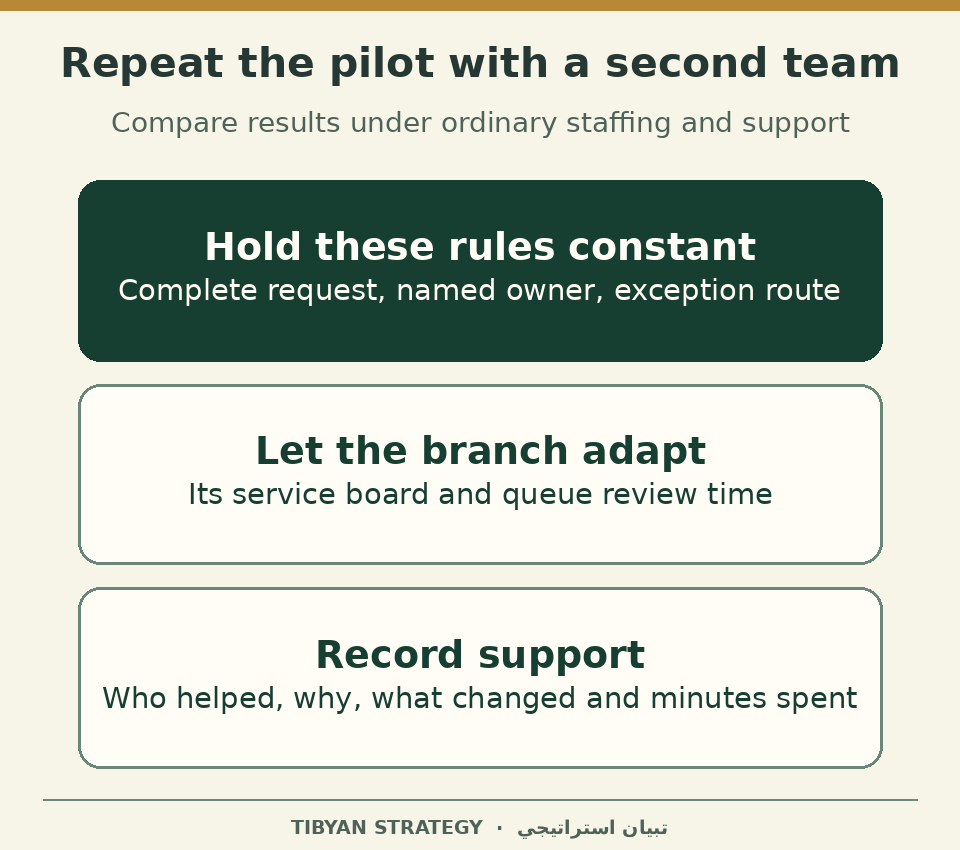
In this test, the second branch uses the same definition of a complete request, assigns each eligible request to a named owner and routes ambiguous cases to a duty lead. Hold those rules constant during the trial. Let the branch use its own service board and choose when to check the queue. Agree what support counts as ordinary and record any intervention beyond that level, including who provided it, why and how long it took.
 Open the diagram full size ↗
Define the conditions for the second pilot before comparing results.
| Check | What the second branch records |
|---|---|
| Incoming work | All requests received, time from intake to completeness for those that became complete, and the count and age of requests still incomplete at review. |
| Assignment speed | Time from a complete request to assignment, using the same start and end points as the original pilot. |
| Quality | Requests unassigned at review or incorrectly routed, with total eligible requests as the denominator. |
| Support | Who intervened, what they did, why, minutes spent and whether the branch can provide that help under normal staffing. |
| Comparability | Case mix, volume, staffing and tool-access differences that could affect the comparison. |
Before starting, agree on the review period or minimum case volume, thresholds for assignment and quality, the support allowed and what would make you extend, modify or stop the trial. Compare with the second branch’s own recent work under similar conditions. If the branch meets the criteria under ordinary support, schedule a later check with normal staffing and try another relevant setting before a broad rollout. If the original lead still resolves routine issues or the incomplete queue grows, diagnose the problem and test again. The short trial can expose reliance on extra support. Evidence of sustained performance comes from follow-up.
Before your next rollout meeting, ask the receiving team to run one real case and tell you where it needed help.
Use Tibyan’s five questions after an activity to debrief the receiving team. For help shaping the test and deciding what evidence to collect, use the small-experiment worksheet.
Take the next step
Free downloads. No registration. Each PDF includes instructions, an illustrative example and a reusable worksheet.
Tibyan Toolkit 07
Help participants move from an experience to a practical next step.
PDF · 8 pages · 114 KB · Version 1
Download English PDFPractical worksheets, not validated assessments. Adapt the task and timing to your context. See each PDF for its revision date.
Explore the tools & toolkits library ↗
Practical perspective
Prepare a B2B quotation that procurement, finance, and operations can assess. Use Tibyan’s QUOTE Framework, an annotated example, and a 13-point checklist.
Read perspective
Talent Development
Check whether the task still matters, how people learn it and what gets in their way before you keep, redesign or retire a course.
Read perspective
Team development
Follow one customer case across teams and find which handoff lost the facts, ownership or promise.
Read perspective