The agreement has been signed, the product presentation delivered and the partner logo added to the website. Weeks later, introductions are inconsistent, proposals contain unsupported promises and nobody knows who should resolve an installation question. The relationship exists; the operating arrangement has not yet been made usable.
Partner activation connects an agreed commercial role to specific work, resources, boundaries and evidence of readiness. It is different from selecting a route or attending training. Evaluate whether both organizations can perform the work together before increasing their commitments.
Use this guide when: you have a candidate or appointed local partner and need to prepare a bounded joint selling or service activity.
Learning outcome: build an activation plan, inspect observable readiness and make an evidence-based decision about the partner's next permitted responsibilities.
Bring: the actual proposed arrangement, approved offer, role boundaries, relevant accounts, service requirements, named people and review owners. Resolve legal permissions through appropriate local review; this guide is not a contract or authorization to operate.
Translate the arrangement into work
Start by defining the role. A reseller buying for resale, a referral partner and a service subcontractor need different capabilities and information. If your arrangement combines roles, identify them separately. A broad label such as “regional partner” should not conceal who contracts, sets prices or delivers support.
For the comparison that precedes activation, use the route-to-market guide. Here, the question is how the selected arrangement becomes workable, not which route has the highest theoretical contribution.
ITA's representative-selection guidance includes coverage, service capacity, incentives, performance monitoring and training. These questions help surface assumptions that activation must address; they do not certify a candidate. ITA: Choosing a Foreign Representative.
Write the first meaningful joint task. “Launch the partnership” is too broad. “Prepare a buyer-permitted discovery meeting for this offer and demonstrate how an installation constraint will be escalated” is observable. Define the output and the commitment that must not be made without approval.
Establish a minimum usable offer kit
A partner cannot represent an offer accurately if the supplier has not made it clear. Prepare a compact kit that answers what the offer does, whom it fits, what evidence supports it and what is excluded. Keep claims tied to their sources and conditions.
Include the current scope, approved positioning, technical prerequisites, pricing approval path, demonstration materials, proposal template, handover requirements and support escalation. Use matching-language materials where the task requires them, and confirm that localized editions carry equivalent promises.
Canada's Trade Commissioner Service treats offer readiness as including adaptation, delivery and after-sales support. That export guidance informs this operating checklist; it does not establish a partner's readiness. TCS: Product or service readiness.
Assign a supplier owner to keep the kit current. Record versions and how obsolete material will be withdrawn. A partner following an old proposal is not always a partner skill failure; the supplier may have created a document-control problem.
Make responsibility visible on both sides
For each task, name the person responsible, the support needed, the output and the approval boundary. “Joint responsibility” without an action owner can leave everyone waiting.
ITA's agreement guidance discusses firm support, training, delivery and specifying a representative's actions. Use appropriate advisers for the actual agreement; the table is an original working aid, not legal drafting. ITA: Negotiating an Agreement.
Also discuss practical priorities. Does the partner have people available for this work? Are other represented offers competing for the same capacity? Are expectations about who funds travel, preparation or service effort explicit? Record the answers as evidence or unresolved questions. Do not substitute optimistic targets for a resource plan.
Check performance before extending independence
Attendance establishes that someone attended. A correct explanation can show understanding of the material. A reviewed joint task provides different evidence about coordination. None automatically establishes independent performance with a real buyer.
Tibyan recommends a progression suited to the role: explain the offer and limits, rehearse a consequential situation, perform an authorized bounded task jointly, then review evidence before expanding responsibility. These are practical steps, not a validated certification sequence or mandatory timetable.
Choose a difficult moment worth observing. Ask the partner to handle a request outside the approved scope, identify when supplier approval is required or explain a prerequisite to a buyer. Evaluate the relevant behavior rather than presentation polish, accent or familiarity with the supplier's internal vocabulary.
Give feedback and a chance to correct the work. A rehearsal should uncover weaknesses while they can be addressed. If a critical service obligation has no capable owner, pause that commitment rather than average the problem into an overall readiness score.
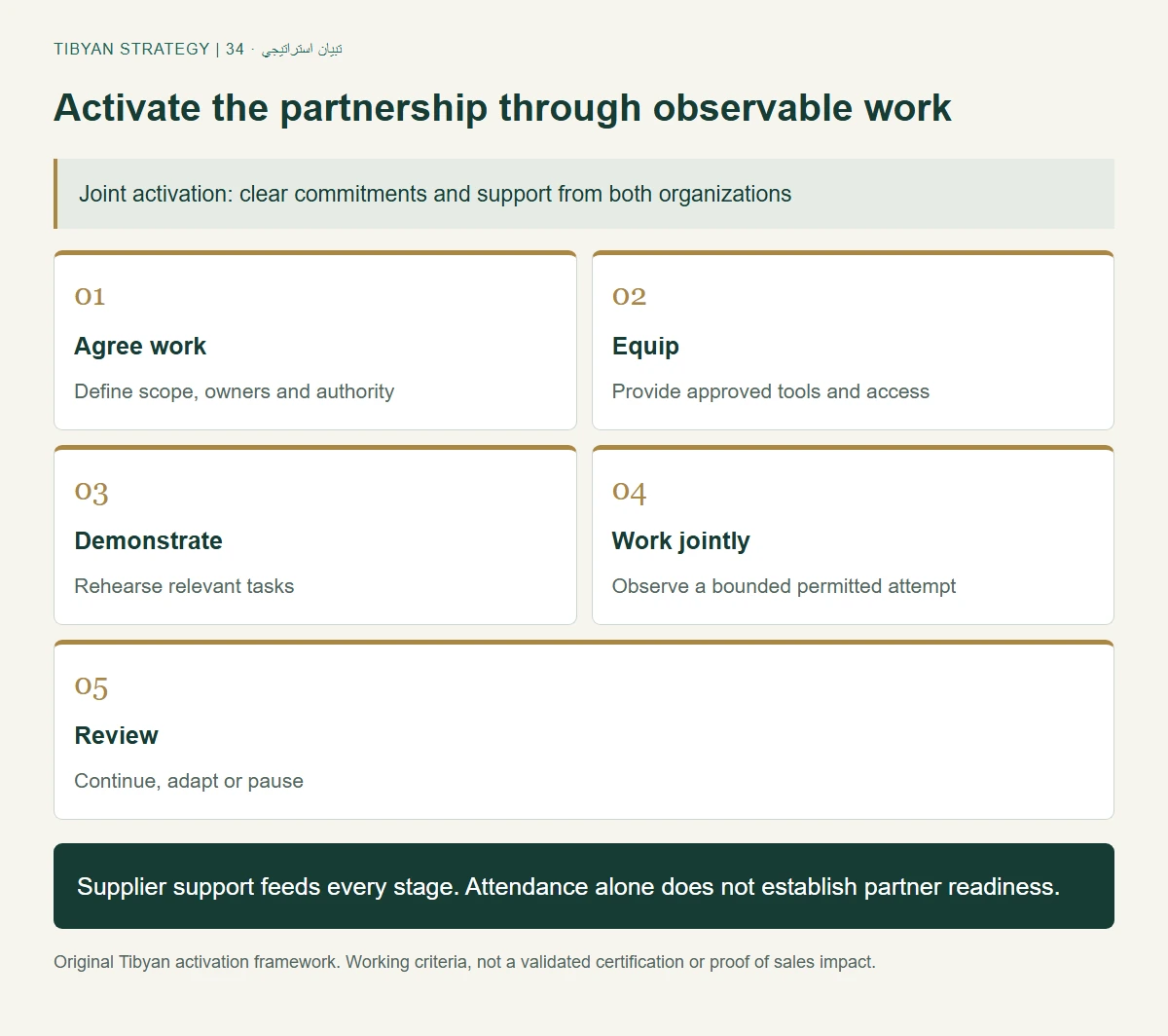 Open the diagram full size ↗
Original Tibyan activation flow. Offer clarity, role boundaries and work evidence support decisions about the next responsibility. The flow is not a legal authorization or a validated partner rating.
Hypothetical example: a promise outside the approved service scope
All parties, readiness observations and decisions in this example are invented for instruction. No actual partner or customer result is reported. An industrial-monitoring supplier retains the customer contract. A local company will introduce relevant contacts and perform defined field-service tasks.
During a fictional rehearsal, the partner promises a response window operations has not approved. The proposed installation also omits a site-preparation dependency. The partner has attended the product presentation, but these gaps show why attendance is insufficient evidence for independent customer commitments.
The supplier should first ask whether its offer kit and briefing made those boundaries clear. If the kit is ambiguous, correct it. If the limits were clear but misunderstood, rehearse the decision again and inspect the explanation. Confirm who can resolve the site dependency before presenting an installation date.
Weak record: “Partner trained; ready to sell.”
Stronger record: “The partner attended the briefing. Independent readiness is unconfirmed: the rehearsal included an unapproved service promise and an unresolved installation dependency. Revise the offer kit and run another rehearsal with the named operations lead. Before a reviewed joint introduction, the partner must explain the approved response window, route the unresolved site-preparation question to Operations and leave any installation date open until Operations confirms it. If the partner misses any of those steps, correct the gap and repeat the rehearsal. Keep proposal and service-date approval with the supplier until a separate review supports extending that authority.”
The next task is a corrected rehearsal and a bounded joint activity when appropriate approvals permit it. No customer should become an unannounced test of the partner's unsupported promise. The fictional gaps justify adaptation; they do not establish that the relationship will fail.
Review a small set of meaningful signals
Choose measures that answer the current decision. Early on, you may need to know whether the offer is represented accurately, agreed tasks are completed and issues reach the right owner. Later, commercial results may become observable. Keep the stages and denominators clear.
Compare promises with evidence, not the partner with an arbitrary universal benchmark. Where performance differs from expectations, inspect both organizations' actions: response delays, missing information, lead fit, capability, available capacity and unclear incentives can all be questions to investigate. Do not assume the partner caused every gap.
Record what changed during activation. If the supplier narrowed the offer or increased support, later results describe that revised arrangement. They should not be presented as proof that the original plan worked unchanged.
Make a bounded next decision
At the review, decide what work may proceed, what must change and what should pause. Name an owner and evidence check for every condition. Increasing authority, widening account coverage and increasing investment are separate commitments; do not bundle them into a vague “activated” label.
For example, the supplier might permit a reviewed joint introduction while retaining approval of all proposals and service dates. If contracting or delivery feasibility remains unresolved, even that activity may need to wait or change scope. Use the actual permissions and obligations of your arrangement.
Plan how customer commitments will be protected if the arrangement changes. Contract changes, exclusivity and termination require appropriate review; this article does not supply default legal terms or recommend a universal notice period.
Apply the activation and review pack
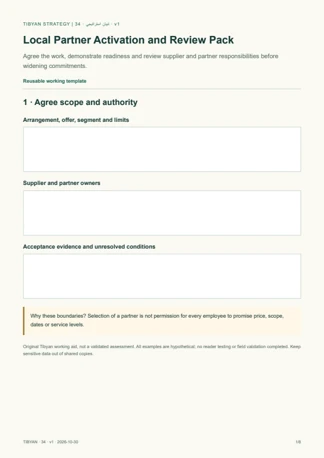
Use the free Local Partner Activation and Review Pack (PDF) to define work, prepare the offer kit, inspect readiness and document the next responsibility. It includes blank pages and a completed hypothetical case with explanations.
You can also use the editable, printable working pack and download your edited copy.
Start with one task your partner and supplier teams must perform together. Have the people who own sales, delivery and support inspect the plan. Test the most consequential boundary in a rehearsal, correct the work and record what still needs evidence. For sales practice design, use the scenario guide; for commitments, use delivery readiness.
If the arrangement exposes unresolved coordination or capability needs, you can discuss the situation with Tibyan.
Evidence limits
Official exporter guidance supports the questions raised here. The activation progression, measures and case are original Tibyan adaptations. No actual partner performance or field outcome has been measured. Intended-reader testing in both languages, practitioner/bilingual review and permissioned cases remain needed. Readiness in a rehearsal does not establish demand, independent delivery or revenue impact.
Cover: original AI-generated conceptual artwork. Diagram and working pack: original Tibyan editorial designs.
Related free resource: supporting working tool.
Sources
Sources checked 30 October 2026.