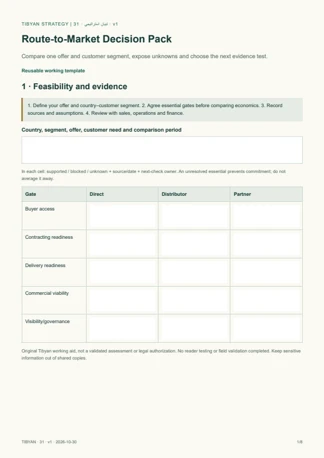
Tibyan Toolkit 31
Route-to-Market Decision Pack
Compare one offer and customer segment, expose unknowns and choose the next evidence test.
PDF · 8 pages · 81 KB · Version 1
Download English PDF Open editable working template ↗Before choosing direct sales, a distributor or a local partner, trace who wins the order, handles field service and pays for it. Use the decision pack to test which costs could change your choice.

Imagine a distributor sells your monitoring system to its first customer. The installation fails. The plant needs someone on site. Whose technician goes?
Work through that question before choosing how to enter a market. Your route to market determines who reaches the buyer, signs the contract and carries out the work the customer was promised. You can sell directly and still hire local service support. A distributor can own the sale and still rely on your engineers. Those responsibilities can change what each route costs and which routes you can deliver.
Use this guide to compare direct sales, a distributor and a local partner for one defined offer and customer segment. Bring your buyer requirements, candidate partners and cost estimates. If you are still deciding whom to serve, start with market selection and demand validation.
The U.S. International Trade Administration distinguishes direct, indirect and combined sales and highlights the management time direct exporting can take. Use its guidance to frame your comparison. The choice for your business depends on what each arrangement can deliver. ITA: Sales Channels.
For this guide, use three working arrangements:
| Arrangement | Commercial structure to investigate | Question that changes the decision |
|---|---|---|
| Direct sale | Your company sells to the end customer and organizes the required selling and delivery work | Can you perform the customer-facing work at an acceptable cost and service level? |
| Distributor/reseller | Another company buys your offer and resells it. Agree which tasks it will handle. | What work and risk does the reseller take on for the margin it earns? |
| Local delivery/referral partner | You contract with the customer and pay a partner for agreed introductions or services. | Can you see what is happening with the customer and resolve problems when the work crosses company lines? |
Here, a local partner provides referral or delivery services while you hold the customer contract. Compare an agent, a subcontractor or a joint venture on its own terms if it allocates the work differently. The labels describe who does the work. Have a qualified adviser check the legal classification.
For each proposal, name the company that takes the customer call, the team that performs the work and the party that pays. Check those assignments against what each company can deliver.
Write one sentence that specifies the country, customer type, offer and use case. Then identify what a customer must be able to buy and receive. For an industrial solution, this might include a technical assessment, installation, user training, agreed support coverage and acceptance criteria. Establish these needs with relevant buyers; do not infer them from nationality.
Ask who evaluates the offer, approves the supplier and signs. Confirm where the work happens and what the buyer needs to see before accepting it. If you have an introduction, use it to find out which roles still need to be involved and how far the buyer has progressed toward a decision.
Work backward from the required experience. If the buyer needs an on-site response you cannot currently provide, record that gap before comparing sales commissions. If a reseller proposes to handle support, ask which staff, tools, coverage and escalation arrangements make that promise deliverable.
Use these five checks to identify which routes are feasible. For each check, mark supported, blocked or unknown. Record what you know, when you checked it and who will investigate any gap.
| Gate | Evidence to seek | Reason to pause |
|---|---|---|
| Buyer access | Relevant references and buyer-permitted conversations involving the right roles | Only a contact list or general relationship claim |
| Contracting readiness | Confirmed contracting parties and a current country/activity-specific review of the proposed arrangement | Unresolved permission, registration or contracting questions |
| Delivery readiness | Named people, capacity, service scope and escalation path | An essential obligation has no capable owner |
| Commercial viability | Consistent receipts, costs, setup investment and payment assumptions | A material cost or financial responsibility is missing |
| Visibility and governance | Agreed opportunity records, customer feedback, approvals and dispute escalation | Important commitments cannot be inspected or controlled |
If an essential requirement is unknown, assign someone to investigate. If the route cannot meet it, pause, even if the route promises excellent access to buyers. Ask qualified local advisers to check the legal, tax and regulatory requirements for your country, activity and proposed contract.
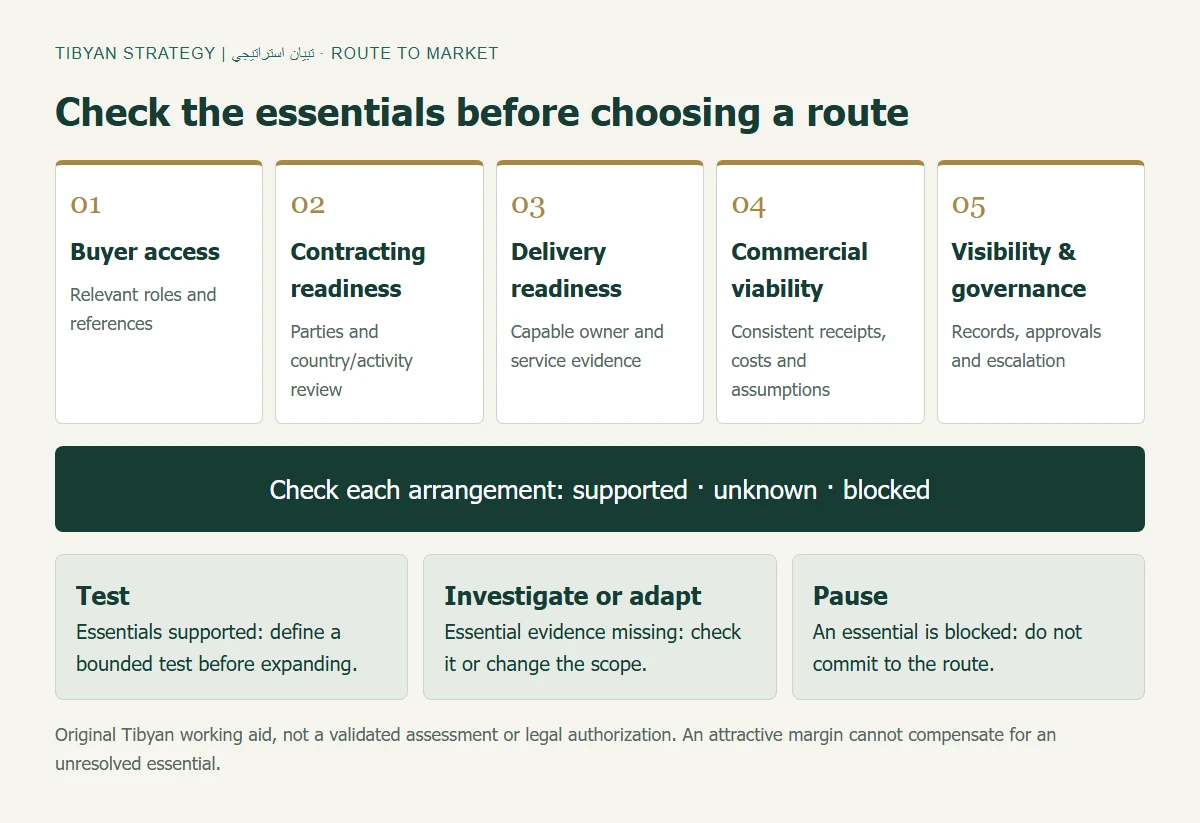 Open the diagram full size ↗
Original Tibyan decision aid. Apply the five gates to each candidate arrangement; unresolved essentials lead to further investigation or a pause, rather than an automatic winner.
ITA's representative-selection guidance covers sales coverage, competing product lines, customer fit and service capability. Adapt those questions to your offer rather than adopting the checklist as a certification. ITA: Choosing a Foreign Representative.
Replace “strong network” with an evidence request: which relevant customer roles can the company introduce, with permission, and what experience supports the claim? Replace “excellent technical support” with a discussion with the proposed service lead about a specific support scenario.
ITA also recommends examining a candidate's history, references and ability to meet special requirements, supported by information beyond its own claims. ITA: Evaluate Foreign Representatives.
Start with the uncertainty most likely to change your choice. Check whether your own team has time for field visits. Ask the distributor how it reaches the buyers you need. Ask the service partner to walk you through how it would handle an urgent fault.
Use the same offer, period, service standard and currency basis. Separate end-customer price from what your company receives. Record which costs another party assumes and which remain with you.
Tibyan's simplified comparison is:
Supplier contribution per contract = supplier receipts − supply/delivery cost − selling/channel fees − retained support cost.
This calculation estimates contribution per contract. Include each cost once. When a distributor pays you a wholesale price, record what it pays you. Its resale margin is already outside your receipts. If a partner fee includes on-site service, enter that service cost in the fee and reserve the retained-support line for work you still pay for separately.
In this fictional example, a supplier is considering a first-year monitoring package for private manufacturing sites in Saudi Arabia. The buyers in the case require installation and an agreed on-site response. All amounts and obligations below are teaching assumptions for this example.
For the same completed first-year package, assume a customer price of 100,000 currency units (CU). The distributor buys from the supplier for 75,000 CU and resells for 100,000 CU. Under the partner route, the supplier retains the customer contract and pays 18,000 CU for agreed referral and service work.
| First-year amount, CU | Direct | Distributor | Local referral/service partner |
|---|---|---|---|
| End-customer price | 100,000 | 100,000 | 100,000 |
| Supplier receipts | 100,000 | 75,000 | 100,000 |
| Supply/delivery cost | 40,000 | 40,000 | 40,000 |
| Selling/channel cost | 12,000 | 4,000 | 24,000 |
| Retained support cost | 10,000 | 6,000 | 8,000 |
| Supplier contribution | 38,000 | 25,000 | 28,000 |
The distributor's 4,000 CU covers supplier enablement, not the resale spread. The partner's 24,000 CU comprises 18,000 CU in partner fees and 6,000 CU in supplier selling work. The 40,000 CU supply/delivery line excludes work already counted elsewhere.
These are assumed receipts and costs for a completed contract, not a revenue forecast or cash-flow model. They exclude separate market setup, corporate overhead, taxes/duties, financing, bad debt and currency effects. Identify the applicable items before a commitment, including legitimate zero or not-applicable cases. Route-level comparison must also allow for different attainable volumes, conversion, timing and capacity; equal prices here are a teaching assumption.
Direct selling leads the partner route by 10,000 CU per contract. How much room does that leave for the field support you still have to arrange?
Another 10,000 CU in direct field costs would bring the two routes level at 28,000 CU, assuming the other figures hold. In this fictional case, the operations team estimates that the extra coverage would cost 25,000 CU per contract. Direct contribution would fall to 13,000 CU, giving the partner route a 15,000 CU lead on this measure.
Before you act on that comparison, verify the coverage estimate, the partner’s ability to respond and whether the customer will accept the proposed arrangement.
Give the reader a recommendation they could act on. Specify the offer, the buyer and what you would check before committing.
For the fictional monitoring package: Investigate the local partner’s ability to provide on-site support. Ask operations to run a service scenario with the candidate. Ask sales to verify its access to relevant buyer roles with permission. Ask finance to check the full first-year cost before making a commitment.
If the route still looks viable, define responsibilities and review any proposed exclusivity against local requirements. The ITA identifies these as points to address in an agreement. ITA: Negotiating an Agreement.
For example, ask how named accounts, lead attribution, technical escalation, customer information, pricing approval and commitments will be handled. These are topics for operational design and appropriate contract review, not a substitute contract template.
Choose a test that answers the question most likely to change your decision. A joint buyer meeting can help check access to the right people. A service simulation can show who responds and how they escalate a fault. For any test, agree who runs it, what it may cost, what you will record and when you will decide.
Canada's Trade Commissioner Service recommends giving market-entry pilots explicit scope, objectives, responsibilities and follow-up decisions. This is export guidance, not proof of the effectiveness of this worksheet. TCS: Marketing and sales.
Define what would justify proceeding, what would require adaptation and what would pause the route. The review date should fit the task and buying cycle. A short test may show whether a partner can coordinate the work; it may not establish demand, repeatability or commercial impact.
Use the free Route-to-Market Decision Pack (PDF) to compare your arrangements, assign responsibilities, check economics and define the next evidence test. It contains blank working pages and a completed hypothetical example with explanations. Choose the most consequential unknown first; avoid filling every field merely to make the document look complete.
You can also use the editable, printable working pack and download your edited copy.
Take one failed installation through each proposed route with sales, delivery and finance. Find out who answers the buyer, who dispatches the technician and where the visit appears in your costs. If market choice is unresolved, start with the market comparison worksheet.
If the exercise exposes unresolved commercial or delivery choices, you can discuss your situation with Tibyan.
The checklist and calculations are Tibyan decision aids based on export guidance and a fictional case. Their use in practice still needs testing. When you apply the pack, check whether your team can distinguish the distributor’s margin from your own fees and costs. Measuring a revenue effect would require observed costs and outcomes over a stated period, with alternative explanations considered.
For the next step, connect the selected arrangement to delivery readiness and handover. Browse the Sales Training collection for the supporting sales operating practices.
Cover: original AI-generated conceptual artwork. Diagram and working pack: original Tibyan editorial designs. Sources checked 22 November 2026.
Take the next step
Free downloads. No registration. Each PDF includes instructions, an illustrative example and a reusable worksheet.
Tibyan Toolkit 31
Compare one offer and customer segment, expose unknowns and choose the next evidence test.
PDF · 8 pages · 81 KB · Version 1
Download English PDF Open editable working template ↗Practical worksheets, not validated assessments. Adapt the task and timing to your context. See each PDF for its revision date.
Explore the tools & toolkits library ↗Practise discovery, qualification, value conversations and negotiation in organizational sales. Build a practical toolkit for progressing opportunities with buyer evidence.

Practical perspective
Prepare a B2B quotation that procurement, finance, and operations can assess. Use Tibyan’s QUOTE Framework, an annotated example, and a 13-point checklist.
Read perspective
Sales Training
Reconcile quoted and actual delivery margin, then trace the biggest differences to the work performed, the agreed scope and the decisions behind them.
Read perspective
Practical perspective
Run a one-week workload experiment around verifiable buyer progress and effort.
Read perspective