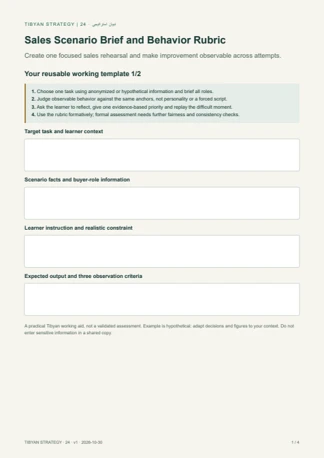
Tibyan Toolkit 24
Sales Scenario Brief and Behavior Rubric
Create one focused sales rehearsal and make improvement observable across attempts.
PDF · 4 pages · 67 KB · Version 1
Download English PDF Open editable working template ↗Turn one difficult sales task into a realistic scenario, a behavior-based rubric and a feedback-and-retry cycle connected to work.

The team knows what good discovery should achieve. During customer calls, however, sellers still move from a general complaint to a product demonstration without checking the consequences. Another presentation about questioning techniques may increase familiarity without showing whether anyone can perform the task.
Useful sales practice creates a realistic decision, makes the relevant behavior observable and gives the learner a chance to try again. It does not require an elaborate simulation or a theatrical “difficult customer.”
Learning outcome: turn one real sales task into a focused practice scenario, observe it with a behavior-based rubric and use feedback to improve the next attempt.
A curriculum connects learning outcomes, assessment, practice and workplace support across a program. A practice task is a specific opportunity to perform and improve one part of that work. If the curriculum is already agreed, begin with the difficult moment inside the task rather than adding more topics.
For example, “handle discovery” is too broad for one short exercise. “When a buyer describes reporting delays, explore one operational consequence and check your interpretation before proposing a solution” gives the learner a decision to make and the observer something to see.
Use the existing sales curriculum guide for program design. This article focuses on the activity you will actually run with learners.
Review authorized work samples: call notes, proposals, handovers or manager observations. Remove identifying details and confidential customer information before creating training material. Do not assume that access to a real sales record also grants permission to circulate it in a workshop.
Choose a situation that occurs often enough to matter, where judgment or behavior is weak and where practice is an appropriate response. If sellers cannot obtain approved pricing or the system prevents a required step, the activity should not pretend that role-play can remove that barrier. Revisit skill gaps and system problems.
CDC's public-health training standards recommend relevant real-world examples, engagement and feedback, with assessments tied to learning objectives. These are training-design principles; using them here does not make a sales course CDC-certified or establish its revenue effect. CDC Quality Training Standards.
Tibyan recommends a short scenario brief with a customer situation, the learner's task, available information, a realistic constraint and a visible output. The buyer role should have enough information to respond consistently. Learners should know what is being practiced and how the exercise will be reviewed.
| Scenario element | Useful design choice | Avoid |
|---|---|---|
| Situation | A specific recent customer problem, anonymized or hypothetical | A generic instruction to “sell anything” |
| Task | One decision or conversation behavior | The entire sales cycle in a few minutes |
| Information | Facts available to both roles, plus clear buyer-role detail | Requiring the learner to guess concealed facts |
| Constraint | One plausible uncertainty or competing concern | Surprise objections unrelated to the objective |
| Output | A corrected problem statement and next evidence step | A performance judged only by persuasiveness |
Realism means preserving the judgment the job requires. A familiar product name or a convincing accent does not make an activity useful if the task itself differs from the work. In bilingual teams, use the language of the actual task and explain how language support will be handled. Do not score accent or presentation polish unless it is part of a justified job requirement.
A behavior-based rubric explains what the observer should look for. It should distinguish an unsupported attempt from work that meets the task's requirements. Avoid traits such as “confident,” “commercial” or “good attitude” without behavioral definitions.
For the discovery task, Tibyan suggests three criteria and three descriptive levels. These are original working anchors, not a validated assessment instrument.
| Criterion | Not yet demonstrated | Emerging | Usable in this task |
|---|---|---|---|
| Explore the consequence | Changes topic or assumes the impact | Asks about impact but leaves the answer vague | Follows a specific consequence and identifies who or what is affected |
| Check the interpretation | Presents an assumption as fact | Summarizes without inviting correction | Separates facts from uncertainty and invites the buyer to correct the summary |
| Agree the next evidence step | Offers a generic follow-up | Suggests an action without a clear purpose or owner | Agrees a relevant evidence action, owner and timing to confirm |
Assess the criteria separately. A persuasive introduction should not compensate for an invented business claim. Record a short example of what was said or done beside each judgment. Use “not observed” when the scenario did not provide an opportunity to demonstrate a behavior; do not silently treat it as failure.
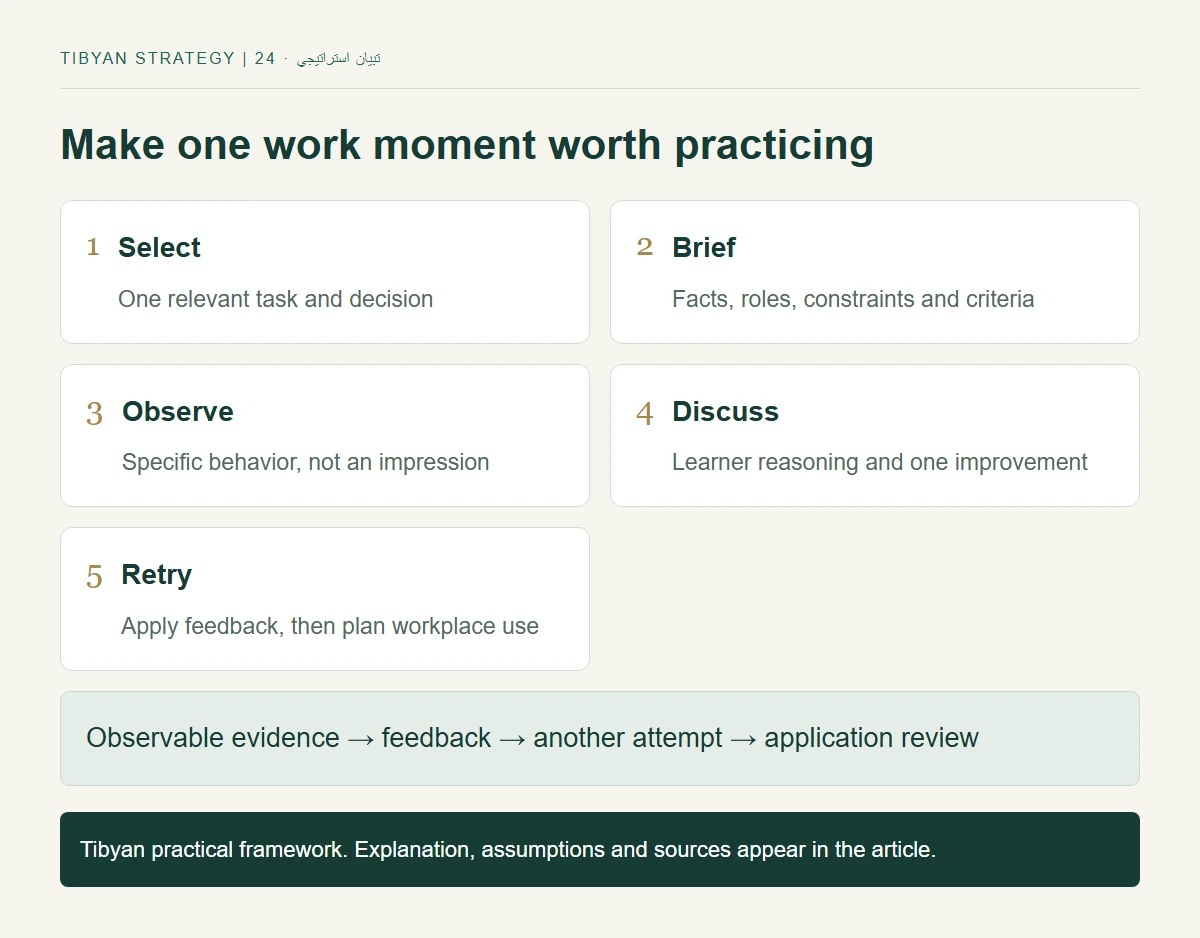 Open the diagram full size ↗
Original Tibyan practice cycle: select a work moment, brief it clearly, observe the attempt, discuss evidence and retry. It is a design aid, not a validated prediction of performance.
As an initial format, try a 15-minute cycle: two minutes to brief, four for the first attempt, four for feedback, four for a retry and one for the workplace action. These durations are illustrative. Adjust them to the task, learner experience and access needs; do not rush a complex conversation to protect an arbitrary timer.
In groups of three, one participant acts as seller, one as buyer and one observes. Rotate roles across rounds so everyone practices. The buyer follows the role brief rather than inventing increasingly difficult objections. The observer records behavior against the rubric, not a running impression of who “won.”
After the attempt, ask the learner what they were trying to achieve and what they noticed. Compare that account with a specific observation. Agree one change, then replay the relevant moment. The second attempt should allow the learner to act on feedback rather than merely listen to it.
AHRQ's healthcare debrief guidance emphasizes reconstructing events, examining what worked and identifying changes for future action in a learning-focused discussion. The sales routine here adapts that broad principle; it does not import clinical outcomes or reproduce a proprietary debriefing script. AHRQ debrief guidance.
A maintenance-analytics supplier meets a factory planning manager. The buyer says the weekly exception report arrives too late. The seller's task is to explore the consequence, check understanding and agree what evidence to examine next. This is a hypothetical learning case, not a customer result.
The buyer-role brief explains that planners sometimes complete scheduling before the report is ready, then review exceptions manually. The time involved has not been measured. If asked, the buyer can describe the last scheduling cycle and introduce the person who owns the workflow. The buyer cannot promise a budget or verify financial savings.
In the first attempt, the seller says, “Our dashboard will save you hours,” and offers a demonstration. The observer records that the impact was assumed, the summary was not checked and the next step did not investigate the problem.
During feedback, the learner identifies the jump from complaint to solution. In the retry, the seller asks what happened in the last cycle, summarizes the manual review as a reported issue rather than a measured cost, and asks whether a workflow review with the planner would help. The proposed next step has a clear evidence purpose. A buyer-agreed owner and timing still need confirmation; the observer should not award full readiness merely for a better question.
Ask two observers to review the same example independently, then compare the evidence behind their judgments. If they disagree, clarify the anchor or task rather than averaging away the difference. Show what a usable response might look like without insisting on identical wording.
For formative practice, use the rubric to support improvement. If the organization later wants to use results for formal assessment, it needs additional checks on fairness, consistency, accommodations and decision rules. A classroom score alone is not evidence of independent performance in a live opportunity.
Choose one behavior from discovery and the business case, buying-group decisions or another current sales task. Write a short scenario and three rubric criteria. Test it with a colleague before using it with the team.
Download the free sales scenario brief and behavior-based rubric. The pack contains a completed hypothetical example and blank working fields. Use it to build practice your managers can recognize in real work.
You can also use the editable, printable working template. Download an edited copy from your browser without submitting your entries.
Explore the Sales Training collection.
Cover: AI-generated conceptual artwork. Diagram and tool: original Tibyan editorial design.
Sources were checked in October 2026. The sales scenario, rubric anchors and suggested cycle are original Tibyan recommendations, not certified instruments or a promise of sales improvement.
Take the next step
Free downloads. No registration. Each PDF includes instructions, an illustrative example and a reusable worksheet.
Tibyan Toolkit 24
Create one focused sales rehearsal and make improvement observable across attempts.
PDF · 4 pages · 67 KB · Version 1
Download English PDF Open editable working template ↗Practical worksheets, not validated assessments. Adapt the task and timing to your context. See each PDF for its revision date.
Explore the tools & toolkits library ↗
Practical perspective
Prepare a B2B quotation that procurement, finance, and operations can assess. Use Tibyan’s QUOTE Framework, an annotated example, and a 13-point checklist.
Read perspective
Talent Development
Check whether the task still matters, how people learn it and what gets in their way before you keep, redesign or retire a course.
Read perspective
Team development
Follow one customer case across teams and find which handoff lost the facts, ownership or promise.
Read perspective