By the end of this guide, you can: Design a short sequence of neutral, answerable questions for a defined purpose.
Bring to the task: A real conversation or investigation, its purpose and any facts already established.
“Why are you always late with proposals?” looks like a request for an explanation. It also assumes repeated lateness and places responsibility on the person being questioned. A more useful opening might be, “Can we trace what happened on the last proposal?” The second question gives the colleague something specific to describe and leaves the explanation open.
Question design begins with purpose. You might need to confirm a fact, understand a sequence, explore an experience, test a belief, create possibilities or make a choice. A question that works well for one purpose can be cumbersome for another. “Was the proposal approved?” is a sensible closed question when approval status is the missing fact.
Choose a purpose before a format
Tibyan uses seven practical purposes: clarify meaning, describe events, investigate explanations, challenge assumptions, generate alternatives, evaluate choices and reflect on action. These are teaching categories rather than an exhaustive or universally validated taxonomy. Select the purpose that addresses the current gap in understanding.
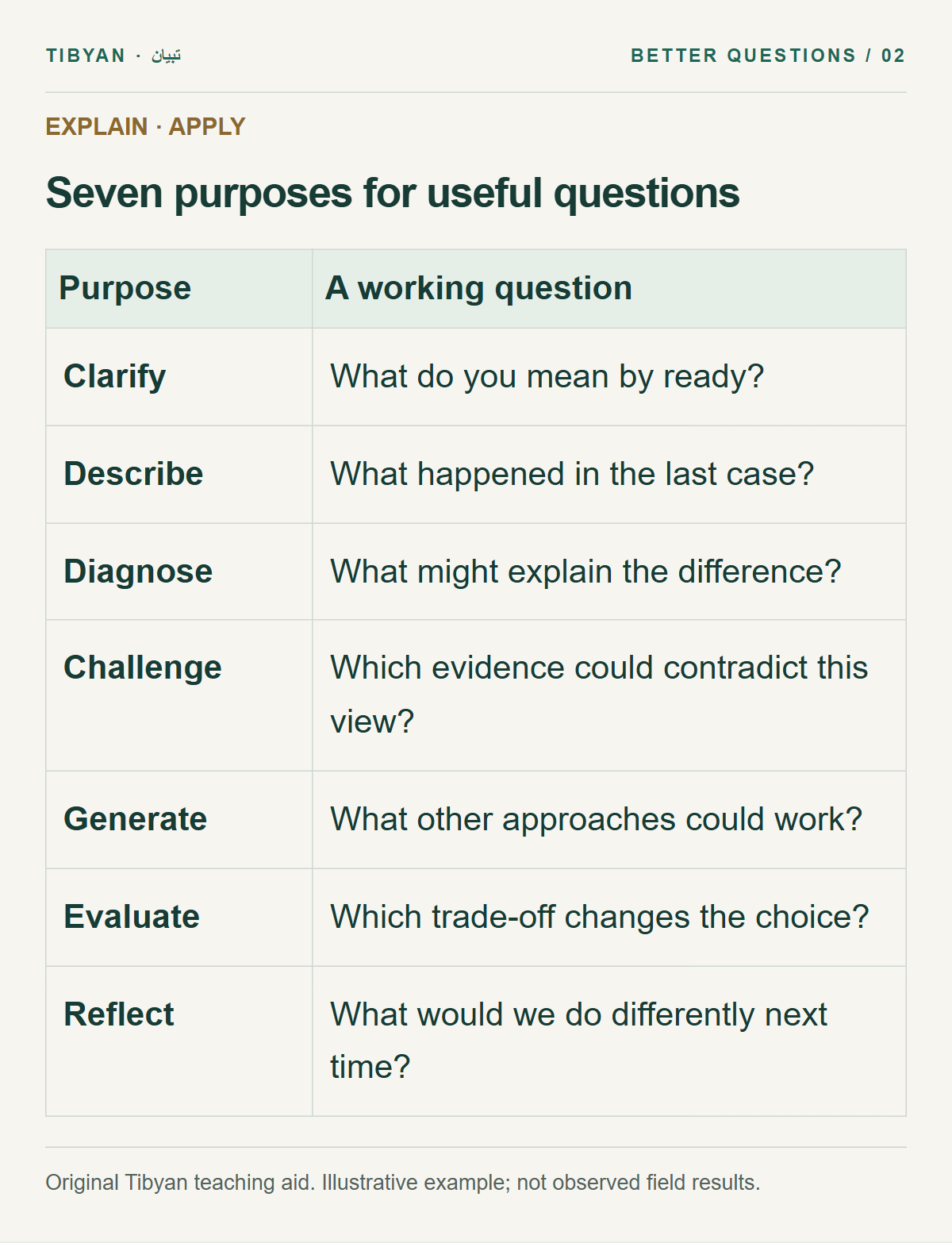 Open the diagram full size ↗
Choose the purpose that addresses the current gap. Then adapt the example to the people, task and facts already established.
- Seven purposes for useful questions
- Purpose | A working question
- Clarify | What do you mean by ready?
- Describe | What happened in the last case?
- Diagnose | What might explain the difference?
- Challenge | Which evidence could contradict this view?
- Generate | What other approaches could work?
- Evaluate | Which trade-off changes the choice?
- Reflect | What would we do differently next time?
- Original Tibyan teaching aid. Illustrative example; not observed field results.
Open questions invite description or explanation. Closed questions establish a bounded fact or choice. Probing questions extend a relevant answer. A hypothetical question explores a possibility, but its answer is not evidence that the imagined behavior will happen. Switch deliberately between forms instead of treating open questions as inherently superior.
Remove the work that makes a question hard to answer
Ask one main thing at a time. “Why did the proposal fail, how did the customer react, and what will you change?” creates three different tasks. Begin with the event, then follow the answer. Replace vague terms: if you ask about quality, explain which feature or outcome you need to understand.
Check presuppositions. “How much time did the new system save?” assumes a saving; “What changed in preparation and checking time?” allows benefit, no change or extra work. Avoid giving your preferred answer in the question. “Wouldn’t an automated form solve this?” invites agreement more than investigation.
The Right Question Institute’s Question Formulation Technique teaches producing, improving and prioritizing questions, followed by reflection. The useful distinction here is between generating possibilities and deciding which questions serve a purpose. The worksheet in this article is Tibyan’s original exercise, not the institute’s full method. Right Question Institute.
Build a sequence that can change
Start with context: “Which proposal are we discussing?” Ask for the event: “What happened after technical review?” Probe a consequential detail: “What input was still missing?” Test your interpretation: “Who was responsible for that request? How was that responsibility agreed?” Finally connect the answer to action: “What would we need to check before changing the handoff?”
This is a route, not a script. If the colleague corrects a premise, revise the next question. A prepared list is useful for remembering the purpose; it should not prevent listening. Explain why a sensitive question matters and give the person time to think.
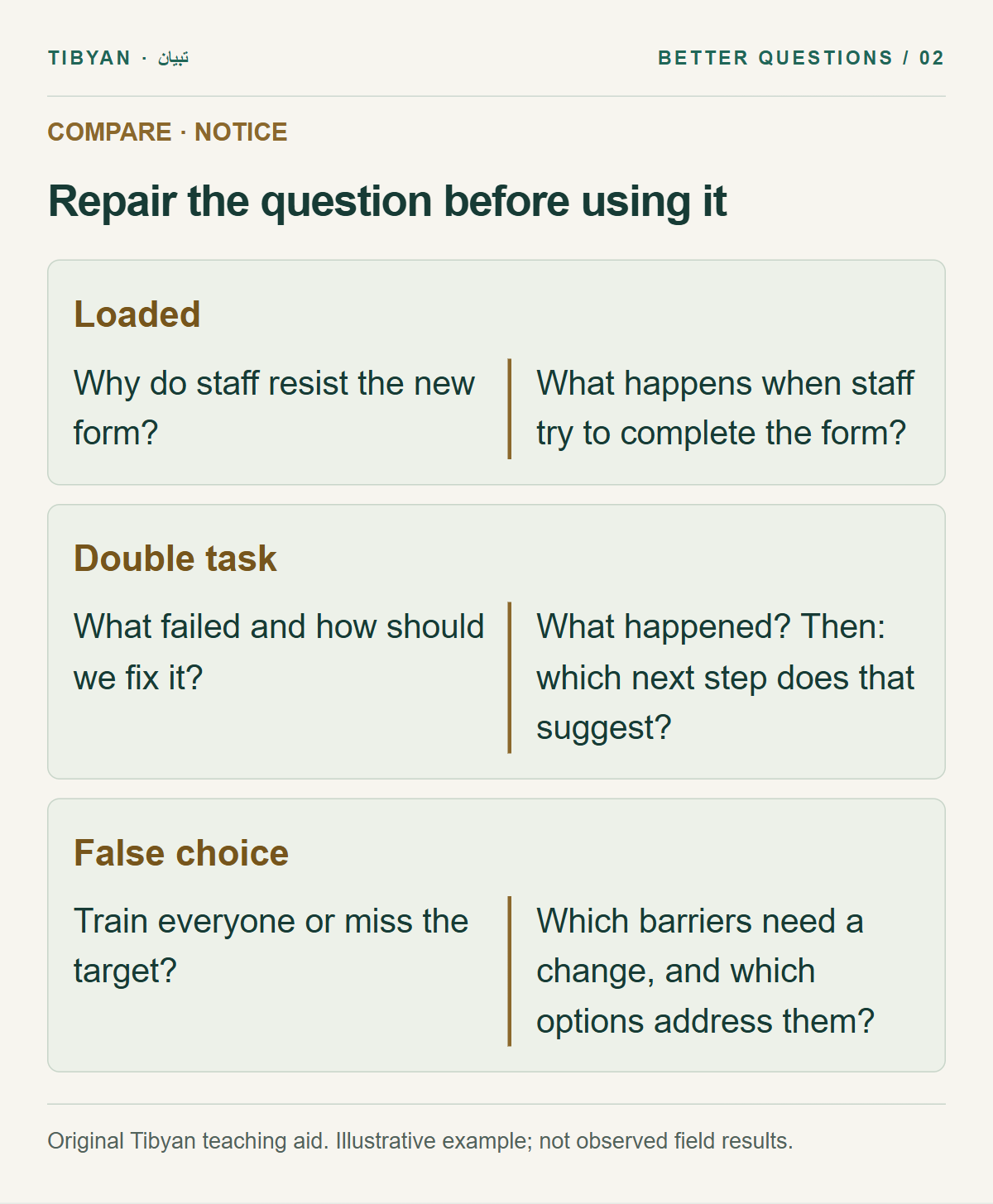 Open the diagram full size ↗
Notice what is removed: an unsupported premise, a preferred solution or several tasks in one question. Explain the repair instead of memorizing its wording.
- Repair the question before using it
- Loaded
- Why do staff resist the new form?
- What happens when staff try to complete the form?
- Double task
- What failed and how should we fix it?
- What happened? Then: which next step does that suggest?
- False choice
- Train everyone or miss the target?
- Which barriers need a change, and which options address them?
- Original Tibyan teaching aid. Illustrative example; not observed field results.
Keep a question broad enough for alternatives
Stanford d.school’s “How Might We” approach offers a way to frame challenges so that several ideas remain possible. Use it when you are ready to explore options, after learning enough about the people and situation. “How might we help an approver find the information needed for a decision?” leaves room for several responses. “How might we force everyone to use our new form?” has already selected one. Stanford d.school.
Too broad is also a problem. Add an identifiable person, task and constraint. A question about all customer communication can become a question about one buyer’s first proposal review. Narrowing the task makes observation and testing feasible without pretending the smaller inquiry answers every strategic issue.
Inspect the answer you are likely to receive
Imagine three different plausible answers. If all three would lead you to do exactly what you already intended, reconsider the question. You may be seeking permission, expressing a view or gathering context rather than testing a decision. Those purposes can be legitimate, but name them honestly.
Watch for false alternatives such as “Should we train the team or accept failure?” Other choices may include changing ownership, improving information or stopping work that has little value. A useful evaluative question makes constraints visible while keeping genuine options available.
Practice a short question repair
Rewrite five questions from a recent meeting. For each, name the purpose, identify any assumed fact, remove extra tasks and write one follow-up that depends on a possible answer. Ask a partner what they would actually need to know to respond. Keep the wording clear enough to say naturally in a conversation.
Five repairs with reasons, not a list of preferred phrases
Original fictional practice set, revised 11 November 2026. Use Namaa's proposal handoff as context. For this exercise, assume P3 underwent an approval review and that a dispatch log confirms one request was sent on 10 November; its routing and outcome are not established. The questioner wants to understand the process before choosing a change. Each repair below has an acceptable alternative; wording is judged by purpose, evidence and the response it permits.
“Who was responsible for that request?” followed by “How was that responsibility agreed?” is more neutral than asking someone to confirm that nobody owned it. A later summary can still invite correction: “I understand that the request went to Omar but no response owner was recorded. What have I misunderstood?”
Try this sequence: identify the case; reconstruct its events; probe one consequential detail; check your interpretation; ask what evidence would change the next action. If the answer corrects your premise, change the next question. A closed question can efficiently confirm a bounded record; its answer still needs appropriate checking before it is treated as fact.
Your reusable working record
Open the editable working tool · Download the printable pack
- Repair row 1: Record original, purpose, problem, repair, acceptable alternative and conditional follow-up.
- Repair row 2: Repeat the full row structure, including an acceptable alternative.
- Repair row 3: Repeat the full row and split extra tasks into later probes.
- Repair row 4: Repeat the full row and remove unverified attribution or repetition.
- Repair row 5: Repeat the full row and replace a false choice with feasible alternatives.
- Selected conversation sequence: Choose three repairs and record how one answer changes your next question.
- Partner correction and revision: Record the correction and what you changed.
Practice and retry
Repair the five original questions before reading the table. For each, justify the change and provide a different acceptable wording. In a five-minute conversation, use three questions and document one answer-dependent follow-up.
Common error and corrective feedback
A question is not neutral merely because it begins with “what.” “What made you ignore the request?” still assumes ignoring. Investigate receipt and action first. Closed questions are acceptable when the missing fact is bounded; an unverified answer is not automatically established evidence.
Independent-study alternative
Write a repair for every original, then compare with the key. Imagine an answer that contradicts your premise and write the next question you would actually ask. Explain one difference between your wording and the model.
Check your work
- Purpose and wording fit.
- Unsupported premises are removed.
- Each question asks one main thing.
- At least one follow-up depends on the answer.
Apply and review
Bring one repaired question to your next meeting and note whether it produced usable information.
Continue the learning route
Previous: Why Better Questions Matter · Series overview · Next: Questions That Improve Learning and Critical Thinking
Sources and further reading