By the end of this guide, you can: Design a learning sequence that tests understanding and transfers a concept to a fresh example.
Bring to the task: A concept you need to understand, a reliable explanation and two different application situations.
A learner can recite a rule and still apply it when a prerequisite is missing. The task in this guide separates knowing the words from checking the conditions in a new situation.
Questions help when they require the learner to do useful mental work. Ask what a concept means, why a relationship holds, when it applies, what would contradict it and how it changes a decision. Begin with adequate instruction: a question cannot reliably repair missing knowledge if the learner invents a plausible explanation and never checks it.
Build understanding, then make it visible
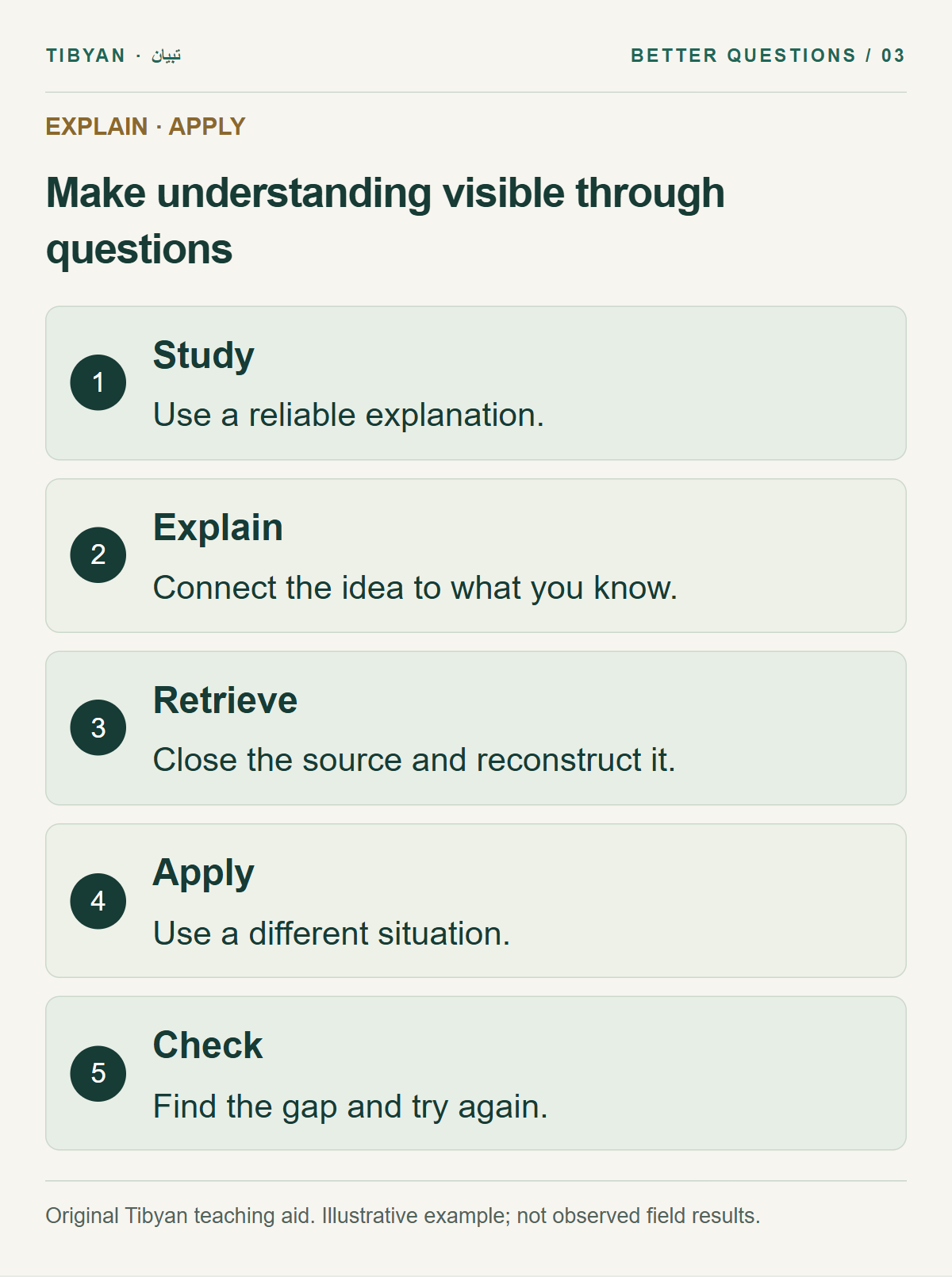
Use a short cycle: study a reliable explanation, explain it in your own words, retrieve it with the source closed, apply it to a new case and check your reasoning. The sequence is a Tibyan learning recommendation. Adapt the amount of support to prior knowledge; a novice may need a worked example before independent questioning.
 Open the diagram full size ↗
The learner must produce an answer, not only recognize an explanation. Use feedback on the actual answer before a fresh attempt.
- Make understanding visible through questions
- 1. Study
- Use a reliable explanation.
- 2. Explain
- Connect the idea to what you know.
- 3. Retrieve
- Close the source and reconstruct it.
- 4. Apply
- Use a different situation.
- 5. Check
- Find the gap and try again.
- Original Tibyan teaching aid. Illustrative example; not observed field results.
A meta-analysis distinguishes elaborative interrogation, self-explanation and practice testing. Their average findings support active learning techniques, but effects vary substantially across studies and tasks. Most included outcomes concern academic achievement. They do not establish a fixed gain for a workplace workshop. Donoghue and Hattie, 2021.
 Open the diagram full size ↗
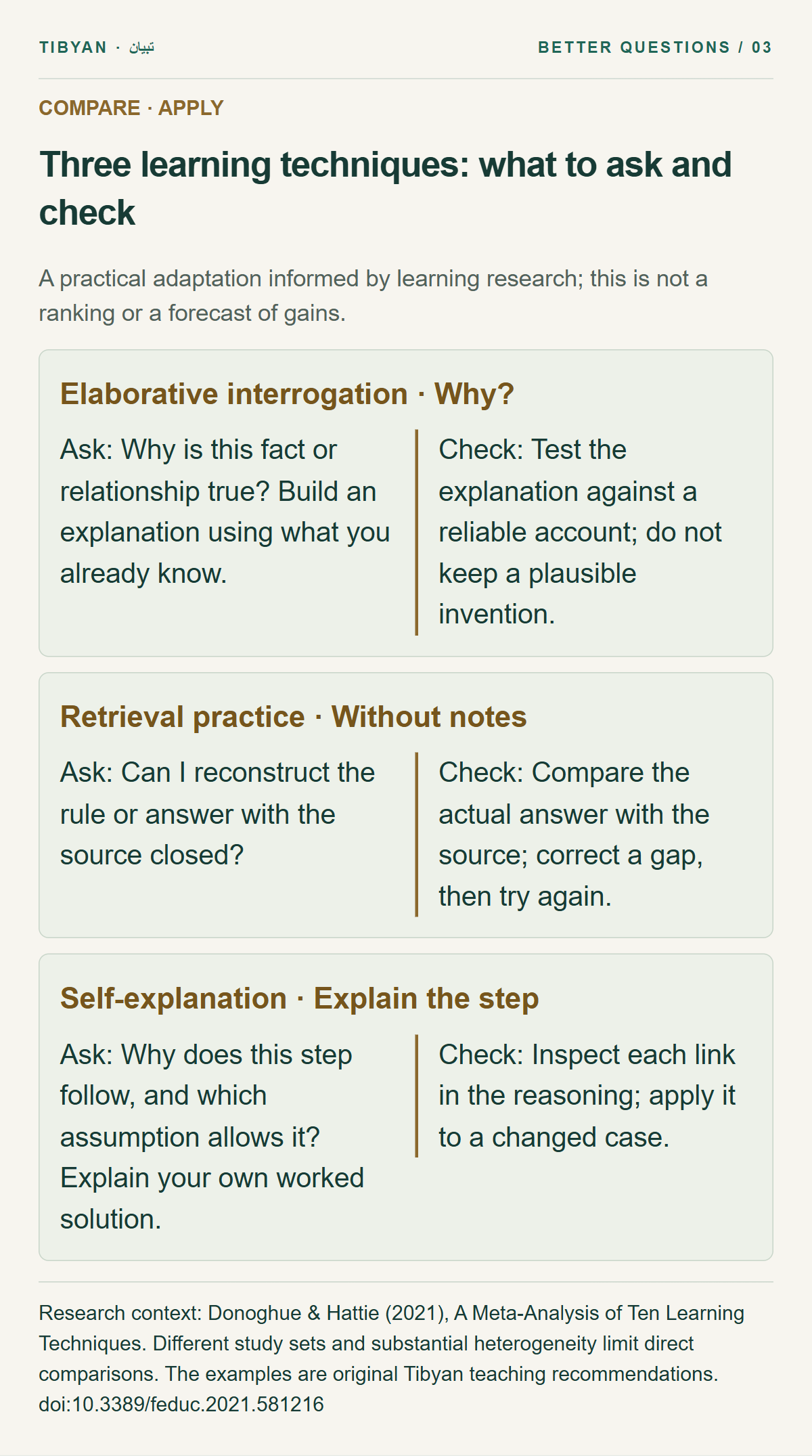
Match the technique to the learning job and inspect the answer. This practical adaptation is informed by research; it is not a ranking or a forecast of learning gains.
- Three learning techniques: what to ask and check
- A practical adaptation informed by learning research; this is not a ranking or a forecast of gains.
- Elaborative interrogation · Why?
- Ask: Why is this fact or relationship true? Build an explanation using what you already know.
- Check: Test the explanation against a reliable account; do not keep a plausible invention.
- Retrieval practice · Without notes
- Ask: Can I reconstruct the rule or answer with the source closed?
- Check: Compare the actual answer with the source; correct a gap, then try again.
- Self-explanation · Explain the step
- Ask: Why does this step follow, and which assumption allows it? Explain your own worked solution.
- Check: Inspect each link in the reasoning; apply it to a changed case.
- Research context: Donoghue & Hattie (2021), A Meta-Analysis of Ten Learning Techniques. Different study sets and substantial heterogeneity limit direct comparisons. The examples are original Tibyan teaching recommendations.doi:10.3389/feduc.2021.581216
The comparison below connects each learning technique to a question and a check. The published synthesis supports considering these techniques; this practice sequence is Tibyan’s teaching recommendation, not a measured effect of this module.
Use different questions for different learning jobs
For comprehension, ask the learner to explain a relationship and identify an example. For retrieval, close the reference and reconstruct the essential idea. For discrimination, compare two cases and explain why the same rule leads to different choices. For evaluation, ask what evidence supports a conclusion and which assumption remains unresolved.
Do not ask “Do you understand?” as the only check. A better check is, “Explain the first decision you would make in this case and why.” An incorrect answer becomes diagnostic information: does the learner lack a concept, misread a cue or apply a rule outside its conditions? Give feedback on that gap and offer another attempt.
Protect independent capability
Whether help comes from a teacher, a colleague or an AI tool, assess what learners can subsequently do independently. A randomized study of high-school mathematics found that assisted practice and later unaided performance could move differently, depending on the design of AI support. That result concerns a particular subject and setting; it is a useful reason to distinguish immediate output from learning, not evidence that every use of AI harms students. Bastani and colleagues, 2025.
Practice and revisit
Choose one concept and write five questions: explain, retrieve, compare, apply and challenge. Answer before reopening the source. Mark an uncertainty, check it against reliable material and revise the explanation. Ask a partner to supply a new case rather than repeating the one you have just practiced.
Return to the concept after a suitable delay and use another case. Record whether you can explain the decision without the original notes. Treat timing as a design choice suited to the course and task; the worksheet does not prescribe a universal interval or claim a validated learning effect.
A complete learning example: prerequisites and optional work
Original fictional teaching exercise, revised 11 November 2026. This exercise provides its own rules, so accounting knowledge is not a hidden prerequisite. A required dependency is an input or completed action that the stated process requires before another task may proceed. Work that happens earlier is not necessarily a dependency. Independent work can proceed in parallel; optional work must not silently become a required gate.
Case A: proposal submission
The fictional submission rule requires a confirmed technical estimate and verified scope, followed by a 20-minute completeness check. The estimate is ready at 12:30 and verified scope at 13:00. An optional cover illustration is ready at 16:00. Assume the checker is available and the required records are complete. Question: What is the earliest justified submission time, and why?
First answer: “16:20, because every item must be finished before submission.” Feedback: That answer adds an unstated requirement. Which items does the rule actually require? Corrected answer: “13:20. The last required input is available at 13:00, then the 20-minute check can occur. The optional cover is not a submission gate.” The answer is conditional on the supplied completeness and availability assumptions.
Close the explanation and answer: Why is sequence alone insufficient to establish a dependency? A model retrieval answer is: “An earlier task may be unrelated or optional. I need the stated rule or a demonstrated input requirement before deciding that the later task must wait.” Compare your explanation with the rule, not with how confident it sounds.
Case B: transfer to a project handoff
A different fictional team may hand work to implementation only after a signed acceptance checklist and a test report, followed by a 15-minute handoff check. The checklist is ready at 10:00; the report at 10:30; an optional demonstration video at 13:00. The checker is available. First answer without rereading Case A.
Model reasoning: “The earliest handoff is 10:45: both required records are ready at 10:30, then the check takes 15 minutes. The video is optional.” Now introduce a new condition: the process also requires a security approval, available only at 11:00. Revised answer: “11:15; the new mandatory dependency changes the latest required-input time.” Keeping 10:45 after this change would show a failure to use the new condition, not simply a memory problem.
The critical evaluation lies in identifying the rule, testing whether a requirement is stated or invented, and revising a conclusion when a consequential condition changes. These small exercises reveal reasoning about these supplied cases; they do not establish general critical-thinking ability or workplace transfer.
Your reusable working record
Open the editable working tool · Download the printable pack
- Concept and supplied rule: State what counts as a required dependency.
- First answer before feedback: Keep the initial reasoning visible.
- Feedback and error diagnosis: Identify the exact reasoning gap.
- Corrected Case A response: Give the result and its assumptions.
- Explanation produced with the source closed: Write the explanation, not a confidence rating.
- Unaided Case B answer: Apply the idea before seeing the model.
- Response to the new mandatory condition: Show how a relevant change alters the conclusion.
- Next independent attempt and criterion: Choose a fresh attempt and a visible check.
Practice and retry
Study the supplied explanation and work Case A. Close it and explain the dependency rule in your own words. Answer Case B unaided, then respond to the security-approval change. Compare with the key, identify the reasoning gap and complete one fresh case later without the old response.
Common error and corrective feedback
Do not score a correct time as full understanding if the reason is wrong or missing. “All tasks must finish” and “the optional task never matters” both overgeneralize: an explicit rule change can make that task mandatory. Ask the learner to identify what the current rule requires and what remains unknown.
Independent-study alternative
Cover the model answers while attempting each case. Write your reason before uncovering the key. If the time is correct but the reason is not, mark the explanation as needing revision and retry with the changed condition.
Check your work
- The explanation is accurate.
- At least one answer is produced without notes.
- A changed condition is considered.
- Feedback leads to a specific revision.
Apply and review
Try another case later without the original notes. Record the gap that remains and the next practice task.
Continue the learning route
Previous: How to Ask Clear, Useful Questions · Series overview · Next: Listen Carefully and Ask Better Follow-Up Questions
Sources and further reading