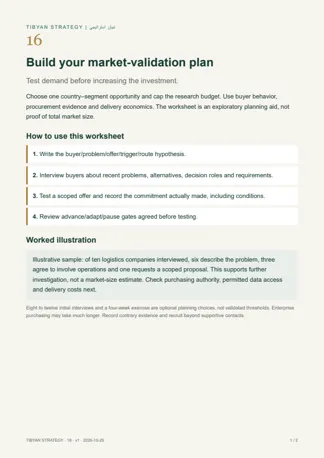
Tibyan Toolkit 16
Build your market-validation plan
Test demand before increasing the investment.
PDF · 2 pages · 63 KB · Version 1
Download English PDFTest a specific B2B offer with buyers, investigate purchasing and delivery constraints, and set evidence-based gates before investing in a new Arab market.

A successful trade-show conversation can justify a follow-up meeting. It does not yet justify hiring a local team, appointing an exclusive distributor, or building a delivery operation.
Demand validation asks whether a specific buyer group has a problem worth addressing, a workable way to purchase, and sufficient reason to choose your offer.
What you can put into practice: Design a bounded demand-validation exercise. Specify the buyer segment, evidence, budget, and advance, adapt, or pause decisions before testing.
Tibyan suggests this starting sentence: “We believe [specific buyers] in [defined market] will consider [offer] because [problem and trigger], and can purchase through [proposed route].”
Separate the unknowns: problem importance, ability to reach buyers, purchasing process, willingness to commit, delivery feasibility, and economics. An encouraging interview cannot resolve all six.
For regional expansion, specify the country and segment. Avoid treating a distributor's optimism as a substitute for evidence from the customers it claims to reach.
Start with buyers' recent experience rather than describing your solution immediately:
Ask permission before recording. Keep identifiable commercial information within the agreed research purpose. Recruit beyond personal supporters: include users, decision makers, relevant procurement roles, and organizations using alternatives.
An initial batch of eight to twelve conversations can be a manageable exploratory exercise. It is a Tibyan planning suggestion, not a statistically representative sample or proof of market size. Revisit the sample when it covers only one type of buyer.
Use a working evidence ladder: a general compliment; a specific account of the problem; access to another buying role; sharing requirements; participation in a scoped evaluation; and an authorized commercial commitment.
This is a practical heuristic, not a universal sales sequence. A signed document may still contain conditions, and some legitimate procurement processes cannot support paid pilots. Record what each action actually means rather than counting every meeting as validation.
Present an offer with a defined scope, indicative price basis, implementation assumptions, and a decision request. Do not offer a discount so large that the test stops resembling the business you intend to build.
International Trade Administration guidance distinguishes direct selling from indirect routes through representatives and distributors. Use that distinction to test who sells, who contracts, who delivers, and who carries the costs. Sales Channels.
Country-specific guidance should generate verification questions. The May 2026 Saudi market-entry guide discusses local partners' potential role in opportunity access and navigating requirements; its statements concern US companies. They do not establish the correct legal structure for every entrant. Saudi market-entry guide.
If a partner is involved, test coverage and service capability. ITA's selection checklist offers relevant questions about customer profiles, conflicts, and facilities. Partner due diligence.
Hypothetical example—not measured demand. A regional analytics provider interviews ten privately owned logistics companies in one target market. Six describe a recurring reporting problem. Three agree to involve an operations manager, and one requests a proposal for a scoped evaluation.
The provider has useful evidence of a problem within this sample. It has not established total demand or repeatable acquisition. The next investigation is whether the evaluation buyer can purchase, what data access is permitted, and whether delivery costs support the proposed price.
A sensible next step is a scoped proposal and procurement check, not immediately recruiting a full country team.
For an illustrative four-week exercise, agree a capped budget and write:
Choose any numeric thresholds for your own business before testing. Do not claim that a fixed number of interviews guarantees readiness. Enterprise buying may take much longer than the research window.
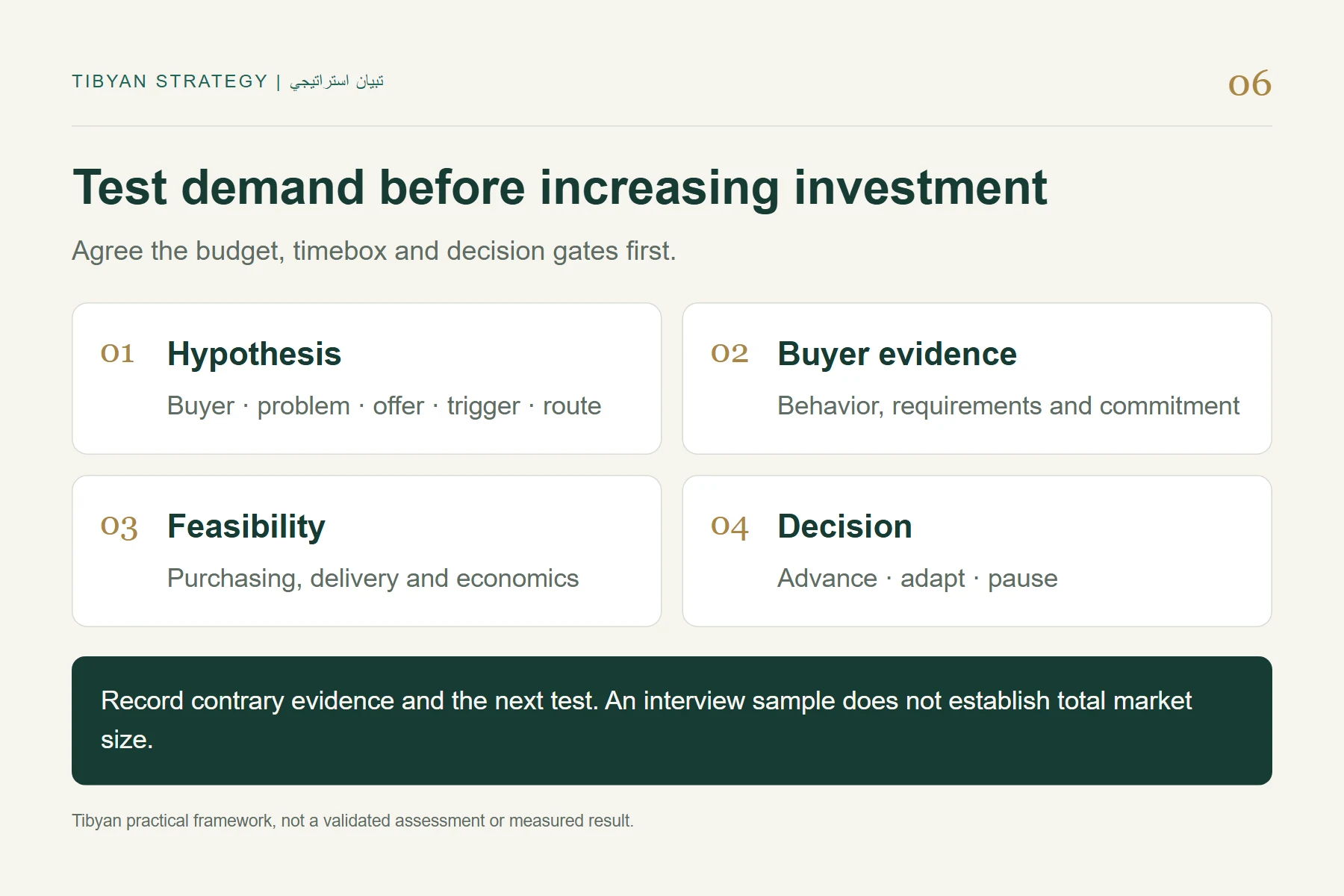 Open the diagram full size ↗
Tibyan practical framework. Open the diagram for a larger view; the steps and qualifications are explained in the text.
Use a simple log: assumption, evidence, source/date, confidence, contrary evidence, next test, owner. Review it with sales, finance, and delivery.
Download the market-validation planning worksheet. Define one buyer segment, write your demand hypothesis, and agree the evidence for advancing, adapting, or pausing. Use the log to organize the next test.
Need help preparing your team to apply this guide? Discuss the sales tasks, customer conversations, and practical learning your team needs. Discuss your team's development with Tibyan.
Explore the complete Sales Training collection.
Cover: AI-generated conceptual illustration. Explanatory diagram: Tibyan editorial design.
Sources checked: 29 October 2026. Interviews, evidence ladder, example and gates are Tibyan's proposed working methods.
Take the next step
Free downloads. No registration. Each PDF includes instructions, an illustrative example and a reusable worksheet.
Tibyan Toolkit 16
Test demand before increasing the investment.
PDF · 2 pages · 63 KB · Version 1
Download English PDFPractical worksheets, not validated assessments. Adapt the task and timing to your context. See each PDF for its revision date.
Explore the tools & toolkits library ↗
Practical perspective
Prepare a B2B quotation that procurement, finance, and operations can assess. Use Tibyan’s QUOTE Framework, an annotated example, and a 13-point checklist.
Read perspective
Talent Development
Check whether the task still matters, how people learn it and what gets in their way before you keep, redesign or retire a course.
Read perspective
Team development
Follow one customer case across teams and find which handoff lost the facts, ownership or promise.
Read perspective