Tibyan Toolkit 37
Customer Business Review and Next-Action Pack
Review delivered value with the customer before proposing more scope.
PDF · 6 pages · 69 KB · Version 1
Download English PDF Open editable working template ↗Review delivered work, adoption and customer outcomes before expanding scope. Use a practical agenda and action pack without overstating commercial impact.

The customer has signed for several sites. Your team sees an expansion opportunity and schedules a business review. The presentation celebrates the relationship, lists product usage and ends with a larger proposal. The customer asks a simpler question: “Are we getting the result we originally wanted?”
A useful review starts with the customer's intended outcomes, the evidence of progress and the work still needed. Growth becomes a question to investigate after that examination. A renewal date or a supplier target is not sufficient evidence that the customer should buy more.
Use this guide when: an existing customer and your team need to review delivered work, adoption and priorities before deciding the next action.
Learning outcome: prepare a customer-facing review that distinguishes usage from outcomes, invites corrections and records justified next steps.
Bring: agreed scope and intended outcomes, relevant baseline and current evidence, delivery/adoption records, unresolved issues and the customer's agenda. Use information you are permitted to discuss and share.
Ask what the customer needs from the conversation. It may be a clearer view of delivery, an answer to a workflow problem, a decision about adoption or an assessment of a possible new use case. A supplier's internal account plan can inform preparation, but should not dictate a customer-facing conclusion.
GitLab's public EBR handbook describes a strategic customer review covering progress, outcomes, adoption and future priorities, with customer input on the content. It is an example of one company's practice, not a universally validated review model. GitLab: Executive Business Reviews.
Tibyan recommends agreeing the question and agenda with the customer beforehand. Clarify who should attend for that decision and which evidence each party can provide. The meeting need not carry an executive label or a fixed quarterly cadence; choose timing and participants appropriate to the actual work.
This differs from internal account planning. An internal plan prioritizes your team's actions. A customer review is a conversation in which the customer can correct the evidence, challenge your interpretation and decline an expansion assumption.
Commercial status, delivery, use and outcomes describe different things. Keep them separate before connecting them.
| Evidence | Question it can help answer | What it does not establish alone |
|---|---|---|
| Contracted scope | What was agreed and purchased? | That it has been deployed or used |
| Delivery/readiness | What was configured, handed over or accepted? | That users apply it in the intended workflow |
| Adoption/use | What eligible work is actually being performed with it? | That the intended business outcome improved |
| Outcome evidence | What changed in the customer's work under comparable conditions? | That the supplier caused the change or that it will generalize |
For each measure, define the unit, period, population and source. “Active users” is not self-explanatory. Which users were eligible, what activity counted and what use was expected? “Time saved” needs a comparable task and measurement method, not a favorable impression.
Ask the customer whether the measure represents useful progress. A dashboard can be accurate and still measure something that does not matter to the customer's current priority. If the priority changed, update the intended outcome rather than presenting an obsolete target as success.
Review the work that remains unfinished. Is configuration incomplete? Are relevant users unable to access the workflow? Does support reach the right owner? Is the product being used for a different task from the one originally agreed?
Do not turn every adoption gap into a training problem. It may involve technical dependencies, capacity, workflow design, unclear ownership or an offer that no longer fits. Investigate with the people who perform the work and distinguish what they say from what the supplier infers.
An unresolved gap does not automatically rule out every expansion. It does mean you should explain how the gap affects the proposed use case and who will resolve it. Selling more of the same while ignoring the existing constraint is not an evidence-based growth recommendation.
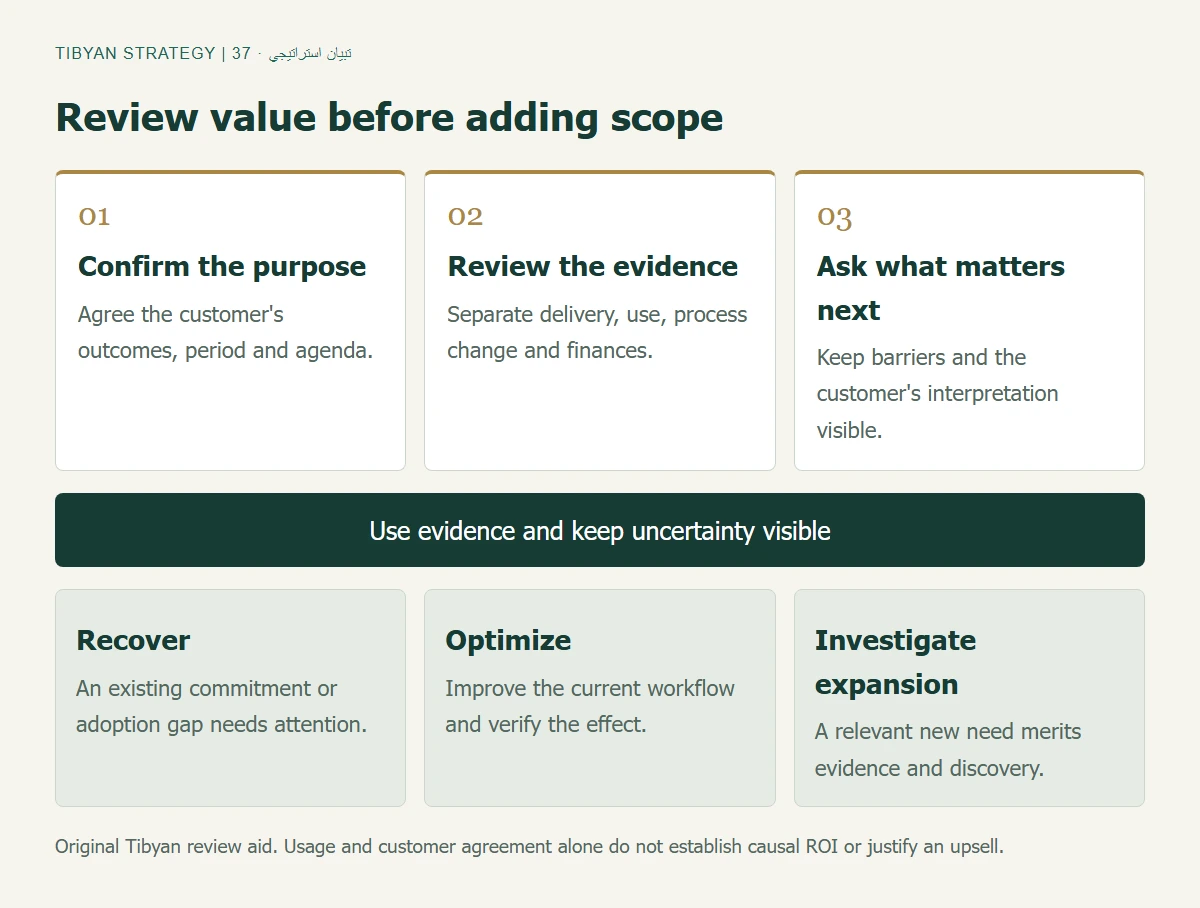 Open the diagram full size ↗
Original Tibyan customer-review map. Move from intended outcomes and evidence to unresolved needs and agreed action. Expansion is a conditional next question, not the automatic destination of the review.
All companies, observations and figures in this example are invented for teaching. No actual customer result or Tibyan impact is reported. A monitoring supplier reviews a contract covering three manufacturing sites. One is configured and working; two have not yet been configured.
At the configured site, 24 of 30 eligible alerts were reviewed during the stated fictional period. That is 80% review activity for those eligible alerts at that site. It is not an adoption rate across all three sites, an organization-wide measure or proof that reviewing an alert produced a business outcome.
| Fictional evidence | Supported statement | Interpretation to avoid |
|---|---|---|
| Three sites contracted | The contract covers three sites | Three sites are using the solution |
| One configured, two not configured | Rollout is incomplete | The two unconfigured sites rejected the offer |
| 24 of 30 eligible alerts reviewed | 80% of those alerts were reviewed at the configured site | 80% adoption across the customer |
| Weekly reconciliation changed from six hours to four | A two-hour difference was observed in the stated process comparison | Supplier-attributed savings or three-site ROI |
The six-to-four-hour difference is two hours, approximately 33.3% of the six-hour baseline. Before interpreting it, check that the task, work volume, recording method and observation period are comparable. Ask about staffing or workflow changes that may also explain the difference. The example's arithmetic does not establish causation, recurring time savings or cash savings.
Do not multiply the difference by three sites or by an annual period without evidence that the task and effect repeat under comparable conditions. A favorable single-site observation does not supply the missing data for other sites.
Present observations in language the customer can correct. “We recorded these alerts as reviewed; does that reflect the workflow you intended?” is more useful than announcing a success score. Ask what the review activity changes in their work, what still requires manual effort and which evidence would make the outcome clearer.
For the two fictional unconfigured sites, ask what prevented configuration and who owns the dependency. Do not label the sites resistant or assume a need for more training without investigation. The issue could be access, scheduling, site readiness or a different priority; none is established by the configuration count alone.
Weak statement: “Usage is strong and time savings are proven. Expand to more sites.”
Stronger, still hypothetical: “One of the three contracted sites is configured. Alert-review activity is visible there, and a limited process comparison shows a two-hour difference that needs interpretation. Let us confirm the intended outcome, understand the other sites' setup barriers and agree the next evidence before considering wider scope.”
That conversation respects the customer's judgment. If the customer does not agree that the current measure reflects value, record the disagreement and decide what to inspect next.
GitLab's success-plan practice records work with success criteria, a responsible owner, updates and next actions. That is an attributed operational example; Tibyan's outcome/action record is original and product-neutral. GitLab: Success Plans.
For each agreed action, capture the desired outcome, the evidence of completion, the owner, dependencies and review condition. Avoid writing “customer to improve adoption” when the supplier must first resolve a technical issue. Separate commitments accepted by the customer from suggestions awaiting confirmation.
In the fictional case, the next work is to recover setup for the two sites and validate usage and outcome evidence before proposing wider expansion. A possible additional use case can remain a hypothesis for discovery. It should not be reported internally as customer-approved pipeline simply because it appeared in the meeting.
Keep the record short enough to use. Circulate a permitted recap when agreed and invite factual corrections. Check whose data is included and what may be shared internally or externally. A customer review is not permission to publish a case study or testimonial.
When a new need emerges, examine the buyer's problem, its priority, relevant people, required evidence and delivery capacity. Reuse disciplined discovery rather than allowing the existing relationship to stand in for qualification.
An expansion may require a different service model, integration or buying group. Check whether current proof applies to the proposed setting. The fact that one site achieved a result does not prove another can achieve the same result with the same effort.
State the next decision proportionately: explore the use case, perform a feasibility assessment, prepare a scoped proposal or pause. Before making new commitments, review sales-to-delivery readiness. For a genuine buying decision, use discovery and buying-group planning.
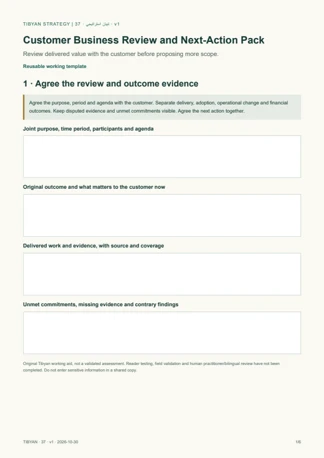
Use the free Customer Business Review and Next-Action Pack (PDF) to prepare the agenda, inspect evidence, record unresolved needs and agree next actions. It contains blank pages and an annotated hypothetical example.
For your next review, choose one intended customer outcome and one unresolved dependency. Ask the customer what evidence would help the conversation and which decision they need to make. Prepare the record without assuming that expansion is the correct conclusion.
If the team needs help structuring these conversations or connecting them to delivery and account work, you can discuss the challenge with Tibyan.
The sources describe a company's documented practice, not independent proof of commercial effectiveness. The agenda, distinctions, calculations and fictional case are original teaching material. Intended-reader testing in both languages, independent practitioner/bilingual review and permissioned field evidence remain needed. No customer outcome, revenue effect or validated measurement instrument is claimed.
Cover: original AI-generated conceptual artwork. Diagram and working pack: original Tibyan editorial designs.
Related free resource: supporting working tool.
You can also use the editable, printable working pack and download your edited copy.
Sources checked 30 October 2026.
Take the next step
Free downloads. No registration. Each PDF includes instructions, an illustrative example and a reusable worksheet.
Tibyan Toolkit 37
Review delivered value with the customer before proposing more scope.
PDF · 6 pages · 69 KB · Version 1
Download English PDF Open editable working template ↗Practical worksheets, not validated assessments. Adapt the task and timing to your context. See each PDF for its revision date.
Explore the tools & toolkits library ↗Practise discovery, qualification, value conversations and negotiation in organizational sales. Build a practical toolkit for progressing opportunities with buyer evidence.

Practical perspective
Prepare a B2B quotation that procurement, finance, and operations can assess. Use Tibyan’s QUOTE Framework, an annotated example, and a 13-point checklist.
Read perspective
Sales Training
Reconcile quoted and actual delivery margin, then trace the biggest differences to the work performed, the agreed scope and the decisions behind them.
Read perspective
Practical perspective
Run a one-week workload experiment around verifiable buyer progress and effort.
Read perspective