By the end of this guide, you can: Build a diagnostic record that compares explanations and selects a proportionate next investigation.
Bring to the task: A defined performance gap, recent cases and people who know how the work is performed.
“We need another course” can be a reasonable request and an untested diagnosis. Before designing the course, ask what people need to do differently, what happens now and what prevents the desired performance. A skill gap is one possibility. Missing information, workload, incentives, access and unclear responsibility are others.
Define the gap in observable terms. “The team lacks ownership” is an interpretation. “A proposal reached its deadline without anyone confirming the technical assumptions” describes a case you can investigate. Specify the expected action and compare it with the actual sequence.
Keep several explanations alive
List two or three plausible explanations and predict what you would expect to observe if each were important. A capability explanation might predict errors even when instructions, time and information are available. An information explanation might predict that competent employees pause at the same missing input. These are investigative predictions, not definitive tests by themselves.
 Open the diagram full size ↗
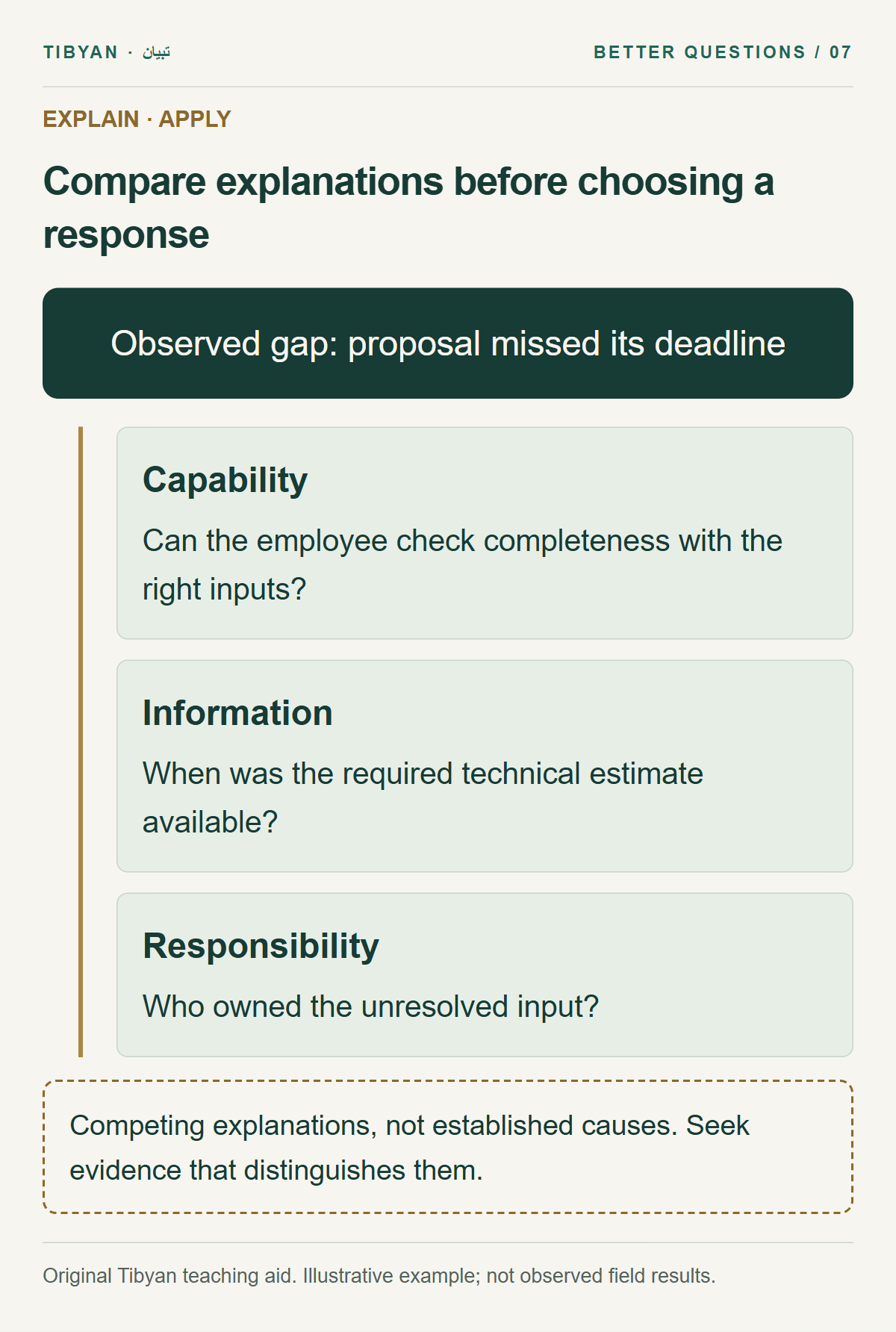
Generate competing explanations for the same case. Ask what each predicts and what evidence would distinguish them; several conditions may interact.
- Compare explanations before choosing a response
- Observed gap: proposal missed its deadline
- Capability
- Can the employee check completeness with the right inputs?
- Information
- When was the required technical estimate available?
- Responsibility
- Who owned the unresolved input?
- Competing explanations, not established causes. Seek evidence that distinguishes them.
- Original Tibyan teaching aid. Illustrative example; not observed field results.
CIPD’s evidence-based practice guidance recommends appraising information from several sources rather than relying on one compelling account. Combine records, direct observation and the perspectives of people involved, while considering how each source could be incomplete or biased. CIPD.
Compare cases that differ
Look at a successful case as well as a difficult one. What changed in the task, people, support or conditions? An exception can expose a condition that a repeated “why?” chain misses. A plausible narrative at the end of five questions is still a hypothesis. Avoid declaring one root cause when several conditions interact.
 Open the diagram full size ↗
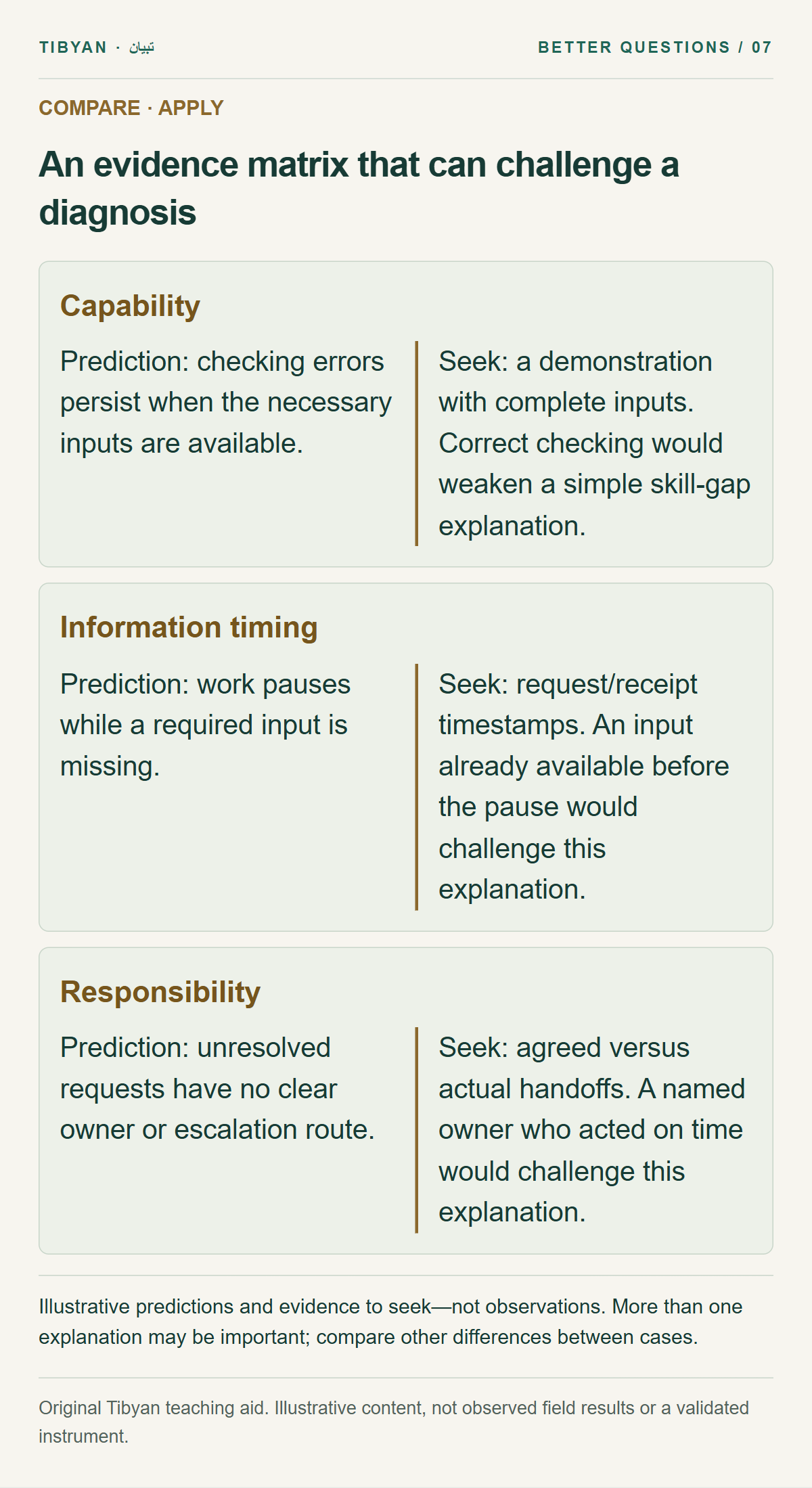
Use the predictions to plan evidence collection, not to label causes already proven. Seek a finding that could weaken each explanation and record other differences between cases.
- An evidence matrix that can challenge a diagnosis
- Capability
- Prediction: checking errors persist when the necessary inputs are available.
- Seek: a demonstration with complete inputs. Correct checking would weaken a simple skill-gap explanation.
- Information timing
- Prediction: work pauses while a required input is missing.
- Seek: request/receipt timestamps. An input already available before the pause would challenge this explanation.
- Responsibility
- Prediction: unresolved requests have no clear owner or escalation route.
- Seek: agreed versus actual handoffs. A named owner who acted on time would challenge this explanation.
- Illustrative predictions and evidence to seek—not observations. More than one explanation may be important; compare other differences between cases.
- Original Tibyan teaching aid. Illustrative content, not observed field results or a validated instrument.
Choose evidence that discriminates
“Do employees like the process?” may offer useful context, but it will not by itself distinguish a skill gap from a missing approval. Ask for evidence that changes the choice of response. Trace when the estimate was requested and received, inspect whether requirements were clear and ask staff to demonstrate how they check completeness.
Keep an evidence table: explanation, supporting observation, contradictory observation, uncertainty and next check. Do not leave the contradiction column permanently empty. Ask what would make the initial explanation less credible and actively seek an appropriate case.
Test a response at a suitable scale
If the evidence points to a handoff problem, try a bounded repair with an owner and review criteria. If it points to capability, design realistic practice and feedback. If the problem is mixed, assign the support and learning actions separately. HM Treasury’s Test and Learn guidance emphasizes examining important uncertainties before expanding an intervention; its business use here is an adaptation. Test and Learn.
Record the purpose of the test. A small trial can show whether a checklist is usable and whether required information is present. It usually cannot isolate an effect on revenue. Changes in work mix, customer behavior and management support may explain an observed improvement.
End with a diagnostic decision
Close with what the evidence currently supports, what remains uncertain and who will perform the next action. A justified decision may be to collect one missing record, repair a process, provide practice or stop an unnecessary intervention. The aim is a better supported response, not an impressively elaborate analysis.
For practice, take a familiar training or technology request and rewrite it as a performance gap. Build competing explanations and select one next check that could overturn your preferred solution.
Work the diagnosis with supplied records
Fictional teaching packet — all dates, records and results below are invented for practice. Namaa requires a proposal's scope and technical assumptions to be confirmed before issue. The operations manager must choose the next response by 11 November 2026. All times are on the same fictional business clock.
A completed competing-explanations matrix
Reasoned next decision: operations manager Salma will retrieve the P43 messages and observe one additional-service completeness check before commissioning training. If the coordinator can perform the check but the item had no acknowledged owner, Salma will test an explicit escalation handoff on the next three suitable proposals. If the check fails despite adequate inputs and instructions, she will add targeted practice with feedback. She will review at the third eligible proposal, or earlier if an unconfirmed commitment is about to be issued. Information and capability problems may coexist.
Weak response: “Two late proposals prove poor time management.” It converts a small, selected packet into a causal conclusion. Improved response: “This packet makes information timing plausible for P41 and leaves P43 unresolved; obtain the missing approval trail before choosing the intervention.”
Your reusable working record
Open the editable working tool · Download the printable pack
- Expected and observed performance: Name the standard, case and period; do not turn an interpretation into the gap.
- Explanation 1: prediction, support and challenge: Use a separate row or paragraph for each component.
- Explanation 2: prediction, support and challenge: Identify evidence that could make this explanation insufficient.
- Explanation 3: prediction, support and challenge: A missing record is an uncertainty, not a confirmed absence of action.
- Source/date and confounding conditions: Record where the observation comes from and what differs between cases.
- Next evidence check and owner: Choose evidence that could alter the intervention.
- Conditional response and review trigger: Write what you will do under at least two plausible findings.
Practice and retry
Complete the matrix from E1–E4 before reading the worked decision. Then add this new fictional fact: P43’s message assigned escalation to sales, but the coordinator did not receive it. Revise one explanation and the next check; do not merely add the fact to your original conclusion.
Common error and corrective feedback
Watch for diagnosing a trait from an outcome, treating missing documentation as proof of inaction, and assuming contrasting cases differ in only one condition. A defensible alternative may retain several interacting explanations.
Independent-study alternative
Cover the worked matrix, complete your own, then compare the predictions and uncertainties rather than matching its wording. Write one reason your first diagnosis might fail.
Check your work
- The gap concerns observable work.
- Competing explanations have different predictions.
- Contradictory evidence is considered.
- The next check could change the response.
Apply and review
Collect the agreed evidence and revise the diagnosis before committing to a larger intervention.
Continue the learning route
Previous: Customer Discovery: Ask Questions That Reveal Real Needs · Series overview · Next: Use Questions to Generate Ideas and Explore Opportunities
Sources and further reading