By the end of this guide, you can: Conduct a neutral discovery interview and distinguish evidence of a problem from expressions of interest.
Bring to the task: A defined customer type, a problem hypothesis and a decision about what to investigate next.
An entrepreneur describes a proposed service and asks, “Would this help your team?” A friendly “yes” feels encouraging. It tells you little about the work the customer is trying to accomplish, what happens today or whether anyone will commit resources to a change. Discovery should produce a correctable account of the customer’s situation.
Start with a hypothesis, not a conclusion: “We think operations managers struggle to obtain complete implementation assumptions before approving proposals.” Identify who actually performs that work, who experiences the consequences and who decides whether a new approach can be adopted. They may be different people.
Learn before presenting the solution
NSF I-Corps uses experiential education and customer discovery to explore the commercial potential of research. The transferable practice is to test assumptions through contact with relevant stakeholders. Its program requirements are not universal interview targets or proof that a particular number of conversations validates your market. NSF I-Corps.
 Open the diagram full size ↗
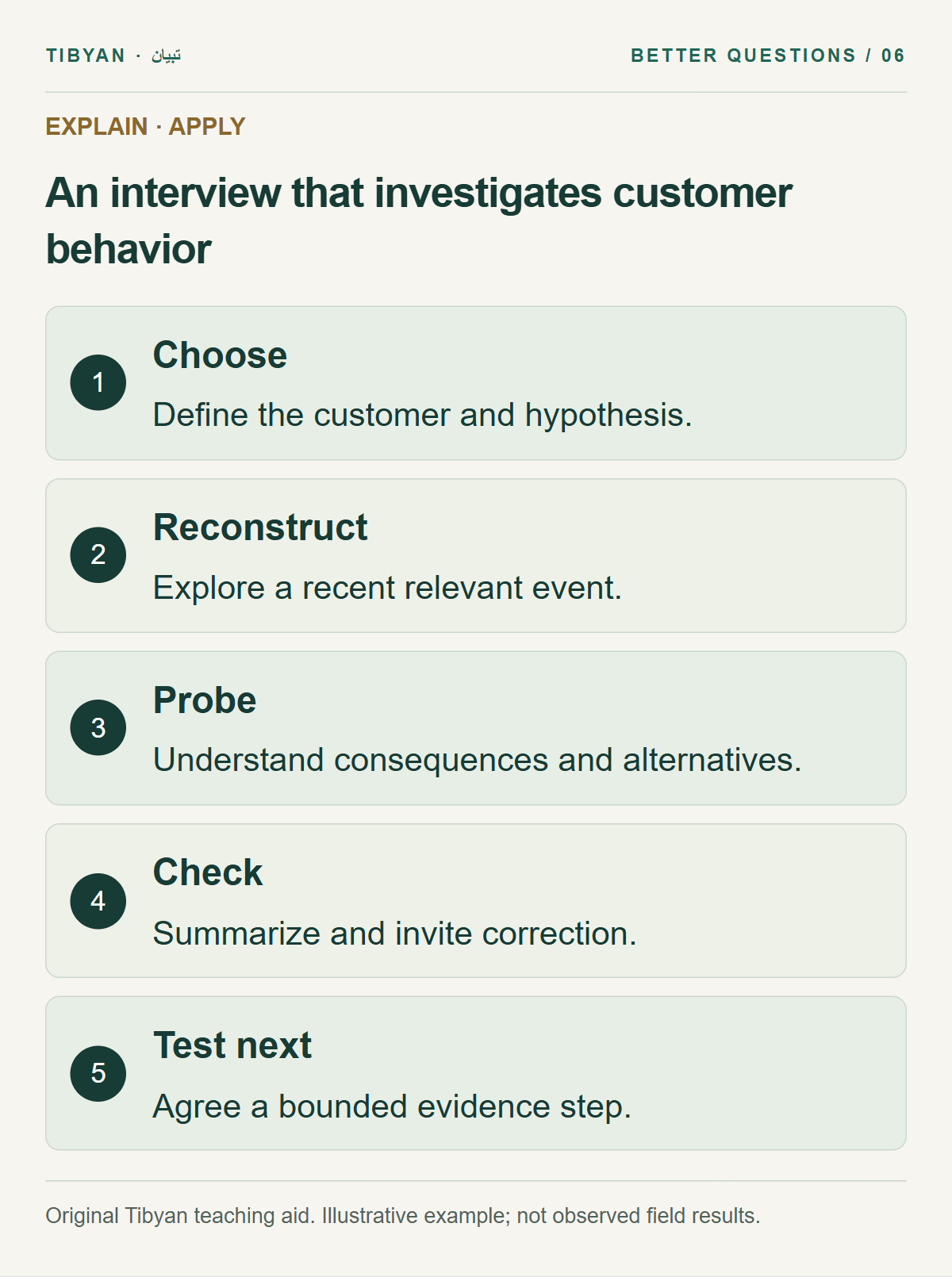
Begin with a recent task and the current alternative. Delay the proposed solution until you understand the customer’s account and its limits.
- An interview that investigates customer behavior
- 1. Choose
- Define the customer and hypothesis.
- 2. Reconstruct
- Explore a recent relevant event.
- 3. Probe
- Understand consequences and alternatives.
- 4. Check
- Summarize and invite correction.
- 5. Test next
- Agree a bounded evidence step.
- Original Tibyan teaching aid. Illustrative example; not observed field results.
Ask about the most recent relevant event. “Tell me about the last proposal that required implementation approval.” Explore the trigger, steps, people involved, documents used and points where work paused. Ask what the customer tried and what that alternative required. Only after understanding the situation should you explore a potential change.
Ask for behavior, then explore meaning
“What happened last time?” is stronger evidence of reported behavior than “What would you probably do?” Neither is direct observation by itself. Ask whether a permitted, non-sensitive document or process walkthrough could help check the account. Respect confidentiality and do not collect customer records you do not need.
Ask about consequences without planting them: “What happened because the assumptions were unclear?” is more neutral than “How much money did this costly delay waste?” A customer may report a trivial inconvenience, a serious risk or no important consequence. Keep all three possibilities available.
Keep discovery distinct from qualification
Discovery explores the task and the problem. Qualification examines whether a particular opportunity is feasible: stakeholders, resources, timing, approval and a mutually useful next step. You may do both in one relationship, but be clear about the purpose. Do not translate a complaint into confirmed demand or a warm introduction into purchase intent.
At the end, summarize the problem, its consequences and the current alternative. Invite correction: “What have I misunderstood or overstated?” If a next step would be useful, agree on a bounded action such as reviewing a fictional example or meeting an additional stakeholder. An agreed action is evidence of that action, not a guarantee of a sale.
Compare accounts before committing
Look for variation across customer situations. A problem may be serious in one segment and unimportant in another. Record the conditions that differ and seek a case that could contradict the emerging pattern. Do not imply statistical representativeness from a convenience sample of interviews.
When an opportunity emerges, reframe it around the customer’s task. Stanford d.school’s question-framing guidance can support exploration of several approaches after discovery. It cannot replace evidence that customers value or can adopt an option. Stanford d.school.
Practice the interview with a partner who has a real but non-sensitive work experience. Keep your solution out of the opening, ask two answer-dependent follow-ups and write a brief separating the account, your interpretation and the next uncertainty.
 Open the diagram full size ↗
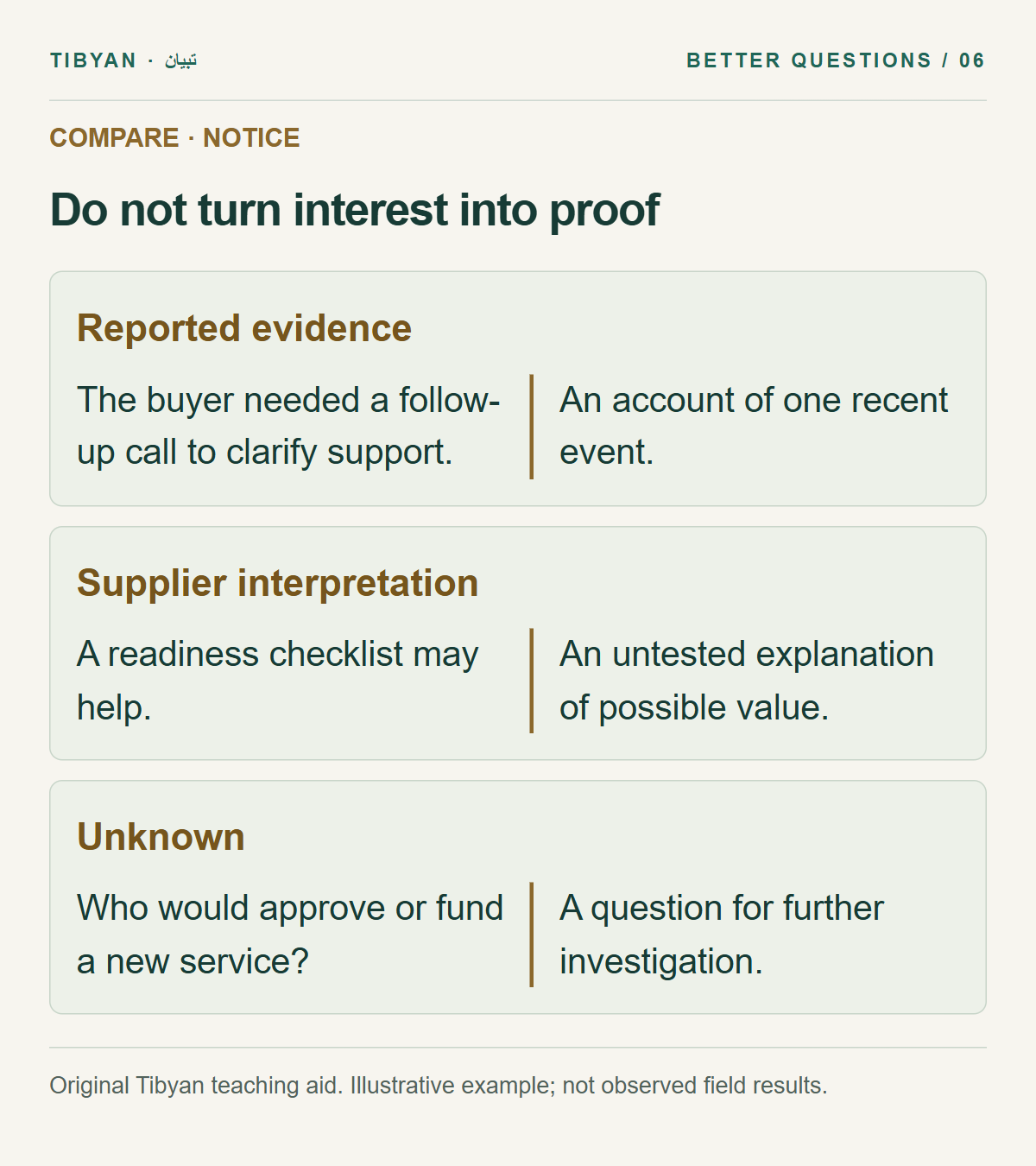
A complaint can support a problem hypothesis without proving demand. Keep reported behavior, interpretation and the next unknown in separate fields.
- Do not turn interest into proof
- Reported evidence
- The buyer needed a follow-up call to clarify support.
- An account of one recent event.
- Supplier interpretation
- A readiness checklist may help.
- An untested explanation of possible value.
- Unknown
- Who would approve or fund a new service?
- A question for further investigation.
- Original Tibyan teaching aid. Illustrative example; not observed field results.
A discovery interview that produces a usable record
Fictional research exercise, prepared 11 November 2026. Sami is exploring a proposal-readiness service. His initial claim is too broad: “Service buyers need clearer proposals and will buy a checking service.” Discovery examines the task and problem; qualification examines whether a specific opportunity is feasible, including decision roles, resources and timing. Neither a complaint nor an interview establishes purchase intent.
Use this interview sequence as an adaptable guide: 1. Agree the purpose and permission: “I am learning how approval works, not asking you to assess my service. May I take task-related notes?” 2. Choose a recent event: “Tell me about the last proposal that needed implementation approval.” 3. Reconstruct the steps: “What happened next? Who needed which information?” 4. Examine the current workaround: “How did you resolve what was unclear?” 5. Explore consequences neutrally: “What happened because that item was unresolved?” 6. Clarify decision roles: “Who could authorize the commitment, and who could adopt a different process?” 7. Check the account: “What have I misunderstood or overstated?” 8. Agree the next uncertainty: “Which permitted, non-sensitive example could help us check that?”
Three accounts, including a contrary case
These are supplied fictional accounts, not real interviews or representative findings.
A completed synthesis and next decision
Sami writes: “I will narrow the hypothesis to some multi-party implementation purchases where commitments need confirmation across roles. I will not assume that shorter proposals or a paid checking service address the problem. Amal's and Karim's accounts suggest investigating confirmation and authority; Nour's account makes the broad segment claim untenable.”
His next step is a planned usability check, not a demand test. On 12 November, Sami will ask one operations participant and one procurement participant to identify two deliberately unresolved commitments using two matched fictional proposals with the same required commitment information: one in the current presentation and one in an assumptions summary. He reverses the format order for the second participant and records that order. For this exercise, both material commitments must be noticed without prompting before he treats the summary as ready for further investigation; this is a case-specific requirement, not a universal research benchmark. If either remains hidden, he will revise the presentation. If both are found, willingness to adopt or pay still requires separate evidence. He limits this first check to two 45-minute sessions. With only two participants, order and practice effects may remain; this is an exploratory task check, not a causal comparison. If the current presentation already reveals both items, he must examine whether the new summary adds useful value rather than assume it does.
Choose participants for the task and decision roles, including people with a workable current alternative and cases that may contradict your idea. Do not rely only on friendly supporters. These purposeful conversations help refine a hypothesis; they do not estimate market prevalence.
Your reusable working record
Open the editable working tool · Download the printable pack
- Purpose, hypothesis and participant selection: Name the task and include contrasting roles/cases.
- Interview record A — repeatable record: Role/context/date | event | exact reported words | consequence | alternative | interpretation | unknown.
- Interview record B — repeatable record: Use the same structure for another relevant decision role.
- Contrary interview record C — repeatable record: Include a case that may weaken the proposed problem or segment.
- Source status and permitted next evidence: Separate an account from observation or documentation.
- Cross-interview comparison: Compare similarities, differences and conditions, not only counts.
- Revised hypothesis and current decision: State what is retained, changed and still unsupported.
- Next evidence test, owner and decision rule: Specify the task, limits and what results change.
- Note-taking and information boundaries: Record actual permission in real use; do not assume it.
Practice and retry
Draft the opening and eight-stage interview guide, then conduct a ten-minute interview or use the supplied accounts. Complete three repeatable records, compare their conditions and rewrite the hypothesis. Specify one next evidence step and what it cannot establish.
Common error and corrective feedback
Do not turn “we called twice” into verified cost savings or a buying commitment. Do not erase a contrary case because its segment differs; use the difference to refine scope. A confirmed next meeting proves only that meeting, and a usable summary does not establish demand.
Independent-study alternative
Read account A and write your hypothesis before opening B and C. After each new account, record exactly what you retain, qualify or reject. Then create a neutral follow-up for each role and compare your synthesis with the model.
Check your work
- Questions explore a recent event.
- The proposed solution does not lead the opening.
- Consequences and alternatives are examined.
- Interest and purchase intent remain distinct.
Apply and review
Compare the account with another relevant stakeholder and document what confirms or changes your hypothesis.
Continue the learning route
Previous: Questions for Leadership, Coaching, and Team Learning · Series overview · Next: Diagnose the Problem Before Choosing a Solution
Sources and further reading