Tibyan Toolkit 04
Turn an objective into an activity
Design practice that lets learners demonstrate the intended skill.
PDF · 8 pages · 114 KB · Version 1
Download English PDFConnect ISD and ADDIE to a real performance need, then plan practice, evidence, accessible delivery, and workplace support with practical Tibyan resources.

A training request often arrives as a solution: a workshop, an online course, or a new set of materials. To design it responsibly, the trainer and manager first need a shared understanding of the work: what should people be able to do, what prevents them from doing it, and what evidence would show progress?
Instructional Systems Design (ISD) connects the decisions from that initial question through practice, assessment, implementation, and review. Use this guide to plan a learning project around an observable performance need and the conditions in which employees will apply the skill.
Learning outcome: after reading, you should be able to outline a small ISD project linking one performance gap to a learning outcome, practice, assessment, and workplace follow-up.
ISD is a systematic approach to creating learning experiences. The Association for Talent Development (ATD) describes it as encompassing analysis, design, development, implementation, and evaluation. You may also encounter ISD expanded as “instructional systems development.” ATD: What Is Instructional Design?
For a practical project, think about the connections: a decision about the work task affects what learners practise; the intended skill affects the assessment; the conditions at work affect the support needed after training.
Tibyan's recommendation: keep these connections visible in a short design brief that the trainer and manager can both review.
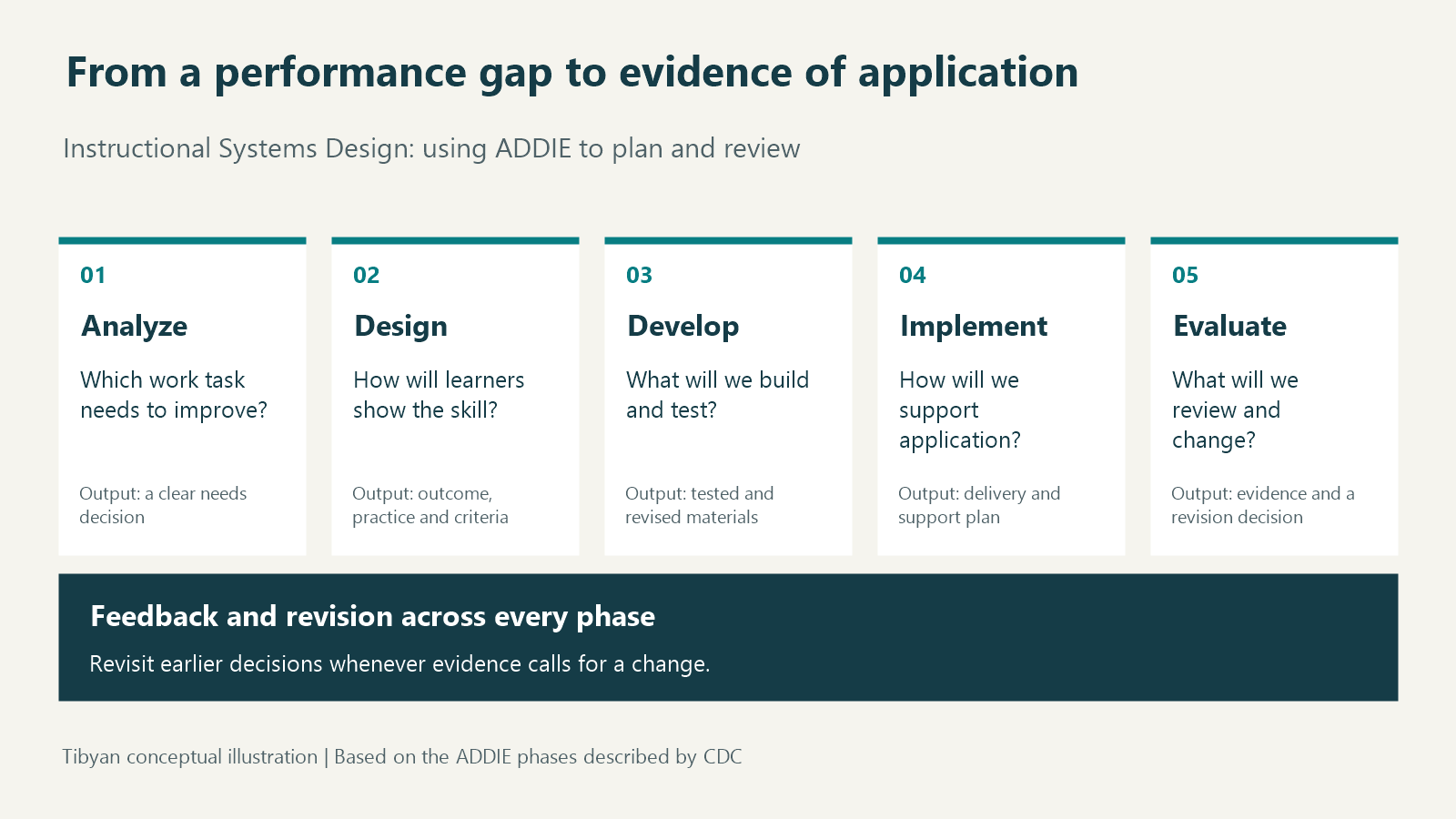
ISD describes the broader approach. ADDIE is one framework for organizing the work: Analyze, Design, Develop, Implement, Evaluate. CDC presents ADDIE as one available model, with outputs and opportunities for feedback during development. CDC: About Training Development
Use the phases to structure decisions and revisit them when evidence changes. For example, a pilot may show that an exercise requires information learners cannot access. That calls for a design change or a workplace fix before wider delivery.
 Open the diagram full size ↗
Conceptual illustration by Tibyan, based on the ADDIE phases described by CDC. The questions and suggested outputs are Tibyan's practical adaptation; feedback can lead back to any earlier decision.
A systematic foundation can accommodate contemporary learning formats. ATD's publisher description of Chuck Hodell's ISD From the Ground Up, fifth edition, published in April 2025, includes microlearning, technology, and sample design and lesson plans. It is a supporting reference for the field; this guide is Tibyan's practical synthesis rather than a review of the full book. ATD Press: ISD From the Ground Up
Tibyan recommends carrying four questions across the phases:
| Design concern | A decision to keep visible |
|---|---|
| Access and participation | Can learners use the language, format, device, and interaction? |
| Delivery and support | Which parts need independent work, dialogue, coaching, or a workplace opportunity? |
| Evidence and ownership | Who will check performance, using which criteria, and what decision will follow? |
| Revision | What is still uncertain, and what small trial could inform the next decision? |
Distinguish the model that organizes the project from the checks applied to its outputs and the tools used to deliver it. Selecting a learning management system does not settle the learning outcome, assessment, or support plan.
For a practical design cycle, first agree on the intended performance and acceptable evidence, then sketch practice and test its uncertain parts. Our companion explains how to combine ADDIE, backward design, and SAM.
If the journey includes online or blended delivery, consider access and support during analysis and design. The companion on accessible online and blended learning develops those decisions with a lesson blueprint and starter checks.
The following is Tibyan's suggested project checklist, adaptable to the size and risk of the task.
| Phase | Decision to make | A useful project output |
|---|---|---|
| Analyze | Which task is falling short, and what is causing the gap? | A needs statement with evidence and a decision about whether learning is needed |
| Design | What must the learner demonstrate, and how will practice prepare them? | An observable outcome, practice task, and assessment criteria |
| Develop | What materials and tools will we build and try? | A tested exercise, worked example, job aid, and scoring guide |
| Implement | Who will deliver, participate, and support application? | A delivery plan with access, responsibilities, and manager follow-up |
| Evaluate | What evidence will inform the next decision? | Findings about learning and application, followed by a revision or continuation decision |
During analysis, check whether training is appropriate. CDC's public-health training standards advise validating the need for training and considering delivery barriers. They also recommend formative evaluation during development and follow-up support. These are professional reference points here, rather than regional compliance requirements or evidence of a guaranteed business result. CDC: Quality Training Standards
Carnegie Mellon University's Eberly Center explains alignment between learning objectives, instructional strategies, and assessments. Its guidance concerns course design; the workplace example below is Tibyan's application of that principle. Eberly Center: Articulate Your Learning Objectives
Suppose the intended skill is deciding where an exception case should go. A presentation might explain the routing rules, but the design still needs an opportunity to make that decision and receive feedback. An assessment should let the learner demonstrate the intended decision under stated conditions.
Ask the team to complete one sentence:
“Given [work conditions and tools], the learner will [observable action], meeting [specific criteria].”
Then check that the exercise and assessment actually require that action. Tibyan's guide from learning objective to workplace practice develops this step with practical feedback and application planning.
Hypothetical example: a customer-service team at a regional distributor in the Arab region sends incomplete exception cases to its operations team. This is an illustrative design exercise, not a client case study or a report of measured results.
The trainer and supervisor review anonymized case samples and observe employees handling a sample exception. For this fictional scenario, they identify two issues: some employees cannot choose the correct route, and some lack access to a required system field.
The process owner takes responsibility for access. The learning project addresses the routing decision and evidence checklist. Before development, the supervisor confirms which exceptions employees may handle and which require escalation.
For the initial trainer–manager conversation, use Tibyan's guide to diagnosing the real development need.
Use this proposed learning outcome:
“By the end of the session, given three unfamiliar exception cases, the current routing guide, and a simulated case form, the employee will choose the correct route and include every required evidence item for all three cases.”
The three-case standard is a fictional design choice to discuss with a subject matter expert. It is not an industry benchmark.
Plan two coached practice cases, feedback against the checklist, and then a separate set of three unfamiliar assessment cases. Keep the routing guide available because the intended task includes using it.
Build the sample cases, an annotated handover, the simulated form, and a scoring guide. Ask a subject matter expert to check the routes and evidence requirements.
Try the exercise with representative learners. If several misunderstand the same instruction, investigate the wording and task design before treating it as a learner failure. Revise and try again.
The facilitator runs the session. The supervisor checks access and schedules supported use on real work. Where the team uses Arabic and English materials, confirm that the terminology matches the actual forms and system fields.
Give employees a named contact for questions and a clear route for exceptions beyond their authority.
Score the three assessment cases against the agreed criteria. For this proposed plan, the supervisor then reviews three comparable work samples in the following week and holds a further application conversation after 30 days.
Record missing evidence, routing decisions, and remaining barriers. Use the findings to decide whether to revise the exercise, provide coaching, or address a process issue.
Tibyan recommends separating three questions:
For this project, record a baseline using comparable cases and note other changes, including the access fix. If handovers improve after both interventions, report the observed change without assigning the entire improvement to training. A satisfaction score can inform the learner experience; it does not answer these three questions on its own.
Use Measuring Talent Development Impact Beyond Attendance to plan the evidence, then prepare the manager's follow-up with the 30-day application review guide.
Choose one recurring work task and draft these six lines with its manager:
Leave uncertain points marked as questions to investigate. The brief should help the team decide what to build and what to test next.
Download Turn an objective into an activity and use one objective from your design brief to draft a task, feedback, and evidence of performance. Review it with the responsible manager before full production. You can also explore Tibyan's free talent development toolkit for resources covering diagnosis, practice, and follow-up.
If your organization needs a shared learning journey across roles or departments, explore Tibyan's customized corporate programmes and request a consultation. Bring one performance challenge, the intended audience, and the constraints so the conversation can focus on a useful scope.
Sources checked October 25, 2026. The checklist, example, criteria, and review schedule are Tibyan's practical suggestions, not findings from an intervention study.
Take the next step
Free downloads. No registration. Each PDF includes instructions, an illustrative example and a reusable worksheet.
Tibyan Toolkit 04
Design practice that lets learners demonstrate the intended skill.
PDF · 8 pages · 114 KB · Version 1
Download English PDFPractical worksheets, not validated assessments. Adapt the task and timing to your context. See each PDF for its revision date.
Explore the tools & toolkits library ↗
Talent Development
Check whether the task still matters, how people learn it and what gets in their way before you keep, redesign or retire a course.
Read perspective
Practical perspective
Compare two deals using the same observable criteria and record what changed about the conditions.
Read perspective
Practical perspective
Pick one recurring sales behavior, improve it through feedback, and use a work sample to check whether it carries over to a real buyer conversation.
Read perspective