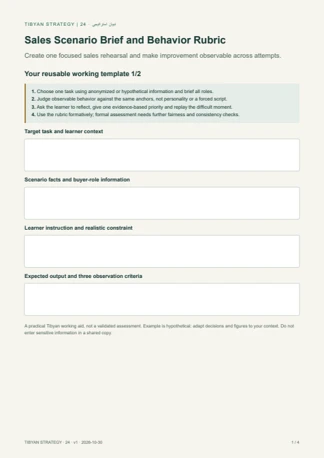
Tibyan Toolkit 24
Sales Scenario Brief and Behavior Rubric
Create one focused sales rehearsal and make improvement observable across attempts.
PDF · 4 pages · 67 KB · Version 1
Download English PDF Open editable working template ↗Use a focused expert interview to uncover cues, alternatives and judgment, then build a checked decision record and practice brief.

Ask an experienced seller how they conduct discovery and you may hear a polished sequence of questions. Ask about a difficult recent opportunity and a different kind of knowledge appears: a small inconsistency they noticed, a risk they decided to investigate, or a promise they deliberately avoided. Those judgments help explain what a novice needs to practise.
For sales leaders and learning designers, the task is to turn expertise into a decision record and a realistic practice brief. Bring a permissioned, anonymized work example, access to an experienced practitioner, and a clear task boundary. A top performer’s whole career is too broad to analyze in one conversation.
Hypothetical teaching case: a regional B2B services company sells multi-site implementation work. Its proposals sometimes omit unresolved requirements. In our fictional episode, an experienced account executive notices that the buyer wants a fixed start date but cannot identify who will prepare the data. The seller investigates before proposing a firm commitment. This episode and its observations are invented for teaching, not reported client evidence.
The useful learning question is specific: how did the seller recognize that data ownership mattered, and what shaped the next action? “Be more consultative” gives the designer little to work with. A decision about clarification or escalation provides a situation, alternatives and consequences.
The manager selects a decision relevant to current work and confirms who can discuss it. The designer keeps the interview focused on reasoning available at the time. A delivery expert helps check whether the inferred risk is technically credible.
Militello and Hutton’s original Applied Cognitive Task Analysis paper describes complementary interviews for mapping tasks, examining expertise and exploring a scenario, with a table to consolidate cognitive demands. It offers a foundation for investigating judgment rather than merely collecting content. Militello and Hutton, 1998.
The shorter sales interview below is Tibyan’s adaptation. It is not the complete ACTA protocol, and using it does not make the resulting sales guidance validated. Learn the full method when the project calls for a formal cognitive task analysis.
Begin with a bounded episode and a rough chronology. Ask what happened before the dependency became important, what the seller knew, and what they did next. Anchor the account in permitted notes or document versions where available.
Avoid starting with “Why did you win?” That encourages a broad explanation of an outcome influenced by many factors. A seller can make a sound decision in a lost opportunity, or make a weak decision in a deal that closes for other reasons.
Ask the practitioner to separate what they knew then from what became clear later. If the exact customer wording is uncertain, mark the reconstruction as approximate. Do not turn a remembered paraphrase into a direct quotation.
In the fictional case, the chronology might include the requested start date, a vague answer about preparation, a proposed scope, and a follow-up with delivery. The interview should establish which of those details actually influenced the seller’s decision before producing a rule.
Use questions that expose the reasoning behind the action. Ask follow-ups where an answer remains general.
| Interview focus | Useful question |
|---|---|
| Cue | What detail made you pause? |
| Interpretation | What did that detail suggest, and what else could it mean? |
| Options | What actions were possible at that point? |
| Choice | Why did you choose clarification rather than a firm commitment? |
| Constraint | What could you not decide without another person? |
| Novice difficulty | What might a less experienced colleague miss? |
| Exception | When would the same cue require a different action? |
The manager should resist converting every preferred habit into a mandatory technique. The designer asks whether the decision remains sensible with another customer, language or delivery arrangement. The expert identifies circumstances in which the advice would fail.
For example, an unnamed data owner may signal a material dependency. It may also reflect a buyer who is early in planning. The teachable response is to investigate the implication and preserve uncertainty, rather than assume the opportunity is unqualified.
Request a similar episode that ended differently and a case in which the initial interpretation was wrong. Compare the cues and operating conditions. This tests whether the proposed lesson is a durable distinction or a story that fits only one outcome.
Ask another practitioner to challenge the draft account. A delivery colleague may explain that the technical issue was manageable if explicitly scoped. A seller may point out that the buyer lacked authority to resolve it during the call. Preserve these qualifications in the learning material.
Where experts disagree, document the disagreement and seek evidence. It may reflect different customer segments or authority limits. Do not silently select the opinion of the most senior person and label it best practice.
Use one record per important decision. Keep confidential source material in approved systems and retain only the permissions and references needed for design.
| Field | Blank decision record |
|---|---|
| Task and moment | What decision was required? |
| Available information | What was known then? |
| Cue and interpretation | What was noticed, and what did it suggest? |
| Alternatives | Which actions were considered? |
| Action and rationale | What was chosen, and why? |
| Limits and unknowns | What remained uncertain or outside authority? |
| Learning challenge | What should the novice notice or practise? |
| Verification | Who can check accuracy and exceptions? |
Illustrative completed entry: the buyer requests a fixed implementation date, while data-preparation ownership is unknown. The fictional seller considers promising the date, asking for clarification, or seeking a provisional delivery review. They choose clarification and record the unresolved dependency. A technical commitment remains with the authorized specialist.
Annotation: the teachable element is the connection between a date commitment and an unverified prerequisite. It is not the exact sentence the seller used. The record does not establish whether the customer ultimately bought or whether this decision caused a commercial result.
A weak entry such as “experienced sellers build trust” lacks the cue, choice and boundary needed to create a task. Revise it until another designer can identify what the learner would need to decide.
Give the learner a customer situation containing the relevant cue, a realistic information gap and more than one plausible action. Keep the customer’s hidden context in a separate role brief. Decide what information becomes available if the learner asks an appropriate question.
For our case, the buyer knows the target date but has not assigned preparation ownership. If asked, they can explain that assignment requires an internal operations discussion. The seller should identify what remains unknown and agree a verification action without inventing an answer.
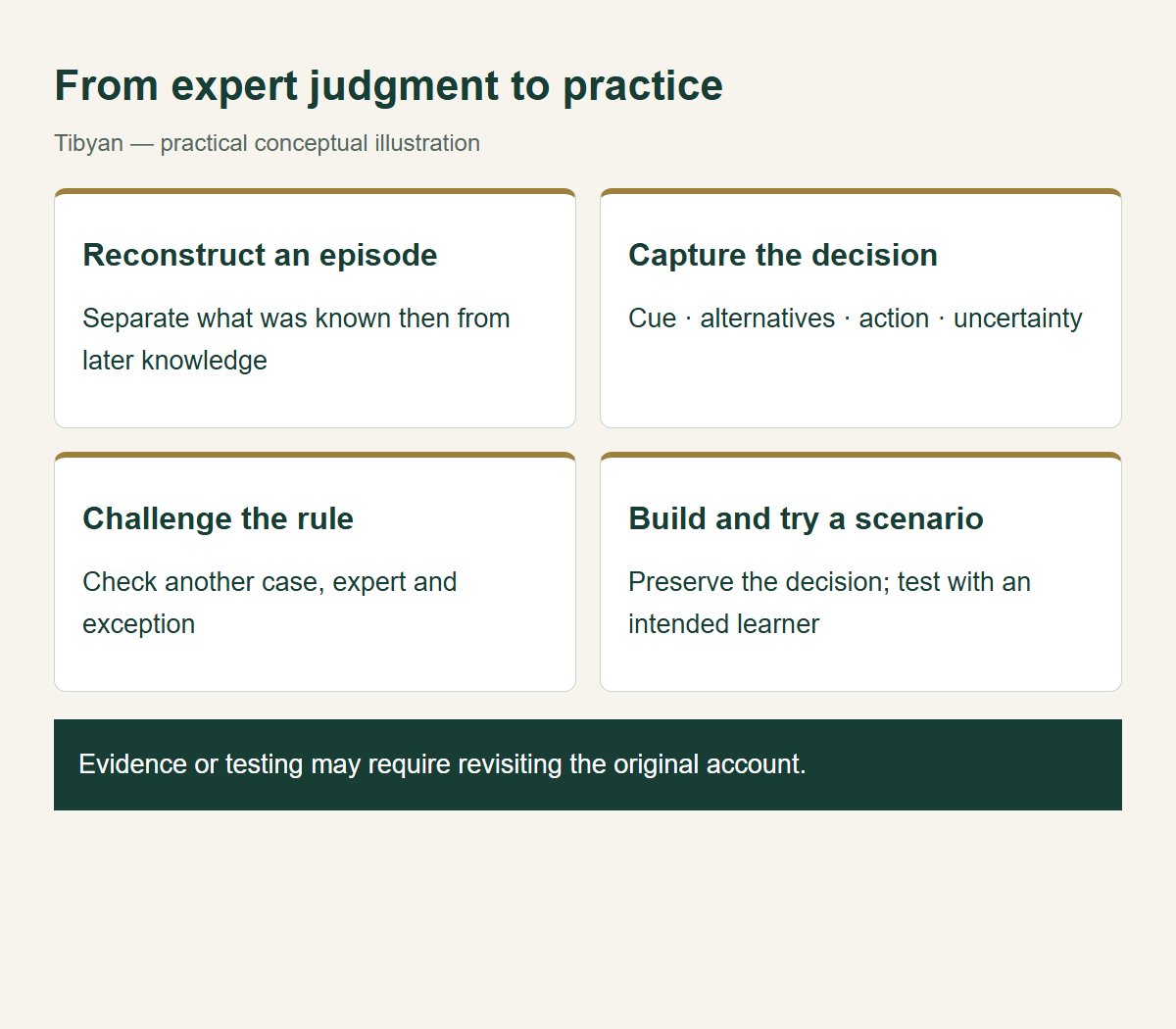 Open the diagram full size ↗
Tibyan conceptual transformation. Verification and testing can send the designer back to the original account.
Write feedback explaining why the action fits the available evidence and authority. Include a plausible consequence: a premature commitment could create scope ambiguity; a focused follow-up could clarify what needs confirmation. These are scenario possibilities, not claims about what always happens with buyers.
Ask an expert whether the scenario preserves the real decision and whether the alternatives are credible. Then ask a less experienced learner to attempt it and explain their reasoning. Observe whether the task reveals the intended challenge or merely rewards guessing the designer’s preferred phrase.
CDC recommends subject matter review of training accuracy. This public-health guidance supports an accuracy check here; it does not make expert agreement proof of effectiveness. CDC: Quality Training Standards.
Revise when the novice needs information absent from the brief, when an expert identifies a reasonable unscored option, or when the feedback assumes knowledge not yet available. Record the changes and the people who actually reviewed the specific version. Proposed reviewers are not completed approvals.
Choose a work task with a consequential judgment. Interview one practitioner about an episode, complete the blank record, and ask another colleague to challenge the inferred rule. Draft a fresh scenario and test whether a novice can explain what they would notice and do.
The output is ready for a small learning trial when it contains a meaningful cue, plausible alternatives, a justified action, an authority boundary and assessable evidence. If it only retells the expert’s success, return to the moment of decision.
Use Sales Scenario Brief and Behavior Rubric to turn the verified learning challenge into a rehearsal. This resource supports scenario and assessment design; it is not an ACTA interview instrument. For practical scenario guidance, see Design Sales Practice Around Real Customer Situations.
Cover: AI-generated conceptual illustration. The interview prompts, record and sales scenario are Tibyan adaptations and fictional teaching examples.
Sources checked November 2, 2026. No sales-effectiveness finding is inferred from the ACTA paper or the fictional episode.
Take the next step
Free downloads. No registration. Each PDF includes instructions, an illustrative example and a reusable worksheet.
Tibyan Toolkit 24
Create one focused sales rehearsal and make improvement observable across attempts.
PDF · 4 pages · 67 KB · Version 1
Download English PDF Open editable working template ↗Practical worksheets, not validated assessments. Adapt the task and timing to your context. See each PDF for its revision date.
Explore the tools & toolkits library ↗
Practical perspective
Prepare a B2B quotation that procurement, finance, and operations can assess. Use Tibyan’s QUOTE Framework, an annotated example, and a 13-point checklist.
Read perspective
Talent Development
Check whether the task still matters, how people learn it and what gets in their way before you keep, redesign or retire a course.
Read perspective
Team development
Follow one customer case across teams and find which handoff lost the facts, ownership or promise.
Read perspective